A fish-only tank can tolerate parameter drift measured in weeks. Ammonia creeps up, you notice the fish acting oddly, you test, and you fix it before anything dies. Reef tanks do not work that way. An alkalinity swing of 1.5 dKH over two days will burn coral tips. A week of undetected low magnesium will lock calcium out of solution no matter how much you dose. Phosphate at true zero triggers dinoflagellates within days, and by the time you see the rust-coloured film it has already smothered half the sand bed.
Corals are sessile filter feeders with no ability to move away from bad water. They respond to parameter problems immediately and visibly: tissue recession, bleaching, closed polyps, browned-out colour. Fish-only discipline will fail a reef. You need tighter ranges, more frequent testing, and an understanding of why the parameters interact rather than sitting in isolation. If you are choosing between saltwater and freshwater, this is the difference that matters most.
The short version
Salinity 1.025 to 1.026, alkalinity 8 to 9 dKH held steady, calcium 400 to 450 ppm, magnesium 1300 to 1400 ppm, nitrate 1 to 10 ppm, phosphate 0.03 to 0.10 ppm, temperature 25 to 27 degrees Celsius. Stability outranks any single target. A tank at 8 dKH for six months will outperform one bouncing between 7 and 10 each week.
The reef parameter set is different
The base parameters from a freshwater or fish-only tank still apply: ammonia and nitrite must be zero, temperature must be stable within the species range, and pH must stay within bounds. But a reef adds a second layer, because corals are not just living in the water — they are building permanent structures out of minerals dissolved in it. The standard aquarium parameters are the foundation, but they are not sufficient on their own.
Every stony coral, every coralline algae, every calcareous tube worm is pulling calcium and carbonate out of solution and depositing it as calcium carbonate. That consumption is continuous, and in a tank with significant coral growth the depletion is fast enough to measure day by day. If you do not replace what the corals remove, alkalinity crashes, calcium drops, pH becomes unstable, and growth stops.
Soft corals do not build calcium carbonate skeletons, but they still respond to alkalinity and nutrient swings just as sharply as SPS. The parameter set is not optional for any reef type.
The big three and why they move together
Calcium, alkalinity and magnesium are not three independent sliders. They are a coupled system, and trying to fix one without checking the other two is the most common reason dosing fails.
Here is the chemistry. Corals build skeleton by combining calcium ions with carbonate ions to form calcium carbonate. Alkalinity is a measure of the carbonate and bicarbonate buffering capacity in the water — in practical terms, it is the reservoir of carbonate available for skeleton building. When a coral builds, it consumes both calcium and carbonate, so calcium and alkalinity drop together.
Magnesium does not go into the skeleton directly, but it governs how much calcium and carbonate stay dissolved in the first place. Low magnesium allows calcium carbonate to precipitate out of solution onto pumps, heaters and the walls of the tank rather than staying available to corals. This is why a tank with persistently low calcium that does not respond to dosing almost always has low magnesium behind it. The calcium is being dosed, but it is crashing out of solution before the corals can use it.
The ratio in natural seawater is roughly three parts magnesium to one part calcium by mass. Most reef salt mixes hold that ratio, and most dosing regimens target it. If you chase calcium upward without checking magnesium, you will hit a ceiling and calcium will stop climbing no matter what you add.
Alkalinity: the parameter you test most
Alkalinity is measured in degrees of carbonate hardness, written as dKH, or in milliequivalents per litre, written as meq/L. One meq/L equals roughly 2.8 dKH. Most test kits and most reefers use dKH, so that is the unit used here.
Natural seawater sits around 7 to 8 dKH. The common target for reef tanks is 8 to 9 dKH, which gives a small buffer above natural levels to account for consumption. Some successful tanks run at 7 dKH, some run at 11 dKH. The number itself is less important than the fact that it does not move.
Alkalinity is the parameter most sensitive to swing. A change of more than about 1 dKH in a 24-hour period will cause burnt or bleached coral tips, tissue recession starting from the base, and polyp retraction. Fast-growing SPS in particular react within a day. If alkalinity swings up and down repeatedly over a week or two, corals stop growing and start losing tissue even if the average is in range.
This makes alkalinity the parameter you test most often. Weekly at minimum once the tank is stable, daily if the tank is new or if coral growth is heavy enough that consumption is rapid. A tank with ten small frags might drop 0.2 dKH per day. A tank with twenty large colonies might drop 1.5 dKH per day. You cannot know which you have without testing, and you cannot dose accurately if you do not know consumption.
Raising alkalinity fast is worse than a low stable number. If alkalinity has dropped to 6 dKH, bring it back to target over two or three days with small doses rather than slamming it back to 9 in one hit. Corals tolerate low better than they tolerate rapid change.
Calcium: slower to move, still critical
Target calcium is 400 to 450 ppm, close to natural seawater at roughly 420 ppm. Calcium moves more slowly than alkalinity because there is simply more of it in solution to begin with — the reservoir is larger, so depletion is slower.
A reading that sits persistently below 380 ppm usually means one of two things: magnesium is low and calcium is precipitating out, or consumption has outpaced replacement for long enough that the deficit has compounded. Check magnesium first. If magnesium is in range and calcium is still low, increase the calcium dose or the frequency of water changes if you are relying on those alone to replace it.
Calcium above 500 ppm is usually a dosing error rather than consumption. Very high calcium with normal alkalinity will eventually precipitate and crash alkalinity with it, so if calcium climbs above 480 ppm without explanation, stop dosing it and let consumption bring it down naturally.
Magnesium: tested less, blocks everything when low
Magnesium is the parameter people forget to test because it does not get consumed as visibly or as fast as calcium and alkalinity. Natural seawater runs around 1280 ppm; the common target for reef tanks is 1300 to 1400 ppm, again with a small buffer to account for slow depletion and variation between salt mixes.
Magnesium depletion is slow, so testing it every two weeks is usually sufficient once the tank is stable. The problem is that when magnesium does drop low — below about 1200 ppm — it silently prevents calcium and alkalinity from doing their job. You dose calcium and it crashes out. You dose alkalinity and it does not stay up. The corals look starved even though you are dosing constantly.
If calcium or alkalinity are persistently low despite dosing, or if the tank has gone months without a magnesium test, test magnesium. If it is low, dose it back to range over several days, then retest calcium and alkalinity. Often they will stabilise on their own once magnesium is corrected.
Nutrients: nitrate and phosphate are not the enemy
For years the reef-keeping standard was ultra-low nutrients: nitrate and phosphate as close to zero as filtration could drive them. The theory was that low nutrients meant low algae and clean water. The reality turned out to be pale corals, slow growth, and persistent blooms of dinoflagellates and cyanobacteria that thrive in nutrient-starved conditions where normal algae cannot compete.
The modern position is that a small measurable amount of nitrate and phosphate is beneficial and often necessary. Corals rely on zooxanthellae — symbiotic algae living in their tissue — for a large proportion of their energy. Zooxanthellae need nutrients just like any other photosynthetic organism. Starve the zooxanthellae and the coral loses its colour, its growth slows, and it becomes more vulnerable to stress.
The rough target is 1 to 10 ppm nitrate and 0.03 to 0.10 ppm phosphate, keeping them in a ratio of about ten to one by mass. That ratio is more important than the absolute numbers, because a large imbalance in either direction allows nuisance organisms to exploit the gap. A tank running 15 ppm nitrate and 0.15 ppm phosphate may be perfectly stable. A tank running 15 ppm nitrate and 0.01 ppm phosphate will grow hair algae until phosphate comes up.
If nitrate and phosphate are both near zero and the corals are pale or washed out, the fix is to raise nutrients deliberately. Increase feeding, reduce mechanical filtration, or dose nitrate and phosphate directly in controlled amounts. It feels counterintuitive after years of being told nutrients are bad, but the results speak clearly: corals with access to a small nutrient load are healthier, more colourful and faster-growing than corals in stripped water. Regular water changes help maintain the balance by exporting excess nutrients without stripping them to zero.
Salinity and temperature: the basics still apply
Salinity should sit at 1.025 to 1.026 specific gravity, equivalent to roughly 35 parts per thousand. Measure it with a refractometer calibrated against a reference standard solution, not with a swing-arm hydrometer. Hydrometers are imprecise, drift with age, and give false readings if salt creep builds up on the arm. A refractometer calibrated properly will read within 0.001 specific gravity, which is the precision a reef needs.
Evaporation raises salinity because pure water leaves and salt stays behind. In a small tank evaporation can raise salinity measurably within a day or two, so top off with fresh water daily or install an automatic top-off system. Do not let salinity swing more than about 0.002 specific gravity day to day; corals tolerate slow acclimation to a new salinity, but they do not tolerate rapid swings.
Temperature should stay between 25 and 27 degrees Celsius, with 26 degrees being the common target. Higher temperatures reduce dissolved oxygen and increase coral stress; lower temperatures slow metabolism and growth. Use a reliable glass or digital thermometer and verify it against a second thermometer occasionally, because a failed heater or a miscalibrated controller can kill a reef faster than almost any other single failure.
Heater failures are particularly dangerous in small tanks where the thermal mass is low. A 100-litre reef can swing five degrees in an hour if the heater sticks on or the room temperature drops suddenly. A temperature controller with an independent over-temperature shutoff is worth the investment.
Reef parameter targets
This table summarises the target and acceptable ranges for the parameters that matter in a reef tank, along with how often to test them and what a bad reading looks like in practice.
| Parameter | Target range | Acceptable range | Test frequency | What a bad reading looks like |
|---|---|---|---|---|
| Salinity | 1.025–1.026 SG | 1.024–1.027 SG | With every water change, after large top-offs | Corals closed, fish breathing rapidly, tissue recession |
| Temperature | 25–27°C | 24–28°C | Continuous monitoring | Bleaching, closed polyps, fish gasping, sudden death |
| pH | 8.1–8.4 | 7.8–8.5 | Monthly, or weekly if unstable | Slow growth, low alkalinity that will not hold |
| Alkalinity | 8–9 dKH | 7–11 dKH | Weekly minimum, daily if consumption is high | Burnt tips, tissue recession, bleaching after a swing |
| Calcium | 400–450 ppm | 380–480 ppm | Every two weeks once stable | Slow or stopped growth, low reading that will not rise |
| Magnesium | 1300–1400 ppm | 1250–1450 ppm | Every two weeks once stable | Calcium and alkalinity will not stabilise despite dosing |
| Nitrate | 1–10 ppm | 0.5–20 ppm | Weekly | Pale washed-out colour if too low, algae if too high |
| Phosphate | 0.03–0.10 ppm | 0.01–0.15 ppm | Weekly | Dinoflagellates or cyano if too low, algae if too high |
| Ammonia | 0 ppm | 0 ppm | Only if something looks wrong | Closed polyps, fish gasping, sudden death |
| Nitrite | 0 ppm | 0 ppm | Only if something looks wrong | Fish breathing rapidly, corals closed |
Symptom to parameter: what to check first
Coral symptoms are rarely specific to one parameter, but the pattern of what you see usually narrows the list. This table maps common visible problems to the parameters worth checking first.
| Symptom | Check first | Likely cause | Action |
|---|---|---|---|
| Tissue recession from the base | Alkalinity, then flow and pests | Alkalinity swing, low flow, brown jelly infection | Stabilise alkalinity, increase flow, inspect for infection |
| Burnt or bleached tips | Alkalinity | Rapid alkalinity increase or swing | Stabilise alkalinity, dose slowly over days not hours |
| Brown jelly disease | Temperature, alkalinity, then physical injury | Stress from parameter swing, injury, or introduced infection | Remove affected coral, improve stability, do not reintroduce |
| Pale washed-out colour | Nitrate, phosphate | Nutrients too low, zooxanthellae starving | Raise feeding, reduce filtration, dose nutrients if near zero |
| No growth or very slow growth | Calcium, alkalinity, magnesium, lighting | Low or unstable calcium/alkalinity, insufficient light | Test and stabilise all three, verify lighting intensity and spectrum |
| Cyanobacteria film on sand or rock | Phosphate, nitrate, flow | Nutrient imbalance, low flow, low dissolved oxygen | Increase flow, balance nutrients, siphon out manually |
| Dinoflagellates (rust-coloured film) | Nitrate, phosphate | Ultra-low nutrients, allowing dinos to outcompete normal algae | Raise nutrients deliberately, increase export, UV sterilisation |
Dosing without making it worse
Dosing is how you replace the calcium, alkalinity and magnesium that corals consume. The principle is simple: measure consumption over a known period, then dose to match it. The failure mode is also simple: dose to a number you read once, without knowing whether that number represents a long-term baseline or a temporary outlier, and swing the parameter wildly trying to hit a moving target you invented.
The correct method is this. Test daily for a week. Calculate the average daily drop in alkalinity, calcium and magnesium. Dose an amount calculated to replace that daily drop, then verify the next week that the parameter has stabilised rather than continuing to fall or climbing too high. Adjust the dose in small increments — ten or twenty percent at a time — based on the trend, not based on a single reading.
Two-part dosing
A two-part solution doses calcium in one bottle and alkalinity plus a magnesium maintenance amount in the other. The two parts are dosed in equal volumes to maintain balance. It is simple, widely available, and effective for most tanks. Follow the manufacturer's instructions for the initial dose, then adjust based on your measured consumption.
Kalkwasser
Kalkwasser is calcium hydroxide mixed into fresh top-off water. It replaces calcium and alkalinity together and raises pH slightly, which is useful in tanks where pH trends low. It is dosed slowly, usually via an automatic top-off system dripping at night. Kalkwasser can precipitate if dosed too fast or if the concentration is too high, so it requires more care than two-part but offers very stable results when done correctly.
Calcium reactors
A calcium reactor dissolves calcium carbonate media in a chamber of low-pH water, releasing calcium, alkalinity and magnesium in the ratio corals consume them. It is the standard solution for large tanks with heavy coral loads, because it scales easily and requires less manual dosing. It is also more expensive, more complex to set up, and requires CO2, so it is overkill for a small tank with light consumption.
Whatever method you use, dose to consumption measured over time, not to a single test result. A reading of 7.5 dKH does not mean you should dose alkalinity up to 9 dKH today. It means you should dose the amount that would have prevented the drop in the first place, then verify over the next week that the number holds steady.
Testing discipline: consistency matters more than frequency
Testing is only useful if it produces comparable results. That means testing at the same time of day, with the same kit, following the same procedure every time. Alkalinity and pH swing on a daily cycle tied to the lighting period, because photosynthesis consumes CO2 during the day and respiration produces it at night. An alkalinity reading taken at 10 AM will be higher than one taken at 10 PM in the same tank with no change in actual consumption.
Pick a time — first thing in the morning or just before lights-out are both common — and test then every time. Record the result with the date and time. If you switch test kits, note it, because different manufacturers calibrate to slightly different standards and a reading of 8.2 dKH on one kit might be 8.5 dKH on another. That offset is fine as long as you know it exists.
Test reagents expire. Alkalinity reagents in particular degrade with time and exposure to air, and an expired kit will give false readings that make you chase problems that do not exist. Check expiry dates, replace kits that have been open more than a year, and if a result does not match what you expect, verify it with a fresh test before you make a major change. Building a consistent maintenance schedule that includes weekly parameter testing will catch problems before they become crises.
How TankSync fits a reef parameter workflow
The difficulty in reef keeping is not running a single test. It is running ten tests weekly for six months and spotting the trend where alkalinity started drifting down two weeks ago at 0.1 dKH per day, which is invisible day to day but compounds into a crash if you do not catch it.
Logging the full reef parameter set
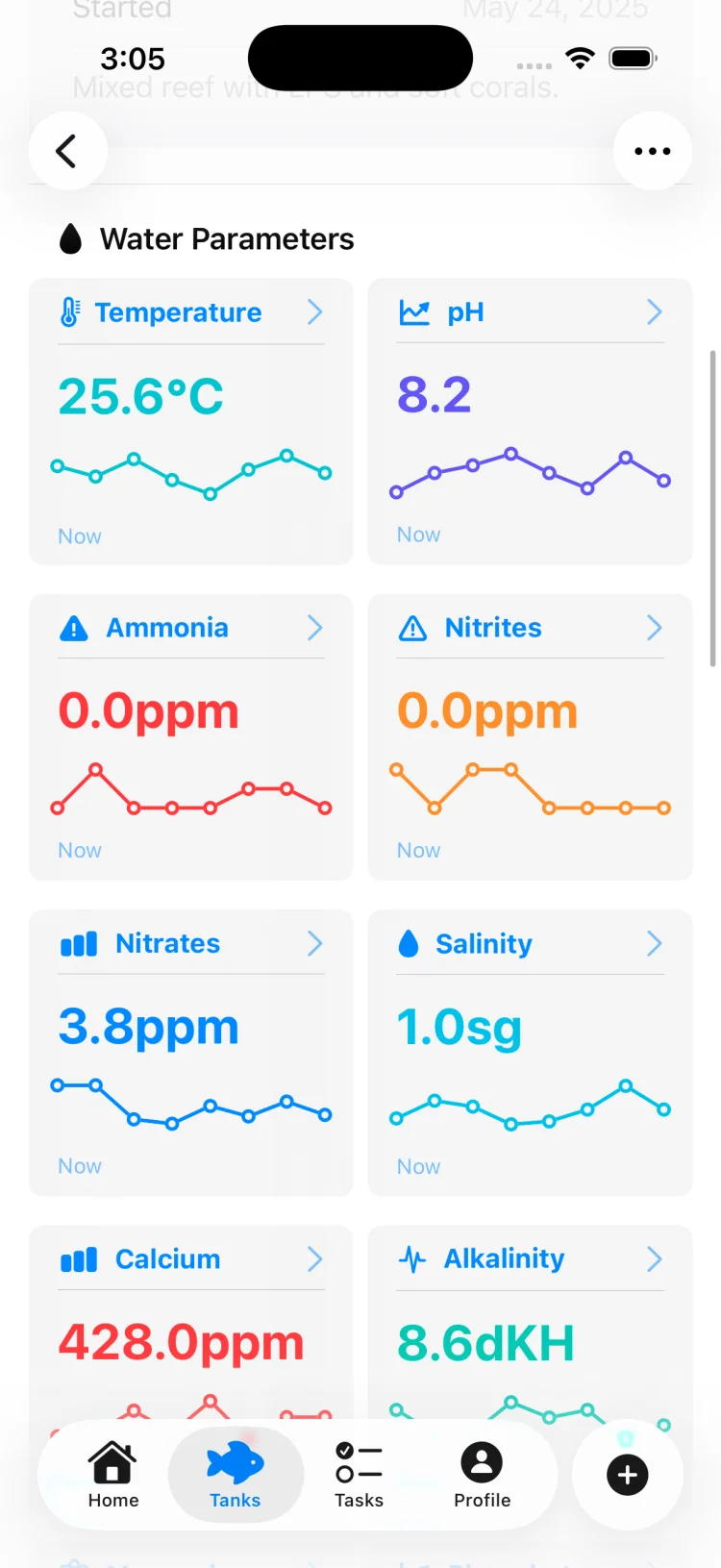
TankSync tracks all ten standard aquarium parameters, including the reef-specific ones: calcium, alkalinity, magnesium and phosphate. Each parameter logs with a timestamp, and the app applies the safe range appropriate to the water type you set when you created the aquarium. Set the type to reef and the safe bands reflect reef targets, not freshwater or fish-only ranges.
Trend charts that make slow drift visible
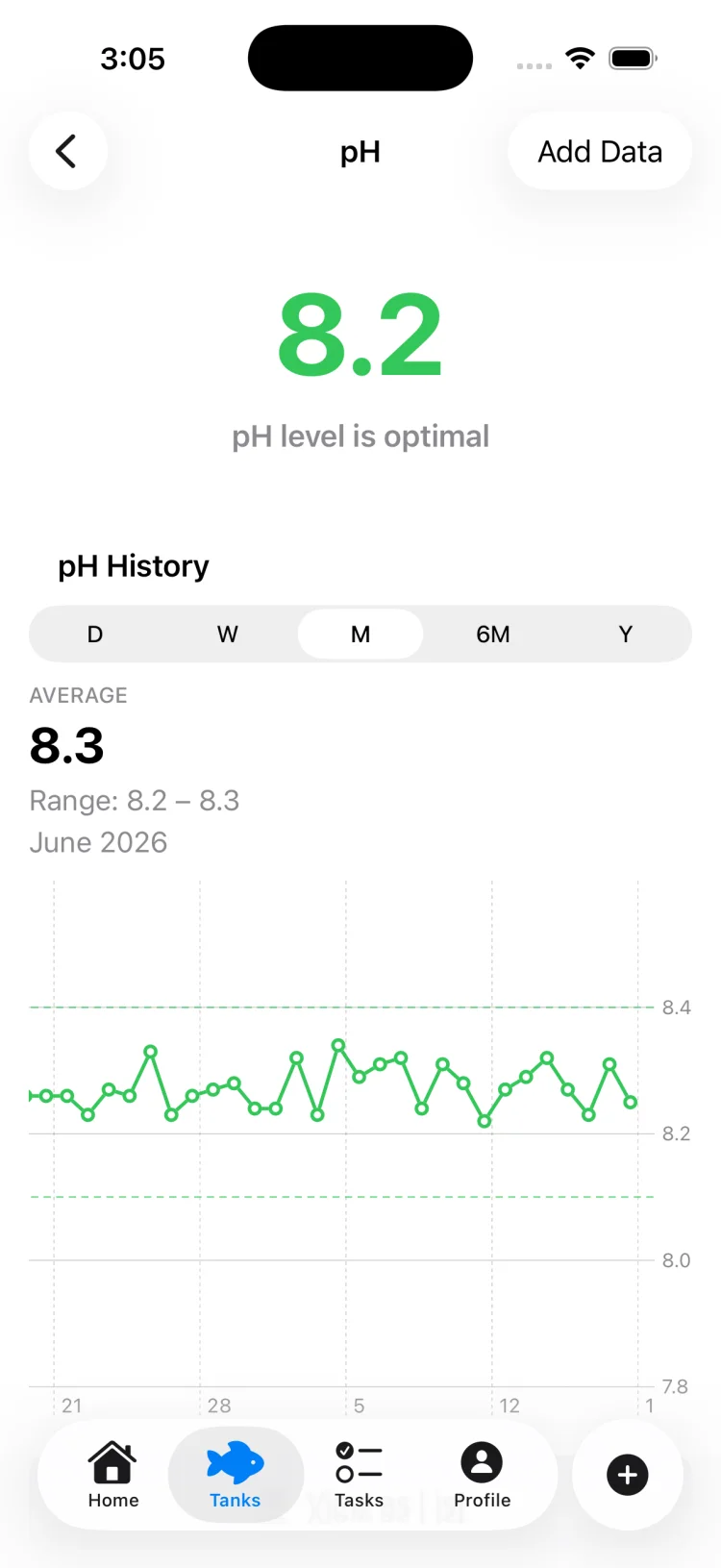
A single alkalinity reading of 7.8 dKH tells you almost nothing. An alkalinity chart showing 8.5, 8.3, 8.1, 7.9, 7.8 over five weeks tells you exactly what is happening: consumption is outpacing replacement by about 0.15 dKH per week, and if you do not adjust the dose it will be at 7.0 dKH in another month. The trend is the information, and you cannot see a trend without a chart.
Every parameter in TankSync has a trend chart with day, week and month windows, so you can zoom out and see the shape over time or zoom in and see whether today's reading is an outlier. Safe ranges are drawn in as bands, and readings outside the safe range are flagged in the grid and on the chart.
Reef-appropriate safe ranges when the water type is set
The safe range for nitrate in a freshwater tank is not the same as the safe range in a reef. TankSync applies the ranges that match the water type you selected: freshwater, saltwater fish-only, or reef. For a reef tank, alkalinity is flagged if it moves outside 7 to 11 dKH, calcium if it moves outside 380 to 480 ppm, magnesium if it moves outside 1250 to 1450 ppm, and nitrate if it moves outside 0.5 to 20 ppm. You can see immediately whether a reading is in range without consulting a reference table.
Coral species in the database
The TankSync species database includes 82 coral species covering common SPS, LPS and soft corals. Each species entry includes care level, lighting and flow requirements, and compatibility notes. When you add a coral to the tank, it appears in the stocking list and contributes to the tank health score, which weights water quality, stocking density and maintenance together.
Tracking reef parameters in TankSync
Set the aquarium up as a reef tank and the parameter ranges adjust automatically:
- Create the aquarium with water type set to reef. The safe ranges for all ten parameters are applied based on that choice.
- Log test results as you run them: alkalinity, calcium, magnesium, nitrate, phosphate, salinity, temperature, pH. Every parameter goes onto its own trend chart.
- Check the charts weekly to catch drift early. If alkalinity is trending down at 0.1 dKH per week, you see the line dropping before it becomes a crisis.
- Set test reminders for the parameters that need frequent monitoring. Alkalinity weekly, calcium and magnesium every two weeks.
- Add your coral species to the stocking list. The app tracks bioload and flags compatibility issues if you add a species that will fight with one already present.
- Use the tank health score to verify that water quality, stocking and maintenance are all in balance. A dropping score tells you something has drifted before the corals show visible damage.
General guidance, not a prescription
The ranges and methods in this guide are typical, not universal. Parameter targets vary with coral species, tank age, bioload, and the specific salt mix, dosing method and filtration in use. A target that suits one reef may be wrong for another.
TankSync's reference content, including its species data and AI features, is informational and is not veterinary advice. Verify anything that affects an animal's health against your own test results and, where the animal is unwell, an aquatic veterinarian or experienced coral specialist.
Frequently asked questions
What are the ideal reef tank parameters?
Salinity 1.025 to 1.026 specific gravity, temperature 25 to 27 degrees Celsius, alkalinity 8 to 9 dKH held steady, calcium 400 to 450 ppm, magnesium 1300 to 1400 ppm, nitrate 1 to 10 ppm, phosphate 0.03 to 0.10 ppm. Stability matters more than any single target. A tank running alkalinity at 8 dKH for six months with no swing will outperform one bouncing between 7 and 10 each week, even though the average is higher. Corals adapt to a number; they do not adapt to volatility.
What alkalinity should a reef tank run at?
Eight to nine dKH is the widely recommended range, matching natural seawater at roughly 7 to 8 dKH and giving a small buffer for consumption. Some tanks run as low as 7 dKH or as high as 11 dKH successfully, but those are deliberate choices made after months of stable results at a standard level. The rule is hold whatever number you choose within about 0.5 dKH day to day. Swings of more than 1 dKH in 24 hours cause burnt tips and tissue recession even if the number itself is in range.
Why is my alkalinity dropping?
Corals consume alkalinity continuously as they build calcium carbonate skeleton. A tank with significant coral growth can drop a full dKH or more per day, which is why alkalinity is the parameter tested most often in a mature reef. If alkalinity is falling faster than expected, check whether coral growth has accelerated, whether you recently added new colonies, or whether the salt mix you are using for water changes has lower alkalinity than the previous batch. If it drops despite minimal coral load, verify the test kit is not expired.
Should nitrate and phosphate be zero in a reef tank?
No. The modern position is that ultra-low nutrient levels cause more problems than they solve. Tanks running near-zero nitrate and phosphate often suffer pale washed-out coral colour, slow growth, dinoflagellate blooms and persistent cyanobacteria. A small measurable amount of both nutrients supports zooxanthellae and prevents nuisance organisms from exploiting the void. Target roughly 1 to 10 ppm nitrate and 0.03 to 0.10 ppm phosphate, keeping them in a rough ten-to-one ratio by mass. Deliberately raising nutrients with controlled feeding is sometimes the fix for a tank that has been stripped too clean.
How often should I test a reef tank?
Alkalinity weekly at minimum, daily if the tank is new or consumption is high. Calcium and magnesium every two weeks once stable. Nitrate and phosphate weekly. Salinity with every water change and any time evaporation has been significant. Temperature continuously with a reliable thermometer. pH is worth checking monthly unless there is a specific reason to track it more closely. Test at the same time of day, because pH and alkalinity swing on a daily cycle with the lighting period.
Why are my corals losing colour?
Pale or washed-out colour with no tissue damage usually means nutrient depletion. Corals lose their brown pigment and vibrant colours when nitrate and phosphate are too low, because the zooxanthellae they rely on for photosynthesis are starving. Check nitrate and phosphate first, and if both read near zero, raise feeding gradually or dose a small amount of nitrate and phosphate directly. Bleaching — complete colour loss to white — signals stress from temperature shock, alkalinity swing or lighting intensity that is too high too fast. Brown colour often means excess nutrients or insufficient light.