Most tank problems are a parameter that drifted for weeks before anything looked wrong. Ammonia climbs silently while fish behave normally. Alkalinity falls over a month and coral growth slows before you notice. pH slides half a point and the only symptom is that new fish do not settle as well as the last batch did. By the time something is visibly wrong — fish gasping at the surface, ich spreading across a whole tank, coral tissue receding — the parameter that caused it has been out of range long enough to do permanent damage.
The solution is unglamorous. Test a fixed set of parameters on a schedule, write down the number even when it looks fine, and watch for any drift over weeks. The specific number on any given day is less important than the direction it is moving and whether that direction has changed. A stable tank is not one where every parameter reads textbook-perfect — it is one where every parameter reads the same this week as it did last week.
The short version
Ammonia and nitrite must always read 0 ppm. Nitrate should stay below 40 ppm in freshwater, below 10 ppm in reef tanks. Temperature needs to be stable within a degree or two and appropriate for the species. pH should be stable week to week; the exact number matters less than the consistency. Reef tanks add calcium, alkalinity and magnesium to the list, all of which need testing and dosing weekly. The rest — general hardness, phosphate, salinity — matter but do not need checking as often. Test more in the first three months, less once the tank has been stable for half a year.
The non-negotiables
Some parameters have no wiggle room. Ammonia and nitrite are toxic at any detectable level. Temperature swings of more than about 2 degrees Celsius in a day stress most fish. Salinity in a saltwater tank must stay within a few points of the target or osmotic stress starts damaging cells. These are the ones where "close enough" is not close enough, and they are the ones you test first when diagnosing a sick tank.
Other parameters have ranges rather than absolutes. Most community fish tolerate pH anywhere from 6.5 to 7.8 as long as it does not swing. Nitrate below 40 ppm is good, below 20 ppm is better, but 60 ppm in an established tank with healthy fish is not an emergency — it is a reminder to do a water change this week instead of next week. General hardness and alkalinity affect breeding success and long-term health but do not kill fish in the short term if they are slightly off.
Knowing which category each parameter sits in tells you how to react when the reading is wrong. Ammonia above 0.25 ppm needs a water change today. Nitrate at 50 ppm needs a water change this week. Alkalinity at 4 dKH in a reef tank needs correcting, but you have days to do it rather than hours.
Stability beats perfection
Fish adapt to water that is slightly wrong if it stays consistent. A stable pH of 7.8 is safer for most tetras than a perfect pH of 6.8 that swings to 7.2 overnight. Salinity that holds at 1.024 is better than salinity that bounces between 1.023 and 1.026 depending on evaporation. Temperature that sits at 25 degrees every day is better than temperature that averages 24 but hits 22 at night and 26 in the afternoon.
The reason is physiological. Fish regulate their internal chemistry relative to the surrounding water, and that regulation costs energy. Stable conditions mean stable internal chemistry, which leaves more energy for growth, immune function and reproduction. Swinging conditions mean constant recalibration, which is metabolically expensive and leaves the fish more vulnerable to disease and stress. This is why fish moved between tanks with different pH often get ich within a week even if both pHs were within the species' published range — the swing itself was the stressor.
So the first goal is stability, and the second goal is getting the stable number close to ideal. Do not chase a perfect pH by adding buffers every few days. Do not top off evaporation with tap water one day and RO water the next. Pick a maintenance routine, follow it consistently, and let the parameters settle into whatever they settle into. Then, if that settled number is problematic, adjust it slowly — over weeks, not days — and let it stabilise again.
Temperature
Temperature controls metabolic rate, oxygen solubility, bacterial activity in the filter, and how much waste fish produce. Warmer water speeds everything up; colder water slows it down. Most tropical fish do well anywhere from 24 to 27 degrees Celsius. Colder-water species like goldfish prefer 18 to 22 degrees. Discus and some other South American fish need 28 to 30 degrees.
The number itself is less critical than the stability and the match to species. A tank that runs at 26 degrees all year is fine for almost any common tropical fish. A tank that swings from 22 at night to 28 in the afternoon will stress even hardy species. Check that your heater is appropriately sized for the tank volume and that it is not fighting an air conditioner or sitting in direct sunlight for part of the day.
Warmer water holds less dissolved oxygen, which is why overstocked tanks in summer often see fish gasping at the surface. If you must raise temperature to treat a disease like ich, increase aeration at the same time. Temperature also affects the toxicity of ammonia — the warmer the water, the more of the total ammonia exists in the toxic un-ionised form, which is another reason an ammonia spike in summer is worse than the same spike in winter.
Test frequency: Check daily with a glass thermometer or digital probe. Heater failures are common and usually kill fish within 24 hours if the temperature crashes, so this is one parameter worth watching every single day.
pH
pH measures how acidic or alkaline the water is on a scale from 0 to 14, with 7 being neutral. Most freshwater fish come from rivers and lakes with pH between 6.0 and 8.0. Saltwater sits around 8.1 to 8.4. Reef tanks need pH above 8.0 or coral calcification slows.
The published ideal range for a species is often narrower than the range they actually tolerate. Wild discus live in blackwater at pH 5.0, but captive-bred discus raised in tap water at pH 7.4 do fine as long as they were not suddenly moved from one to the other. Rift Lake cichlids want pH 8.0 or higher, and they genuinely do need it — keeping them at 6.5 will not work. For most community fish, anything from 6.8 to 7.6 that stays put is workable.
pH drift is the thing to watch for. Biological processes in the tank produce acids, which gradually lower pH over weeks or months. If your source water has low alkalinity, pH can crash into the 6.0 to 6.5 range where nitrification starts slowing down. You will see this as nitrite reappearing in a previously cycled tank, often accompanied by cloudy water and fish that suddenly stop eating. The fix is a large water change to restore alkalinity, followed by adjusting your maintenance schedule or adding something to buffer the water long-term.
Do not adjust pH chemically unless you have to. Most liquid pH adjusters create short-term swings that stress fish more than the wrong pH did in the first place. If your tap water is far from what your fish need, consider mixing it with RO water or switching to RO with a remineraliser, both of which let you control pH through the ratio rather than through daily dosing.
Test frequency: Weekly in new tanks, every two weeks in established tanks. Test more often if you have soft water with low buffering or if you notice any unexplained behaviour changes.
Ammonia
Ammonia is the starting point of the nitrogen cycle and the most immediately dangerous parameter in any tank. Fish produce it through their gills and as waste. Uneaten food and decaying plant matter break down into it. At any detectable concentration it damages gill tissue, suppresses the immune system, and kills fish if it stays elevated for more than a few days.
In a cycled tank, ammonia should always read 0 ppm. Any reading above that means the biological filter is not keeping up with the waste load, which happens when a tank is overstocked, overfed, or has lost part of its bacterial colony due to a medication, a filter cleaning in tap water, or a pH crash. A reading above 0.25 ppm is an emergency. Stop feeding, do a 50 percent water change, and test again the next day.
New tanks always read ammonia during cycling, which is expected and not a crisis as long as there are no fish in the tank. Once the cycle finishes, ammonia should stay at 0 indefinitely. If it reappears weeks later, something has disrupted the bacterial colony and you are seeing a mini-cycle. This is covered in detail in the new tank syndrome guide.
Total ammonia exists in two forms: ionised ammonium, which is relatively harmless, and un-ionised ammonia, which is highly toxic. The ratio between the two depends on pH and temperature. At higher pH and higher temperature, more of the total exists as the toxic form, which is why the same 1 ppm reading is far more dangerous at pH 8.0 and 28 degrees than at pH 6.5 and 22 degrees. Test kits measure total ammonia, so you have to infer toxicity from pH and temperature.
Test frequency: Daily or every other day in new tanks for the first three months. Weekly in established tanks. Any time fish are gasping, lethargic, or showing red gills.
Nitrite
Nitrite is the intermediate product in the nitrogen cycle, produced when one group of bacteria oxidises ammonia. A second group of bacteria converts nitrite to nitrate, which is far less toxic. Nitrite interferes with the blood's ability to carry oxygen, which is why fish suffering nitrite poisoning gasp at the surface even in well-aerated water. Prolonged exposure causes brown blood disease, where blood literally turns brown from methaemoglobin buildup.
Like ammonia, nitrite should always read 0 ppm in a cycled tank. Any detectable reading means the filter is not processing waste completely. The causes are the same as for ammonia: overstocking, overfeeding, bacterial die-off, or a tank that was never fully cycled in the first place. Nitrite above 0.25 ppm needs immediate intervention. Salt can be used as a short-term treatment in freshwater tanks — one gram per litre of aquarium salt or non-iodised table salt reduces nitrite toxicity by blocking its uptake at the gills.
During a fishless cycle, nitrite often climbs so high it goes off the top of the test chart and sits there for two or three weeks. This is normal and not a problem when there are no fish. The bacteria processing nitrite reproduce more slowly than the ones processing ammonia, so this stage takes longer. Once nitrite starts falling and nitrate starts rising, you are in the final stretch. The cycling guide walks through this timeline in detail.
Test frequency: Same as ammonia. Daily or every other day in new tanks, weekly in established tanks, and immediately if fish are gasping or refusing food.
Nitrate
Nitrate is the end product of the nitrogen cycle. It is far less toxic than ammonia or nitrite, but it still accumulates over time and needs to be removed through water changes or consumed by plants. Most freshwater fish tolerate nitrate up to 40 or 50 ppm without obvious harm, though chronic exposure above 20 ppm weakens immune systems and makes fish more susceptible to disease. Fry and sensitive species like discus do better with nitrate below 10 ppm.
Reef tanks need nitrate kept much lower. Many corals tolerate up to 10 ppm, but cleaner water with nitrate below 5 ppm produces better colour and faster growth. SPS corals in particular suffer when nitrate climbs above 10 ppm for extended periods. Very low nitrate — under 1 ppm — can also be a problem in reef tanks because corals need some nitrogen; a reading of 2 to 5 ppm is often ideal.
Nitrate that climbs steadily week after week tells you the tank is producing more waste than water changes are removing. The fix is larger or more frequent water changes, heavier planting, better feeding discipline, or reduced stocking. Nitrate that stays steady at 20 or 30 ppm in an established tank is stable equilibrium and not a problem as long as it is not climbing. Nitrate that reads 0 in a lightly stocked planted tank is normal — plants are consuming it as fast as the filter produces it.
High nitrate also fuels algae growth. If you are fighting green water, hair algae or cyanobacteria and nitrate is above 30 ppm, bringing nitrate down often solves the algae problem without any other intervention. The reverse is also true: if nitrate is at 5 ppm and you still have an algae problem, nitrate is not the cause.
Test frequency: Weekly in all tanks. This is the one parameter that always needs regular monitoring even in mature, stable systems.
Salinity
Salinity measures the concentration of dissolved salts in the water and is only relevant in saltwater and brackish tanks. It is usually expressed as specific gravity, with natural seawater sitting at around 1.025 to 1.027. Most marine fish and reef tanks target 1.024 to 1.026. Brackish tanks vary depending on species but typically run 1.005 to 1.015.
Salinity stability is critical. Fish regulate their internal salt concentration relative to the surrounding water, and any sudden change forces a rapid physiological adjustment that stresses them. A swing of more than 0.002 in a day is enough to trigger osmotic shock in sensitive species. This is why you must top off evaporation with fresh water, not saltwater — evaporation removes water but leaves the salt behind, so adding more saltwater would drive salinity up over time.
Measure salinity with a refractometer rather than a hydrometer. Hydrometers are cheap and inaccurate, especially after a few months of use. Refractometers give a precise reading in seconds and last for years. Calibrate with RO water or calibration fluid before the first use and every few months after that.
If salinity has drifted and needs correcting, do it slowly. A change of 0.001 per day is safe for most fish. A change of 0.005 in a single water change can kill. When mixing new saltwater, aim for the same salinity as the tank, not for the ideal salinity. You can nudge it toward ideal over weeks with small adjustments, but the immediate goal is matching what the fish are already in.
Test frequency: Every water change, every top-off if you do not use an auto top-off, and any time fish look stressed. Salinity drift is one of the most common causes of unexplained deaths in saltwater tanks.
Calcium
Calcium is one of the three major reef parameters and is essential for coral skeletons, coralline algae and the shells of invertebrates like snails and clams. Corals pull calcium out of the water constantly, so any reef tank needs either regular dosing or a calcium reactor to replace it. Target range is 400 to 450 ppm for most reef tanks. Below 350 ppm, coral growth slows. Above 500 ppm, calcium can precipitate out of solution and cause other chemistry problems.
Calcium does not act alone. It needs to stay balanced with alkalinity and magnesium or the whole system becomes unstable. If calcium is low but alkalinity is also low, raising calcium without raising alkalinity will not help coral growth. If calcium is high but magnesium is low, calcium will precipitate and the reading will crash a few days after you dose it. All three need to be in range together, which is why reef keeping has a reputation for being chemistry-intensive — it is.
Fish-only saltwater tanks do not need calcium monitoring. There is enough in the salt mix to keep fish and any incidental invertebrates healthy, and water changes replace what gets used. Calcium only becomes a tracked parameter once you add corals or keep a lot of coralline algae.
Test frequency: Weekly in reef tanks. Daily or every other day if you are dialling in a new dosing regimen. Irrelevant in fish-only saltwater or any freshwater tank.
Alkalinity
Alkalinity, often called KH or carbonate hardness, is the water's buffering capacity: its ability to resist pH changes. It is measured in degrees of carbonate hardness, dKH, or in milliequivalents per litre, meq/L. One meq/L equals 2.8 dKH.
In freshwater tanks, alkalinity keeps pH stable by neutralising the acids produced by fish waste, plant respiration and decomposition. Soft water with low alkalinity will see its pH drift downward over weeks until it crashes, at which point the nitrifying bacteria slow or stop and the tank crashes too. Adding crushed coral, aragonite sand or a commercial buffer raises alkalinity and prevents this. Most freshwater tanks do well with alkalinity around 4 to 8 dKH. Below 3 dKH, pH stability becomes a problem.
In reef tanks, alkalinity does double duty. It buffers pH and it provides the carbonate ions corals use to build calcium carbonate skeletons. Coral growth consumes alkalinity steadily, which is why reef keepers test it weekly and dose it alongside calcium. Target range is 8 to 12 dKH for most reefs. SPS-dominant tanks often run lower, around 7 to 9 dKH, because high alkalinity can inhibit colour in some Acropora. Mixed reefs with LPS and SPS do well at 9 to 10 dKH.
Alkalinity swings are more dangerous than a slightly low or high stable reading. A drop of 2 dKH in a day will stress coral visibly. Raise or lower it slowly — no more than 0.5 dKH per day — and test the next day to confirm the change held. Alkalinity that drops every few days despite dosing usually means magnesium is low, because magnesium is required for calcium and alkalinity to stay in solution.
Test frequency: Weekly in reef tanks. Every couple of weeks in freshwater tanks, or whenever pH starts drifting. Not relevant in fish-only saltwater.
Magnesium
Magnesium is the third leg of the reef chemistry triangle and the one most often ignored by new reef keepers. It does not get used as quickly as calcium and alkalinity, but it is required for both of them to stay in solution. If magnesium drops too low, calcium and alkalinity will precipitate out even if you keep dosing them, and coral growth will stop.
Target range for most reefs is 1250 to 1400 ppm. Natural seawater sits around 1280 ppm. Below 1200 ppm, you will start seeing calcium and alkalinity become unstable. Above 1500 ppm does not usually cause immediate problems but is unnecessary and can inhibit the uptake of other elements over time.
Magnesium drifts more slowly than calcium and alkalinity, so it does not need testing or dosing as often. Many reef keepers check it every two weeks and adjust if it has dropped below 1250 ppm. If calcium and alkalinity are falling faster than expected even though you are dosing, low magnesium is the first thing to check.
Freshwater tanks do not track magnesium. There is enough in most tap water and fish food to meet the needs of fish and plants. It only becomes relevant in reefs.
Test frequency: Every two weeks in reef tanks, or whenever calcium and alkalinity start behaving oddly. Not relevant in freshwater or fish-only saltwater.
Phosphate
Phosphate accumulates from fish waste, uneaten food and decaying organic matter. In freshwater tanks it is mostly a nuisance because it fuels algae. In reef tanks it is both a nuisance and a coral health issue because high phosphate inhibits calcium uptake and slows coral growth.
Target phosphate in a freshwater tank is below 1 ppm, and below 0.5 ppm if you are fighting algae. In a reef tank, aim for 0.03 to 0.1 ppm. Very low phosphate — below 0.01 ppm — can actually starve corals of a nutrient they need in small amounts, so ultra-low is not always better. The ideal is a stable low level, not zero.
Phosphate that climbs steadily week after week indicates overfeeding or inadequate water changes. Reducing feeding by half and increasing water change volume usually brings it down within a month. Chemical phosphate removers like GFO work faster but can drop phosphate so quickly that corals stress from the sudden change. If you use GFO, introduce it gradually and test every few days to make sure phosphate is not crashing.
Phosphate often reads higher than expected in new tanks because it leaches out of dry rock during the curing process. This is normal and clears up over the first few months as water changes export it and bacteria and algae consume it.
Test frequency: Every two weeks in established tanks. Weekly if you are fighting algae or dialling in coral colour. Less often in mature, stable tanks that have been running clean for six months or more.
Target ranges by tank type
The safe range for a parameter depends on what you are keeping. A freshwater community tank and a reef tank measure the same chemistry but need different targets. Here are the working ranges that suit most tanks of each type.
| Parameter | Freshwater community | Saltwater fish-only | Reef | Test frequency |
|---|---|---|---|---|
| Temperature | 24–27°C | 24–26°C | 24–26°C | Daily |
| pH | 6.5–7.8 | 8.0–8.4 | 8.1–8.4 | Weekly (new), fortnightly (established) |
| Ammonia | 0 ppm | 0 ppm | 0 ppm | Daily (new), weekly (established) |
| Nitrite | 0 ppm | 0 ppm | 0 ppm | Daily (new), weekly (established) |
| Nitrate | Under 40 ppm | Under 40 ppm | 2–10 ppm | Weekly |
| Salinity | N/A | 1.024–1.026 | 1.024–1.026 | Each water change and top-off |
| Calcium | N/A | N/A | 400–450 ppm | Weekly |
| Alkalinity (KH) | 4–8 dKH | N/A | 8–12 dKH | Fortnightly (FW), weekly (reef) |
| Magnesium | N/A | N/A | 1250–1400 ppm | Fortnightly |
| Phosphate | Under 1 ppm | Under 1 ppm | 0.03–0.1 ppm | Fortnightly |
These are guidelines, not absolutes. Some species have tighter requirements. Discus need warmer water and softer chemistry. Rift Lake cichlids need hard water and high pH. Wild-caught fish are often less tolerant of parameter swings than captive-bred strains. Check species-specific requirements before assuming the community tank range will work for everything.
What a bad reading is telling you
A parameter out of range is a symptom, not a diagnosis. The reading tells you something is wrong; it does not tell you what. Here is how to interpret the most common bad readings and what to do first.
| Symptom / reading | Likely cause | First action |
|---|---|---|
| Ammonia above 0.25 ppm | Overfeeding, overstocking, dead fish or plant matter, bacterial die-off from medication or pH crash | 50% water change immediately. Stop feeding for 24 hours. Find and remove any dead material. Test again tomorrow. |
| Nitrite present | Tank not fully cycled, or filter bacteria disrupted (cleaned in tap water, medication, chlorinated water added) | Daily water changes to keep nitrite under 0.25 ppm. Feed very lightly. Add aquarium salt (1 g/L) in freshwater to reduce toxicity. |
| Nitrate above 40 ppm (FW) or 10 ppm (reef) | Water changes too small or too infrequent, overfeeding, overstocking | Do a 50% water change. Increase weekly water change volume by 10–20%. Reduce feeding slightly. |
| pH falling over weeks | Low alkalinity, insufficient buffering in source water, heavy bioload stripping carbonate hardness | Large water change. Test alkalinity. Add crushed coral or buffer if alkalinity is below 3 dKH. |
| Alkalinity swinging daily | Inconsistent dosing, or magnesium too low to keep calcium and alkalinity stable | Test magnesium. If below 1200 ppm, dose magnesium first. Adjust dosing schedule to same time each day. |
| Phosphate climbing | Overfeeding, infrequent water changes, GFO depleted, rocks still leaching | Reduce feeding by half. Do larger weekly water changes. Replace GFO if using. Wait — new tanks often clear phosphate on their own in 2–3 months. |
Most parameter problems have a maintenance cause rather than a chemistry cause. Overfeeding is behind more crashes than bad test kits. Inconsistent water changes cause more long-term problems than wrong pH. Get the routine right first, then adjust chemistry if the routine is solid but the numbers are still off.
How often to test
The schedule depends on the tank's age, type and stability. A new tank in its first three months needs frequent testing because everything is still establishing. An established tank that has been stable for a year needs far less. A reef tank with SPS corals needs more testing than a freshwater planted tank. Here is a working schedule for each stage.
New tanks, first three months
Test ammonia, nitrite and nitrate every day or every other day until both ammonia and nitrite have stayed at 0 ppm for two consecutive weeks. Test pH weekly. Record everything so you can see the shape of the cycle rather than just today's number. After the cycle finishes and fish are added, continue testing ammonia and nitrite twice a week for the first month to catch any mini-cycle from increased bioload.
Established tanks, three to twelve months
Test nitrate weekly. Test pH every two weeks. Test ammonia and nitrite weekly, or any time fish behaviour changes. This is the period where the tank is cycled but has not yet built the stability that comes from a mature filter and established biofilm. Small disruptions can still cause parameter swings, so regular testing catches them early.
Mature tanks, over a year old
Test nitrate weekly. Test pH monthly unless it has been drifting. Test ammonia and nitrite only if something looks wrong — a fish death, unexplained lethargy, refusal to eat. A tank that has been running clean for a year with consistent maintenance rarely develops an ammonia or nitrite problem unless something catastrophic happens, so daily testing becomes a waste of time and reagent.
Reef tanks
Test calcium, alkalinity and nitrate weekly. Test magnesium and phosphate every two weeks. Test pH weekly because reef tanks need it above 8.0 for calcification. Test ammonia and nitrite weekly in the first six months, then only as needed. Reef chemistry is less forgiving than freshwater, so the testing load stays higher even in mature tanks. Many reef keepers settle into a fixed testing day — Sunday morning, Wednesday evening — and run the same panel every week so it becomes routine rather than a decision.
The argument for a fixed testing day
Pick a day and time each week and test the same parameters in the same order. Make it part of the water change routine or the day before it. This removes the decision of whether to test and turns it into a habit, which is the only reliable way to keep testing for years. Sporadic testing when you remember or when something looks wrong misses the early drift that could have been corrected with a water change instead of a medication.
Test kits: liquid vs strips vs digital
There is no perfect test kit. Every method trades accuracy, speed and cost against each other. Here is what each type does well and where it fails.
Liquid test kits
Liquid kits use reagent drops added to a water sample in a test tube, followed by colour matching against a card. They are slower and messier than strips but far more accurate. The difference between 0 and 0.25 ppm of ammonia is life or death during cycling, and only a liquid kit can reliably tell you which one you have. Liquid kits also last longer — a bottle of reagent typically handles 100 to 200 tests, whereas a strip kit gives you one test per strip.
The downsides are time and interpretation. Each test takes three to five minutes and requires good lighting to read the colour accurately. Colour-blind users struggle with some tests. Reagents expire, usually within a year or two of opening, and an expired reagent gives false readings without telling you it is expired. Always date a bottle when you open it.
Test strips
Dip a strip in the water, wait 30 seconds, compare the colour pads to the chart. Fast, clean, no reagent bottles or test tubes. The accuracy is coarse — you might be able to tell the difference between 0 and 0.5 ppm of ammonia, but not between 0 and 0.25 ppm, and the latter distinction matters. Strips are fine for routine nitrate checks in an established tank where you are looking for a general trend rather than a precise number. They are inadequate for anything critical.
Strips are also sensitive to storage conditions. A bottle left open or stored in a humid bathroom will degrade within weeks, and degraded strips read low across the board. If you use strips, keep the bottle sealed tight and store it somewhere cool and dry.
Digital meters
Digital pH meters, TDS meters and refractometers remove the colour-matching guesswork and give a number directly. A pH meter reads to 0.01 precision, which is overkill for most tanks but useful if you are chasing a pH crash or trying to maintain reef parameters tightly. Refractometers for salinity are effectively essential in saltwater tanks — hydrometers are too inaccurate to trust.
The catch is calibration. A pH meter that is not calibrated is worse than useless because it gives you a confident wrong answer. Calibrate every month with pH 7.0 and pH 10.0 buffer solutions, and replace the probe every year or two as it degrades. TDS meters need calibration less often but still need it. Refractometers need a zero calibration with RO water every few months.
There are also multi-parameter digital testers that measure several things at once. Most are expensive and fragile, and the accuracy varies wildly by brand. A good liquid test kit is usually a better investment unless you are testing so often that the time saved justifies the cost.
What to buy first
For a new freshwater tank, buy a liquid test kit that measures ammonia, nitrite, nitrate and pH. That covers cycling and ongoing maintenance. Add a glass thermometer or digital temperature probe. For saltwater, add a refractometer. For reef, add test kits for calcium, alkalinity and magnesium. Everything else can wait until you have a specific reason to measure it.
How TankSync fits into water testing
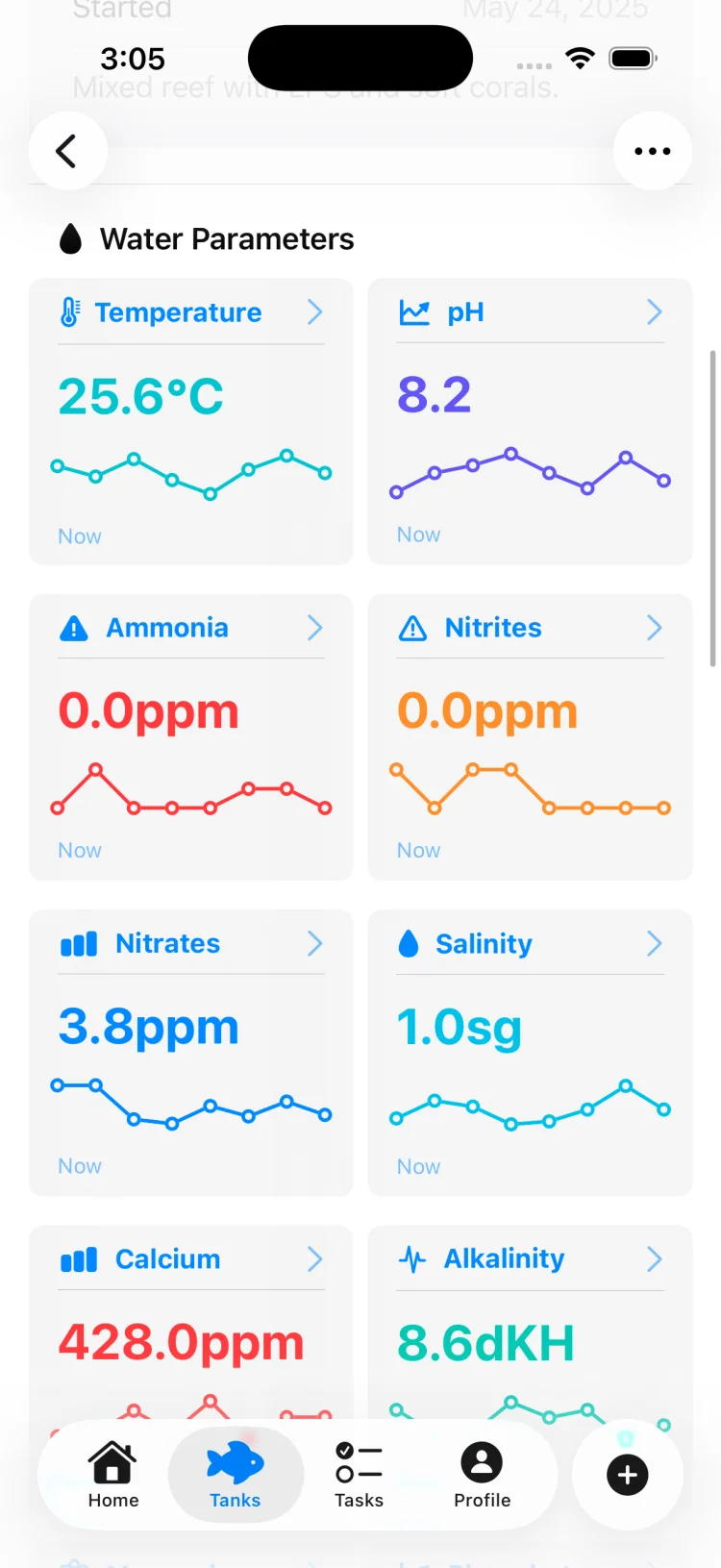
TankSync does not replace test kits. It records the results so you can see what the numbers are doing over weeks and months rather than trying to remember what last Tuesday's nitrate reading was. Water quality is 40 percent of the tank health score, and the scoring is built on logged parameter history, not guesswork.
Logging all ten parameters with safe ranges applied automatically
Each aquarium in TankSync has a water type — freshwater, saltwater or reef — and the safe range for every parameter comes from that choice. Ammonia always flags red above 0 ppm. Nitrate flags yellow above 40 ppm in freshwater, above 10 ppm in reef. Calcium, alkalinity and magnesium only appear for reef tanks because they are not relevant anywhere else. You log the reading and the app tells you whether it is in range without you needing to remember what the target was.
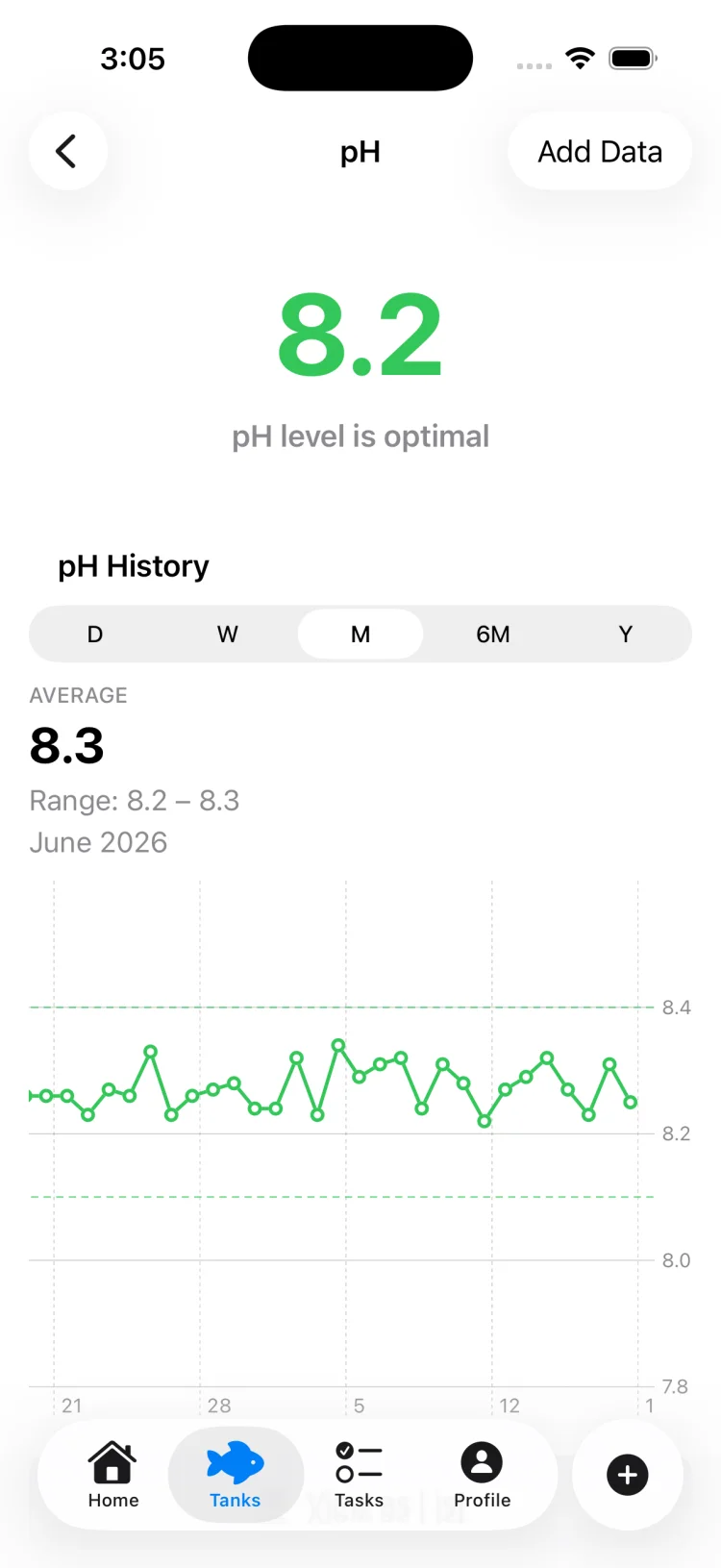
Trend charts over day, week and month windows
Every parameter gets a line chart with the safe band drawn in as a shaded area. Switch between day, week and month views to see short-term swings or long-term drift. A pH that has dropped 0.4 units over six weeks is invisible day-to-day but obvious on a month chart. Nitrate climbing from 15 ppm to 35 ppm over three months tells you the current water change schedule is not enough, and you can see that before nitrate hits problem levels.
Water quality as 40 percent of the tank health score
The health score weights water quality at 40 percent because it affects everything else. Ammonia or nitrite above 0 ppm drags the score down immediately. Nitrate climbing into the yellow or red range reduces it. pH instability over the past two weeks lowers it. Temperature swings lower it. A tank that scores 95 percent has consistently good water. A tank that scores 60 percent has a parameter problem that needs fixing, and the detail view tells you which one.
The other components are stocking at 25 percent, maintenance at 20 percent and cycling status at 15 percent. Water quality is the largest single factor because it is the one that kills fish fastest when it goes wrong.
Logging a full test round in TankSync
Run your tests with your usual kit, then log all the readings in one session:
- Open the aquarium and tap the water parameters card on the dashboard.
- Tap the parameter you just tested — temperature, pH, ammonia, whichever you ran first.
- Enter the reading. If it is out of range, the app highlights it immediately.
- Repeat for each parameter. You can log all ten in under two minutes.
- Check the trend charts to see if anything has moved since last week.
- Set a test reminder for the same day next week so it becomes routine rather than something you remember when a fish looks ill.
Everything syncs to iCloud, so if you test on your iPhone the results are on your iPad two seconds later. No TankSync account needed — the data stays in your own iCloud and nowhere else.
Get TankSync free →General guidance, not a prescription
The ranges and testing schedules in this guide are typical for the majority of aquarium setups, not universal requirements. Species-specific needs vary. Sensitive fish, wild-caught specimens, breeding pairs and specialist setups like discus tanks or ultra-low-nutrient reefs may need tighter parameters or more frequent testing. Source water chemistry, stocking density, feeding habits and filtration all affect how quickly parameters drift.
TankSync's reference content, including its species data, safe ranges and AI features, is informational and is not veterinary advice. Verify anything that affects an animal's health against your own test results and, where the animal is unwell, consult an aquatic veterinarian. The health score is a dashboard indicator built from logged data, not a diagnostic tool.
Frequently asked questions
What are the ideal water parameters for a freshwater aquarium?
Ammonia and nitrite must both read 0 ppm at all times; any detectable level is toxic. Nitrate should stay below 40 ppm in most community tanks, though many fish tolerate higher levels if the rise is gradual. Temperature depends on species but 24 to 26 degrees Celsius suits most tropical fish. pH anywhere from 6.5 to 7.8 works for the majority of common species as long as it stays stable week to week. General hardness and alkalinity matter more for breeding and long-term health than for day-to-day survival. The non-negotiables are zero ammonia, zero nitrite and stable temperature.
What should ammonia, nitrite and nitrate read in a healthy tank?
Ammonia and nitrite must always read 0 ppm. Both are acutely toxic and any detectable reading means something is wrong with the biological filtration or the tank is overstocked or overfed. Nitrate is the end product of the nitrogen cycle and accumulates over time. In freshwater tanks, keep it below 40 ppm; in reef tanks, below 10 ppm. Heavily planted freshwater tanks can often run 0 nitrate because plants consume it as fertiliser. High nitrate alone does not kill fish quickly, but chronic exposure weakens immune systems and encourages algae.
How often should I test my aquarium water?
New tanks in their first three months need ammonia, nitrite and nitrate tested two or three times a week until the cycle stabilises. Established tanks need nitrate checked weekly and pH checked every couple of weeks. Test whenever fish behaviour changes, after adding new stock, after a medication course or if anything looks wrong. Reef tanks need calcium, alkalinity and magnesium tested weekly because coral growth consumes them steadily. Picking a fixed day each week and testing the same parameters in the same order makes it a routine rather than a decision, and that consistency is what catches a drift before it becomes a problem.
Is a stable pH more important than a specific pH?
Yes, in most cases. Fish adapt to a pH that is slightly outside their preferred range as long as it does not swing. A pH that swings by more than 0.3 units in a day stresses fish more than a stable pH half a point away from ideal. Rapid swings damage gill membranes and immune function even when both the high and the low are technically within tolerance. The exception is if your pH is dangerously far from a species' range — keeping Rift Lake cichlids at pH 6 or discus at pH 8.5 will not work no matter how stable it is. For most common community fish, anything from 6.8 to 7.6 that holds steady is better than chasing 7.0 and bouncing all over the place.
What is alkalinity and why does it matter more in a reef tank?
Alkalinity, measured as KH or carbonate hardness, is the water's buffering capacity: its ability to resist pH swings. In a freshwater tank it keeps pH stable by neutralising the acids produced by fish waste and plant respiration. In a reef tank it does that and also provides carbonate ions that corals use to build calcium carbonate skeletons. Coral growth depletes alkalinity steadily, which is why reef keepers dose or use calcium reactors to maintain it. Target range for most reefs is 8 to 12 dKH. If alkalinity drops too low, pH becomes unstable and coral growth slows or stops. Freshwater tanks generally need enough alkalinity to stop pH crashes but do not require active supplementation unless the source water is extremely soft.
Are test strips accurate enough?
For a rough check of nitrate or pH in an established tank, yes. For anything where precision matters — ammonia and nitrite during cycling, reef parameters, diagnosing a sick tank — no. Strips measure by colour comparison on small pads that are easily misread under poor lighting, and their resolution is too coarse to tell the difference between 0 and 0.25 ppm of ammonia. Liquid test kits are slower and messier but far more accurate. Digital meters for pH and salinity remove the colour-matching guesswork entirely and are worth it if you test often. Use strips for routine monitoring if you like, but keep a liquid kit for anything important.