The most common way a first aquarium fails is this. Tank goes up on Saturday. Water goes in, heater goes on, and by Sunday afternoon there are six fish in it because the tank looked ready and the shop said it was fine. Two weeks later the fish are gasping at the surface, the water has gone cloudy, and nobody can explain why. Nothing was neglected. The filter was simply empty — not of media, but of the bacteria that make the media do anything at all.
The short version
Fill the tank, run the filter, and add an ammonia source. Test ammonia, nitrite and nitrate every day or two and write down every reading. Ammonia rises then falls. Nitrite rises then falls. Nitrate rises and stays. When you can dose 2 ppm of ammonia and read zero ammonia and zero nitrite 24 hours later, the tank is cycled. Expect four to eight weeks unless you seed the filter from an established tank.
What the nitrogen cycle actually is
Fish produce waste. Uneaten food rots. Plants shed leaves. All of it breaks down into ammonia, and ammonia kills fish at concentrations low enough that a test kit barely registers them. In a river this does not matter, because the volume of water is effectively infinite. In a sixty-litre glass box it matters a great deal.
What saves the fish is bacteria. One group of nitrifying bacteria consumes ammonia and produces nitrite. Nitrite is also toxic — it interferes with the blood's ability to carry oxygen, which is why fish suffering nitrite poisoning gasp even in well-aerated water. A second group of bacteria consumes nitrite and produces nitrate. Nitrate is comparatively harmless at the levels a normal tank reaches, and you remove it with water changes or let plants use it as fertiliser.
So the chain is: waste → ammonia → nitrite → nitrate → water change. Cycling a tank means growing both bacterial colonies until they are large enough to process waste at the rate your fish produce it. The bacteria live mostly in the filter media, on the substrate and on every surface in the tank — not free-floating in the water. This is why the filter matters and why replacing all your filter media at once is a bad idea.
The colonies grow to match the food supply and no further. A filter cycled for one small fish will crash if you add ten more, because the bacterial population is sized for the waste it has been receiving. This is the single most useful thing to understand about the cycle: it is not a switch that flips on, it is a population that scales.
Why you cannot just add fish and hope
Adding fish to an uncycled tank is sometimes called "fish-in cycling," which makes it sound like a technique rather than what it is: using live animals as the ammonia source while the bacteria establish. The fish spend three to six weeks swimming in ammonia and nitrite at concentrations that damage gill tissue, suppress the immune system and frequently kill them outright. Survivors often carry permanent gill scarring.
The alternative costs nothing except patience. A fishless cycle uses a bottle of pure ammonia or a pinch of fish food as the waste source. The bacteria cannot tell the difference. The tank ends up in exactly the same state, and no animal was involved in getting it there.
If you have already added fish — most people reading this have — skip to the section on stalled cycles and start testing daily. Keep ammonia and nitrite under 0.25 ppm with water changes, feed lightly, and accept that this will take as long as it takes.
Fishless cycling, step by step
The whole process is five decisions and then a lot of waiting. Here is the sequence.
1. Set the tank up and let it run
Fill with dechlorinated tap water. Chlorine and chloramine will kill the bacteria you are trying to grow, so this is not optional even if your water tastes fine. Install the filter and heater and start them. Bring the temperature to around 26–28°C (78–82°F) if you can — nitrifying bacteria multiply considerably faster at the upper end of the aquarium range, and you can drop the temperature to the fish's preference once the cycle is done.
Add substrate, hardscape and plants now if you are using them. Live plants consume ammonia directly and will slightly reduce the readings you see, which is fine but worth knowing so you do not misread a low ammonia number as progress.
2. Add an ammonia source
Pure ammonia solution — no surfactants, no perfume, nothing that foams when shaken — is the cleanest option because you control the dose. Aim for 2 to 4 ppm. Higher is not better; above roughly 5 ppm ammonia starts inhibiting the very bacteria you are cultivating, and above 8 ppm many cycles simply stop.
The alternative is a pinch of flake food every couple of days, left to decompose. It works, it is free, and it is messier and slower because you cannot control how much ammonia you are producing. Either way, test after 24 hours to see where you actually landed.
3. Test consistently and record everything
Use a liquid test kit. Test strips are convenient and imprecise, and precision is what this whole exercise depends on — the difference between 0 and 0.25 ppm of ammonia matters, and a colour pad cannot reliably tell you which one you have.
Test ammonia, nitrite and nitrate every day or every other day at roughly the same time. Record every reading, including the boring ones where nothing changed. The shape of the curve over three weeks is the information; a single reading in isolation tells you almost nothing. This is the part people skip, and it is why so many cycling questions come down to "I do not know what it was doing last week."
The week-by-week timeline
Every tank runs on its own schedule, but the shape is consistent. Here is what a typical fishless cycle looks like from a standing start with no seeded media.
| Stage | Typical timing | Ammonia | Nitrite | Nitrate |
|---|---|---|---|---|
| Dosed, nothing happening | Days 1–7 | 2–4 ppm, steady | 0 | 0 |
| First bacteria establish | Week 1–2 | Starts falling | Appears and climbs | 0 |
| Nitrite peak | Week 2–4 | Falling to 0 within a day of dosing | High, often off the top of the chart | Trace |
| Second bacteria establish | Week 3–6 | 0 | Falling | Climbing steadily |
| Cycled | Week 4–8 | 0 within 24h of a 2 ppm dose | 0 within 24h | 20–80 ppm and rising |
The nitrite stage is where people give up
Ammonia disappearing feels like progress, and it is. Then nitrite climbs off the top of the test chart and sits there for two or three weeks looking exactly the same every single day. This is normal. The bacteria that process nitrite reproduce more slowly than the ones that process ammonia, and they are working against a nitrite concentration far higher than anything a real tank would ever see.
Do not do a large water change to "fix" a high nitrite reading during a fishless cycle. There are no fish in the tank. The nitrite is not hurting anything, and diluting it just removes the food supply the second colony is trying to grow on. The one exception is if nitrite is so high it is inhibiting the process — if you have had no movement for over two weeks, a 50 percent change can help.
Nitrate appearing is the signal
When your nitrate test starts reading something above zero, the second colony is working. Nitrate does not disappear on its own in a tank without plants or specialised media — it accumulates until you remove it with a water change. That accumulation is exactly why nitrate is the number you watch forever afterwards, long after ammonia and nitrite have stopped being interesting.
Confirming the cycle is actually finished
The test is functional, not a calendar date. Nobody can tell you your tank is cycled on day 35. You prove it.
Dose ammonia back up to about 2 ppm. Wait 24 hours. Test all three parameters. If ammonia reads 0, nitrite reads 0 and nitrate has gone up, your filter just processed a full day's worth of waste inside a day. That is a cycled tank. If ammonia is at 0 but nitrite is at 1 ppm, you are close but not there — the second colony is not big enough yet. Wait, dose again, retest.
Do this twice, on consecutive days, before you trust it. One clean result can be a testing error. Two in a row is a filter.
Zero ammonia alone does not mean cycled
A tank with heavy plant growth, or one where the ammonia was never dosed high enough in the first place, can read zero ammonia while having almost no bacterial colony. The nitrate reading is the corroborating evidence — if ammonia is disappearing and nitrate is not appearing, something other than nitrification is consuming it.
When the cycle stalls
A cycle that has not moved in two weeks has a cause, and it is almost always one of five things.
| Cause | What you would see | Fix |
|---|---|---|
| Ammonia dosed too high | Ammonia above 5 ppm and flat for weeks | 50 percent water change, redose to 2 ppm |
| pH crashed | pH below 6.5, everything frozen | Water change with harder water, or add crushed coral to buffer |
| Temperature too low | Below about 21°C, progress glacial | Raise to 26–28°C for the duration |
| Chlorine or chloramine | Cycle regressed after a water change | Dechlorinate every drop that enters the tank, including top-ups |
| Filter cleaned in tap water | Sudden ammonia spike after maintenance | Only ever rinse media in old tank water |
pH is the one people miss. Nitrification consumes carbonate hardness, so a soft-water tank running a heavy cycle can quietly strip its own buffering capacity and drop below 6.5, at which point nitrifying bacteria slow to a crawl. If your cycle stopped dead and you have never tested pH, test pH.
Legitimate ways to speed it up
Seeded media is the only genuinely reliable shortcut. A sponge, a handful of ceramic media, a bag of gravel or a used filter cartridge from an established, healthy tank carries the actual bacterial biofilm. Drop it into your filter and you may be cycled in a week or less. Ask a friend with a mature tank, or a local shop — most will hand over a squeeze of filter sponge if you ask.
Keep the media wet and get it into your filter the same day. Bacteria on a sponge in a bag with no oxygen start dying within hours.
Bottled bacteria products are a mixed bag. Some contain viable cultures of the right organisms and genuinely work. Many contain organisms that are not the ones doing the work in your filter, or contain the right ones in a state that did not survive six months on a warm shelf. Treat a bottle as a possible accelerant, not a substitute for the process, and confirm with the 24-hour test regardless.
Higher temperature, good oxygenation and a source of carbonate hardness all help. Antibacterial medications, UV sterilisers running during the cycle, and frequent large water changes all hurt.
How TankSync fits into cycling
The hard part of cycling is not the chemistry. It is keeping a consistent record across six weeks when each individual test result looks identical to the last one. TankSync has a dedicated cycling dashboard for exactly this.
Stage tracking rather than a raw number dump
The cycling dashboard tracks the tank through the stages — not started, ammonia building, nitrite building, nitrate building, almost complete, complete — so you can see where you are rather than trying to interpret a wall of numbers. It detects the milestones automatically from your logged results: the first ammonia spike, the first nitrite spike, and completion.
Every test result charted against the safe range
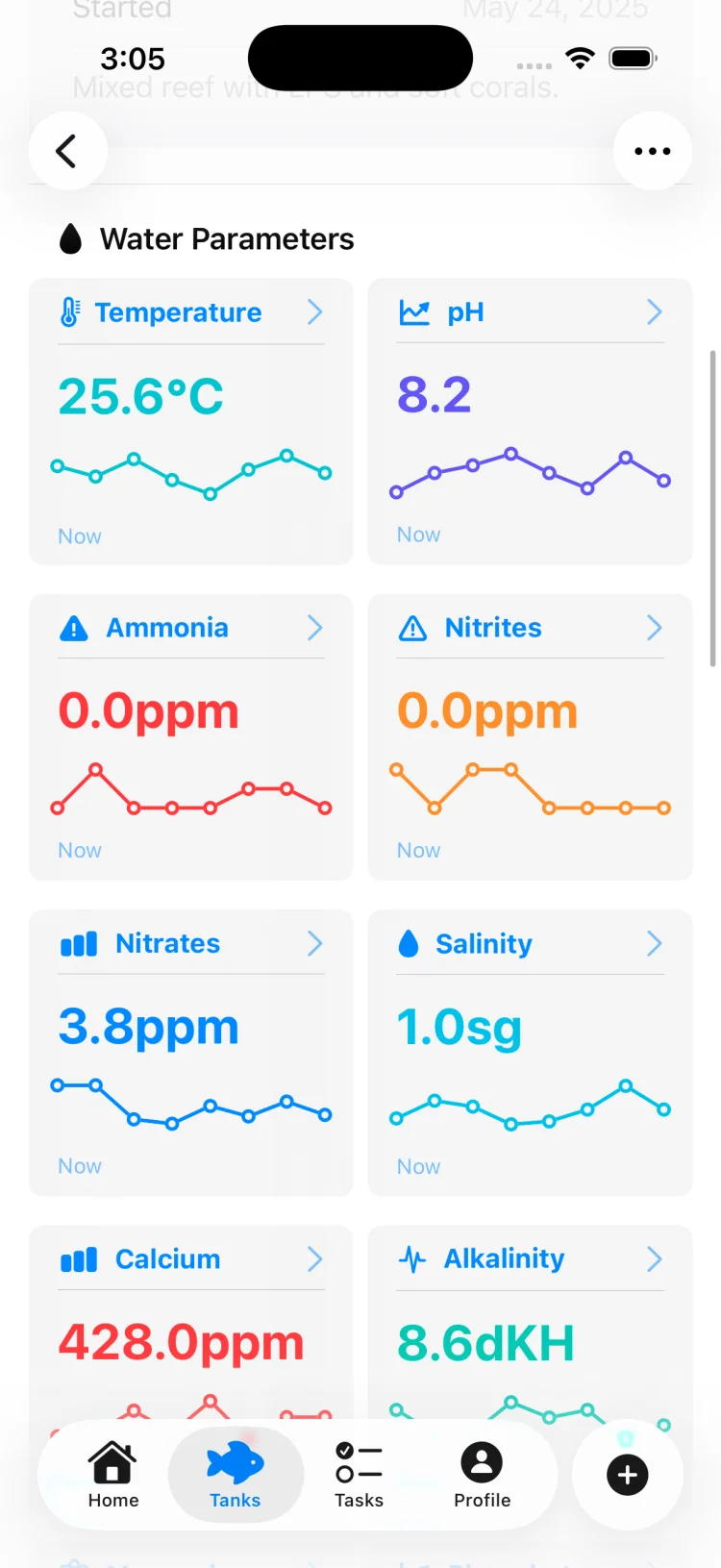
Ammonia, nitrite and nitrate go onto trend charts with their safe bands drawn in, across day, week and month windows. Watching nitrite climb and then fall as a line is far more informative than reading today's number in isolation.
A journal for the things numbers do not capture
Cycling journal entries let you note the dose you added, the water change you did, the day the water went cloudy. Six weeks later, when you are trying to work out why the cycle stalled, that context is the difference between diagnosing it and guessing.
Cycling a tank in TankSync
Set the tank up in the app before you dose the first ammonia, and the record builds itself:
- Add the aquarium with its volume and water type. The safe ranges for every parameter come from that choice.
- Open the cycling dashboard and start tracking. The stage begins at "not started."
- Log each test result as you run it — ammonia, nitrite and nitrate together, so the handover between stages is visible.
- Turn on test reminders so the readings do not develop a week-long gap halfway through.
- Add journal entries for doses, water changes and anything unusual.
- Watch for the milestone detections. When the dashboard reads complete, run the 24-hour confirmation test yourself before you buy fish.
After the cycle: the first water change and stocking
At the end of a fishless cycle your nitrate will be high — often 80 ppm or more, because six weeks of dosed ammonia has all ended up there. Do a large water change, 50 to 80 percent, to bring it down to something reasonable before any fish arrive. This does not harm the cycle; the bacteria are in the filter and substrate, not the water.
Then stock slowly. Your bacterial colony is sized for the ammonia you have been dosing. If you dosed 2 ppm daily and then add a full tank's worth of fish at once, the waste load can outrun the colony and you get a "mini cycle" — a fresh ammonia spike in a supposedly cycled tank. Add a few fish, wait two weeks, test, add a few more.
Work out what "a few more" means before you go shopping, not in the shop. The stocking guide covers how bioload actually works, and the compatibility guide covers the fish that will fight regardless of how well the filter is running.
General guidance, not a prescription
The ranges and timings in this guide are typical, not universal. Cycling speed varies with temperature, pH, carbonate hardness, filter media type, water source and whether any seeded material was used. Species requirements vary too, and a target that suits one fish may be wrong for another.
TankSync's reference content, including its species data and AI features, is informational and is not veterinary advice. Verify anything that affects an animal's health against your own test results and, where the animal is unwell, an aquatic veterinarian.
Frequently asked questions
How long does it take to cycle a fish tank?
Four to eight weeks is typical for a fishless cycle started from nothing, with six weeks being the common outcome. The first stage, ammonia to nitrite, usually completes in one to two weeks. The second stage, nitrite to nitrate, is slower and is where most of the waiting happens. Seeding the filter with media, gravel or a sponge from an established tank can cut the whole process to one or two weeks because you are transplanting the bacteria rather than growing them. Warmer water in the high 70s Fahrenheit speeds it up, cold water slows it down substantially.
What is the nitrogen cycle in an aquarium?
It is a two-step bacterial process that converts fish waste into something far less toxic. Fish waste, uneaten food and decaying plants break down into ammonia, which is lethal to fish at very low concentrations. One group of bacteria oxidises ammonia into nitrite, which is also highly toxic. A second group oxidises nitrite into nitrate, which fish tolerate at moderate levels. Nitrate is then removed by water changes or consumed by live plants. Cycling a tank means growing both bacterial colonies in the filter until they can process waste as fast as the fish produce it.
Can I cycle a tank with fish in it?
It is possible but it exposes the fish to ammonia and nitrite for weeks, which causes gill damage, stress and often death. If you have already added fish, cycle with very light stocking, feed sparingly, test daily, and do a water change any time ammonia or nitrite reads above about 0.25 ppm. A fishless cycle using pure ammonia achieves the same result with no animal exposed to the process, which is why it is the standard recommendation.
How do I know when my tank is cycled?
The test is functional, not a date on a calendar. Dose ammonia to about 2 ppm and test again 24 hours later. If ammonia reads 0 and nitrite reads 0 and nitrate has risen, the filter processed a full day's worth of waste in a day and the tank is cycled. A single zero reading proves nothing on its own — you need both toxins at zero and nitrate present, and you need it to happen within 24 hours of dosing rather than over three days.
Why has my cycle stalled?
The most common causes are ammonia dosed too high, which inhibits the bacteria above roughly 5 ppm; pH that has crashed below about 6.5, at which point nitrification slows dramatically; temperature too low; chlorine or chloramine from untreated tap water killing the colony; or the filter having been cleaned in tap water. Check pH first, since a soft-water tank with no buffering can crash quietly during a cycle and freeze it there. A partial water change to lower ammonia and restore some buffering usually restarts a stalled cycle within a few days.
Do bottled bacteria products actually work?
Some do and some do not, and results vary with product, storage and shelf age. The bacteria involved are not the ones in most general-purpose products, and they do not survive long at room temperature on a shop shelf. Treat a bottled starter as something that might shorten the cycle rather than something that removes the need for it. Seeded media from an established tank is far more reliable because it is the actual colonised biofilm rather than a suspension that may or may not still be viable. Whatever you use, confirm with the 24-hour ammonia test before you trust it.