Walk into any fish shop and ask how many fish fit in your tank, and the answer comes back in seconds: one inch of fish per gallon of water. A twenty-gallon tank holds twenty inches of fish. Simple, universal, dangerously wrong.
The rule survives because it gives an immediate answer to an anxious question, but it treats fish as length measurements rather than living organisms with mass, territory, waste output and behaviour. A six-inch oscar is not six neon tetras. A four-inch goldfish is not a four-inch hatchetfish. The inch-per-gallon rule is simple the way that throwing out the instructions and guessing is simple — it works until it does not, and then it fails badly.
The short version
Stocking is limited by bioload, adult size, swimming space, territory and your filtration and water change schedule — not by a single arithmetic rule. A tank can be overstocked at five fish or understocked at thirty depending on which fish and how the system is maintained. When in doubt, stock lighter. Algae and nitrate problems almost always trace back to too much bioload for the maintenance routine, not mystery chemistry.
Why the inch-per-gallon rule fails
Mass scales with the cube of length. A fish that is twice as long is not twice the fish, it is roughly eight times the mass, and waste production tracks mass far more closely than it tracks length. A six-inch fish is not six one-inch fish. It is dozens of one-inch fish worth of bioload packed into a single animal that also needs territory, swimming space and surface area for oxygen exchange.
Body shape matters. A six-inch eel is a slender tube. A six-inch discus is a dinner plate. The discus has far more mass, produces far more waste, and needs completely different flow, tank height and social structure. Length by itself tells you almost nothing.
The rule ignores territory. Many cichlids, bettas and bottom feeders will fight regardless of how much filtration you have. A male betta and a rainbow shark cannot share a twenty-gallon tank even though the combined length is well under twenty inches, because they will fight until one is dead or hiding. Territory is measured in floor space and line-of-sight breaks, not inches of fish.
It ignores schooling minimums. Six neon tetras are the minimum school, not a suggestion. Keeping three because the inch-per-gallon rule says you have room for three is not half a school, it is a stress problem. Schooling fish kept in too-small groups become skittish, fade in colour, hide constantly and have shortened lifespans.
Tank footprint does not appear in the calculation. A 20-gallon long and a 20-gallon high hold the same volume but the long is 30 inches wide and the high is 24 inches tall. Fast swimmers, territorial fish and bottom feeders all need the long. Surface fish and mid-water schooling species tolerate the high. Volume alone does not tell you whether the fish fits the space.
The rule assumes purchase size, not adult size. The two-inch pleco sold as a beginner algae eater becomes a fourteen-inch waste factory within two years. The one-inch angelfish grows to six inches tall and becomes viciously territorial in a community tank. Stocking for the fish's size at purchase guarantees an overstocked tank twelve months later.
What actually limits stocking
Stocking capacity is not a single number. It is the intersection of bioload, filtration, oxygen, swimming space, territory and the owner's willingness to maintain the system. A well-filtered, heavily planted tank with twice-weekly water changes can carry more fish than a bare tank with a box filter and monthly maintenance. There is no universal answer, but there are constraints.
Bioload and filtration capacity
Waste output is what actually limits most tanks. Fish produce ammonia constantly through respiration and waste. The filter processes it through nitrification into nitrite, then nitrate. When waste production outpaces the bacterial colony's ability to process it, ammonia and nitrite climb. When nitrate accumulates faster than water changes remove it, algae becomes unmanageable and fish health declines.
Bioload is not evenly distributed across species. Goldfish, large cichlids, plecos and other heavy-bodied or messy fish produce waste far out of proportion to their length. Ten neon tetras and one fancy goldfish might both fit the inch-per-gallon calculation, but the goldfish will overload the filter and the tetras will not.
Oxygen and surface area
Oxygen dissolves at the water surface. A tall, narrow tank has less surface area than a long, shallow tank of the same volume, so it supports fewer fish unless you add heavy aeration. Overstocked tanks show it clearly: fish crowding near the surface or gasping in the evening when oxygen dips after a day of plant and bacterial respiration.
Adult size, not purchase size
Stock for the size the fish will reach in your tank, not the size it is when you buy it. Most species sold as juveniles triple or quadruple in length within a year or two. Angelfish go from one inch to six. Common plecos go from two inches to over a foot. Tiger oscars go from an inch to twelve. Planning for current size guarantees rehoming or suffering later.
Swimming space and footprint
Fast swimmers and active fish need length. Danios, rainbowfish and barbs should have at least three feet of uninterrupted swimming lane. Sedentary fish like most bottom feeders care more about floor space than open water. Vertical species like angelfish and discus need height. Match the fish to the tank's dimensions, not just its volume.
Territory and aggression
Territorial fish require a minimum range regardless of bioload. A pair of convict cichlids will claim and defend half a 40-gallon tank. A male betta will attack anything with flowing fins even in a planted 20-gallon. Stocking multiple territorial species requires line-of-sight breaks, enough space that each can establish a range without constant conflict, or accepting that you are keeping a single-specimen tank.
The owner's maintenance rate
A tank is only as well-stocked as the maintenance it receives. Twice-weekly 30 percent water changes remove nitrate faster than it accumulates, so a moderately stocked tank stays clean. Monthly 20 percent changes cannot keep up with heavy stocking, so nitrate climbs, algae blooms and water quality slides. If you will not commit to frequent maintenance, stock lighter.
Realistic freshwater stocking by tank volume
These are conservative estimates for well-filtered freshwater tanks with weekly water changes and realistic expectations. Stocking heavier is possible with more frequent maintenance, better filtration and careful species selection, but these numbers hold up without requiring heroic effort.
| Tank size | Footprint (typical) | Small fish capacity | What fits at this size | What still does not fit |
|---|---|---|---|---|
| 10 gallon (38 litres) |
20×10 inches | 5–8 small schooling fish | A single school of neon tetras, ember tetras or chili rasboras. A betta with snails. Heavily planted shrimp tank. | Goldfish, angels, most plecos, anything territorial, most livebearers (they breed too fast). |
| 20 gallon (75 litres) |
30×12 inches (long) 24×12 inches (high) |
10–15 small fish, or two medium fish with a small school | A pair of dwarf cichlids with a dither school. A school of 12–15 ember tetras. A betta sorority if planted heavily with many sight breaks. | Common plecos, full-size angels, goldfish, silver dollars, most medium cichlids above 4 inches. |
| 29 gallon (110 litres) |
30×12 inches | 15–20 small fish, or 4–6 medium-bodied fish | A pair of apistogrammas with two schools totaling 20 fish. A small group of pearl gouramis. A rainbow shark with fast top-dwelling fish. | Oscars, large plecos, fancy goldfish (too much waste), Jack Dempseys, most fish over six inches adult size. |
| 40 gallon breeder (150 litres) |
36×18 inches | 20–30 small fish, or 6–10 medium fish, or 2–3 large fish | A pair of angels with tetras. A group of five to seven German blue rams. A heavily planted community with three schools. A single blood parrot. | Common plecos over 10 inches, multiple oscars, adult common goldfish, anything requiring a six-foot tank. |
| 55 gallon (208 litres) |
48×13 inches | 30–40 small fish, or 8–12 medium fish, or 3–4 large fish | Two pairs of angels. A school of 12 tiger barbs. A heavily stocked planted community. A pair of firemouths. A single juvenile oscar (must upgrade later). | Adult oscars long-term, multiple large plecos, adult common goldfish (need 75+), arowanas, most fish over 10 inches. |
| 75 gallon (284 litres) |
48×18 inches | 40–60 small fish, or 10–15 medium fish, or 4–6 large fish | A pair of severums with dither fish. A large angel community. A heavily planted South American biotope. Two fancy goldfish with strong filtration. A single full-grown oscar. | Multiple oscars (need 125+), arowanas, large clown loaches long-term, common goldfish groups, adult bala sharks. |
| 125 gallon (473 litres) |
72×18 inches | 60–100 small fish, or 15–25 medium fish, or 6–10 large fish | A pair of oscars. A large African cichlid community. A heavily stocked planted display. A group of silver dollars. Three to four fancy goldfish with excellent filtration. | Arowanas long-term (need 180+), full-grown pacu, redtail catfish, many common plecos (they fight and pollute). |
"Small fish" here means adult size under two inches: neon tetras, ember tetras, chili rasboras, celestial pearl danios, male guppies. "Medium" means two to four inches: most corydoras, dwarf cichlids, platies, hatchetfish. "Large" means four to eight inches: angels, most medium cichlids, rainbowfish, larger plecos like bristlenose. Anything over eight inches adult size needs custom planning.
Saltwater is stocked far more lightly
Marine tanks support roughly half to a third of the fish a freshwater tank of the same size would hold, sometimes less. Saltwater holds less dissolved oxygen than freshwater at the same temperature, and marine fish are more sensitive to the dissolved organics that accumulate in the water column. Reef tanks are lighter again because corals export very little nitrogen — the waste from even a few fish accumulates unless you are aggressive with skimming and water changes.
A 40-gallon reef might hold four or five small fish where a planted 40-gallon freshwater tank would comfortably hold fifteen to twenty. A 75-gallon FOWLR (fish-only with live rock) might hold eight to twelve fish where a freshwater 75 would hold thirty to forty small community fish. Stocking saltwater by freshwater numbers guarantees chronic nitrate and phosphate problems.
Territory also matters more in marine systems because many saltwater species are highly aggressive and most cannot be kept in groups. A single dottyback or pygmy angel can dominate a 40-gallon tank. Tangs need six feet of swimming length as adults. Clownfish pairs will exclude other clowns from even a large tank. Plan for fewer fish and more rock, coral and inverts.
Bioload multipliers by species type
Not all fish produce waste equally. These multipliers are relative to small, slender-bodied fish like tetras as the baseline. Use them to estimate how a particular species compares when planning mixed stock.
| Fish type | Waste output (relative) | Practical implication |
|---|---|---|
| Small schooling tetras, rasboras, danios | Baseline (1×) | Light bioload. Filter handles them easily if maintained. School them properly; six minimum, ten or more preferred. |
| Medium-bodied fish: corydoras, dwarf cichlids, gouramis, livebearers | 1.5–2× per fish | Moderate waste producers. Stock at roughly two-thirds the count of small fish. Watch nitrate if keeping groups of livebearers (they breed constantly). |
| Goldfish (fancy and common) | 4–6× per fish | Extremely heavy waste. A single fancy goldfish produces as much waste as six to eight tetras. Common goldfish are worse. Require oversized filtration and large, frequent water changes. |
| Large plecos, large catfish | 3–5× per fish | Very high waste, especially as adults. A full-grown bristlenose pleco is manageable. A common pleco is a nitrate factory. Many produce more waste than the algae they consume. |
| Marine fish (general) | 2–3× per fish | Saltwater fish are more waste-sensitive and the water holds less oxygen. Stock at half to a third of freshwater density even before accounting for aggression and territory. |
| Corals and inverts | 0.1–0.5× per specimen | Very low bioload compared to fish. Shrimp, snails and most corals produce little waste. Coral-dominant reef tanks are limited by nutrient export and lighting, not bioload. |
These are approximations. Individual fish vary with feeding rate, metabolism and activity level, but the pattern holds: slender-bodied schooling fish are light, deep-bodied and bottom-feeding fish are moderate to heavy, and goldfish and large plecos are in a category of their own.
Schooling numbers are a minimum, not a suggestion
Most tetras, rasboras, barbs, danios and corydoras are obligate schooling fish. They have evolved to live in groups of dozens or hundreds, and they become stressed, skittish and short-lived when kept in too-small numbers. Six is the commonly cited minimum for a functional school. Five is marginal. Three is not a small school, it is three stressed fish that will hide, fade in colour and likely die early from suppressed immune response.
More is better. Ten is noticeably more confident than six. Fifteen or twenty of a single species in a well-planted tank produces tight schooling behaviour, vibrant colour and fish that spend time in the open rather than hiding. If your tank cannot hold a proper school of the species you want, choose a different species or a different tank.
Mixing similar species does not work. Six neon tetras and six cardinal tetras are two small, stressed groups, not a school of twelve. They may swim near each other but they do not school together, and both groups behave as if understocked. If you want variety, stock multiple proper schools of different species rather than mixing a few of many.
Signs a tank is overstocked
Overstocking is not always obvious at first. Fish do not immediately die, and water does not turn green overnight. The problems accumulate gradually until something fails. Here is what chronic overstocking looks like.
Nitrate will not come down. You do a 50 percent water change and nitrate drops to 20 ppm. Three days later it is back above 40. A week later it is 60. Nitrate climbing faster than your water change schedule removes it is the single clearest sign that bioload exceeds the system's capacity.
Algae despite maintenance. Green spot algae on the glass, hair algae in the plants, brown diatoms on the substrate, and it keeps coming back no matter how much you scrub or how much light you cut. Persistent algae in a well-maintained tank almost always traces to excess nutrients from too much feeding or too many fish.
Fish at the surface in the evening. Oxygen levels dip overnight as plants stop photosynthesising and bacteria continue respiring. Overstocked tanks hit the threshold where fish crowd the surface or hang near the filter outflow gasping. If your fish are fine in the morning and struggling at night, oxygen demand exceeds supply.
Constant low-level aggression. Chasing, nipped fins, one fish always hiding, and it never settles. Territory and aggression get worse when fish are crowded. A pair of fish that would coexist peacefully in a larger tank fight constantly in a smaller one because neither can establish a range without overlapping the other.
Disease that keeps returning. You treat for ich and it clears up. Two weeks later it is back. You treat again and three weeks later it is back again. Chronic stress from overcrowding suppresses immune response, so fish stay vulnerable to opportunistic infections even after medication. The disease is a symptom; the overstocking is the cause.
Adding fish without crashing the filter
The bacterial colony in your filter is sized to the waste it currently receives. If you have six fish and you add ten more overnight, ammonia can spike even in a fully cycled tank because the bacteria need time to multiply to match the new load. Stock gradually and test between additions.
Add a few fish at a time with two weeks between additions. Three to six small fish, or one or two medium fish, then wait. Test ammonia and nitrite a few days after adding stock. If both read zero, the filter adapted and you can add the next batch. If ammonia or nitrite are above zero, hold off and keep testing until they clear.
This staged stocking also lets you catch compatibility problems early. If the new fish and the residents fight, or if one species is getting harassed, you can intervene before the tank is full and options are limited. Returning or rehoming two fish is easier than rehoming ten.
Feed lightly for the first week after adding stock. Uneaten food breaks down into ammonia faster than fish waste does, so overfeeding while the bacteria are still catching up can push ammonia into the measurable range. Once the filter stabilises you can return to a normal feeding schedule.
How TankSync fits into stocking decisions
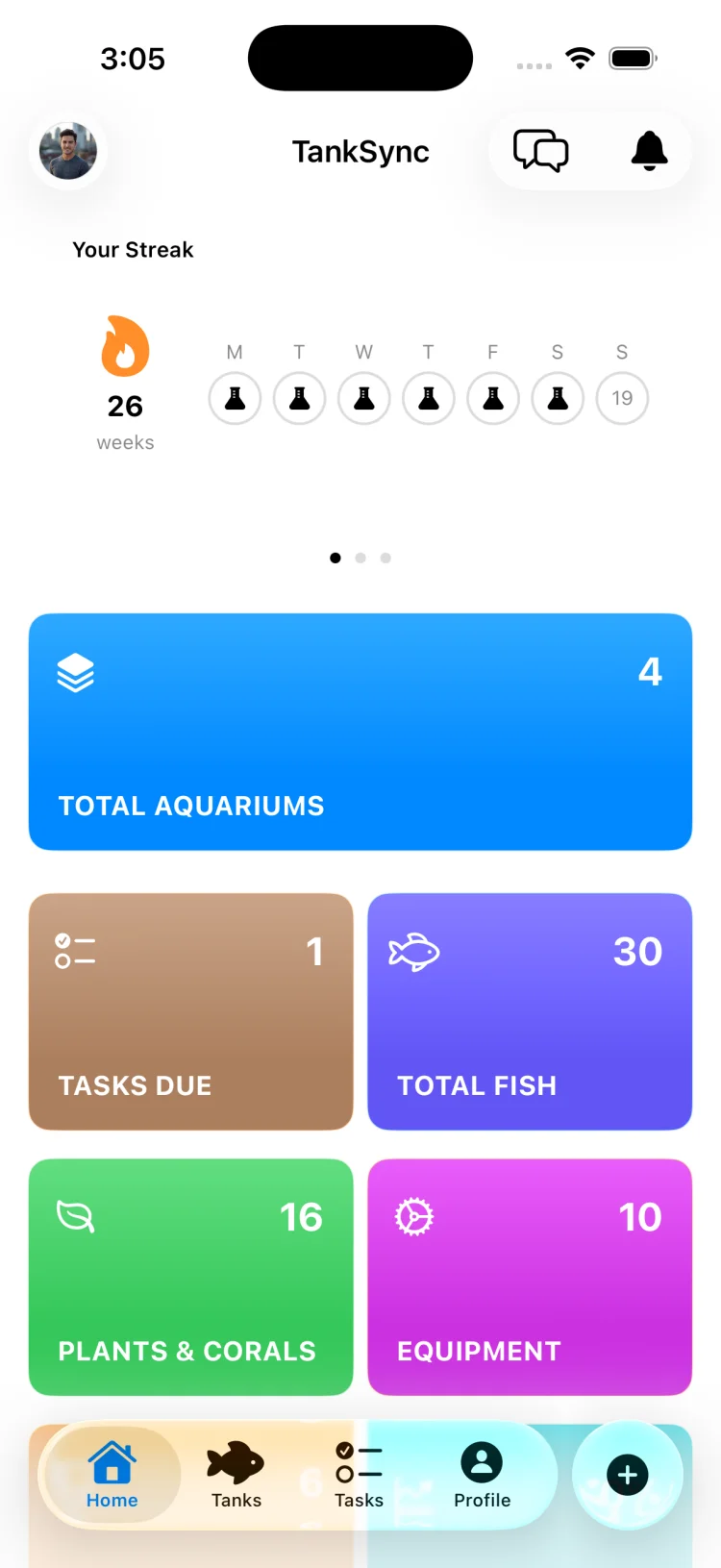
Stocking limits are not abstract theory when the app holds the adult size, bioload category and minimum tank size for every species in its database. TankSync tracks livestock per aquarium, flags stocking level as a component of the tank health score, and warns when you are approaching or exceeding sensible limits for the tank's volume and filtration.
Per-species adult size and minimum tank recommendations
The 857-species database includes adult size and minimum recommended tank size for every entry. When you add a two-inch angelfish to your livestock list, the app knows it will reach six inches and needs at least a 30-gallon tank. The species profile surfaces that information before you buy, not after the fish outgrows the tank.
Stocking level as part of the tank health score
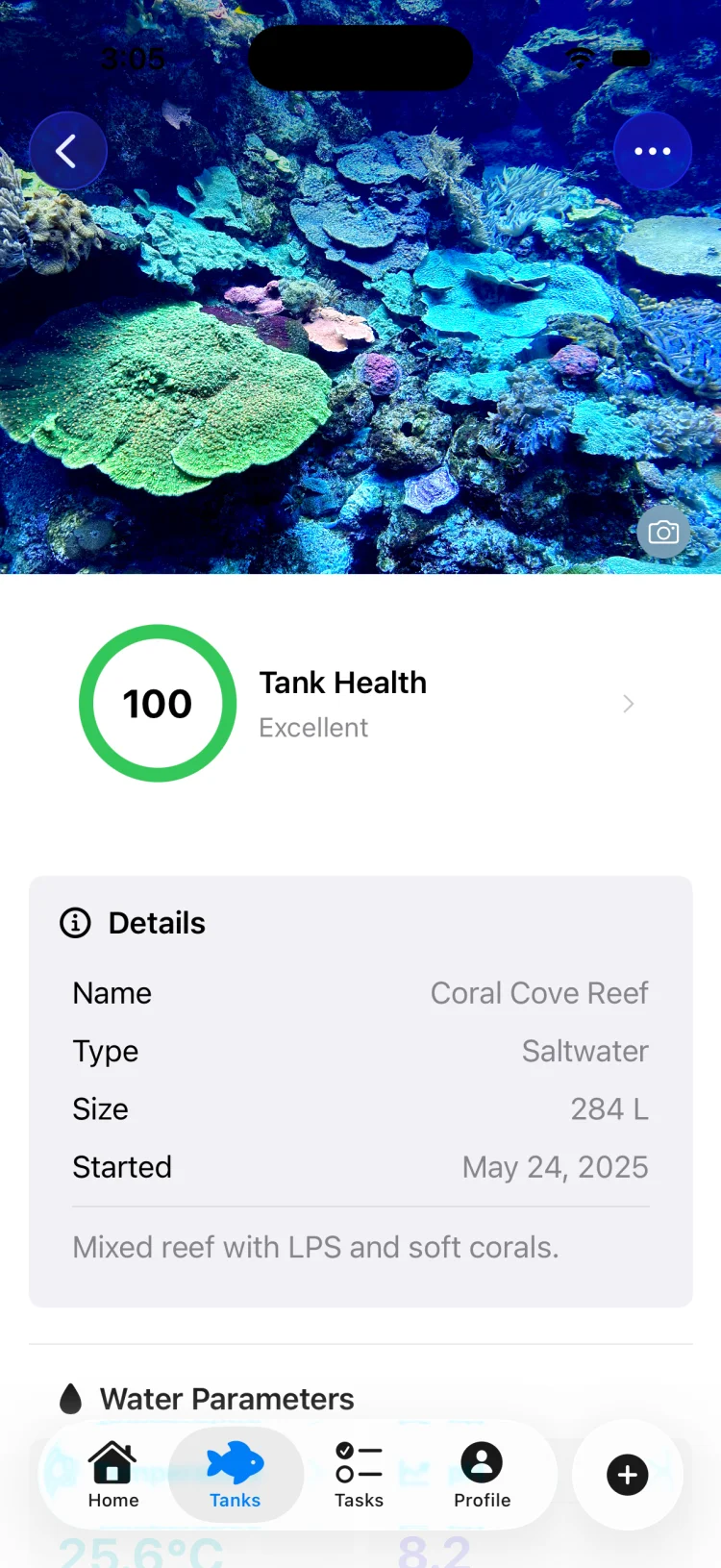
The tank health score weights stocking at 25 percent of the total, alongside water quality, maintenance frequency and cycle stage. An overstocked tank pulls the score down even if water parameters are currently acceptable, because overstocking is a leading indicator of future problems. The score makes bioload visible as a factor rather than something you only notice when nitrate spikes.
Livestock logging per aquarium
You can track which fish, inverts and corals are in which tank, with counts and notes. The livestock list becomes a fact rather than something you try to remember, which matters when deciding whether there is room for another school or whether you are already at capacity. Logging additions and removals over time also builds a record of what worked and what did not.
Tracking livestock in TankSync
Keep a record of what is in each tank so stocking decisions are based on facts, not guesses:
- Add your aquarium with its actual water volume and type (freshwater, saltwater, brackish).
- Add livestock from the species database or create custom entries for anything not listed.
- Log counts for schools and groups so you know whether you are at the minimum or well above it.
- Check the stocking component of the tank health score after adding fish to see whether bioload is climbing into the warning range.
- Use the species profile pages to confirm adult size and minimum tank requirements before you buy.
- For Pro subscribers, use AI compatibility analysis to flag aggression and territory conflicts before adding new species to an existing community.
General guidance, not a prescription
The stocking numbers in this guide are conservative estimates for typical setups. Actual capacity varies with filtration type and size, maintenance frequency, planting density, water source, feeding rate and the specific species kept. A heavily filtered and planted tank with twice-weekly water changes can support higher stocking than the tables suggest. A lightly filtered tank with monthly changes cannot.
TankSync's species data, stocking recommendations and AI features are informational and are not veterinary or professional aquarist advice. Cross-reference any stocking plan against your own test results, your maintenance capacity and the specific requirements of the species you intend to keep. When in doubt, stock lighter and add gradually.
Frequently asked questions
How many fish can I put in a 10 gallon tank?
A 10 gallon tank has room for five to eight small-bodied fish like neon tetras or ember tetras, schooled in groups of six or more. That is the full stock; add nothing else. Most fish sold as beginners are too large: a single fancy goldfish produces more waste than the filter can handle, and a common pleco will outgrow the tank in a year. Tank footprint also limits choice — a 10 gallon is too narrow for fish that need swimming length, and too small for territorial species that require a minimum range. Heavily planted tanks tolerate slightly higher stocking because plants consume ammonia directly.
How many fish can I put in a 20 gallon tank?
A 20 gallon long can hold ten to fifteen small schooling fish, or one or two medium-bodied fish like dwarf cichlids with a school of tetras as dither fish. A 20 gallon high has the same volume but less floor space, so surface-oriented fish and territorial species need lighter stocking. You could run a single pair of German blue rams with a school of eight to ten neon tetras, or fifteen to twenty ember tetras planted heavily. Goldfish still do not fit; two fancy goldfish need at least 30 gallons with powerful filtration.
Is the one inch per gallon rule accurate?
No. It treats a six-inch fish as equivalent to six one-inch fish when the bioload scales with mass, and mass scales with the cube of length. A fish twice as long produces roughly eight times the waste. The rule also ignores body shape — a slender six-inch danio is not the same as a six-inch bodied discus. It says nothing about territory, schooling minimums, swimming space or adult size versus purchase size. The inch-per-gallon rule persists because it is simple, but it is simple in the way that burning books for heat is simple: technically possible, unhelpful, destructive.
How do I know if my tank is overstocked?
Nitrate climbs back above 40 ppm within days of a water change despite regular maintenance. Algae grows faster than you can clean it. Fish hang near the surface in the evening even with good flow and aeration, which signals low oxygen from overcrowding. Aggression becomes constant rather than occasional. Disease keeps returning after treatment, because chronic stress from crowding suppresses immune response. If your maintenance schedule is tight and the water quality still slides, bioload exceeds filtration capacity and the tank is overstocked.
How many fish should I add at a time?
Add three to six small fish, then wait two weeks. The bacterial colony in the filter is sized to your current bioload, so doubling the fish count overnight can spike ammonia even in a fully cycled tank. Test ammonia and nitrite a few days after adding stock; if both read zero, the filter adapted and you can add the next batch. For larger fish, add one or two and wait. This staged stocking gives the bacteria time to grow and lets you catch compatibility problems before the tank is full.
Why can saltwater tanks hold fewer fish?
Marine fish are more sensitive to dissolved waste, and saltwater holds less oxygen than freshwater at the same temperature. Most reef keepers stock at half the bioload of an equivalent freshwater tank, or lighter. Coral tanks are even more restricted because corals export very little nitrogen, so all the waste stays in the water column unless you remove it mechanically or through water changes. A 40 gallon reef might hold four or five small fish where a planted freshwater 40 would hold fifteen.