The conversation around aquarium disease usually starts at the wrong end. Someone sees white spots or frayed fins, searches for the medication to fix it, and discovers there are thirty products with contradictory instructions and half of them do not work. What gets lost is the step that would have prevented the outbreak: stable water, appropriate stocking, and a quarantine tank. The pathogens responsible for most fish deaths are already in your tank. They are on the substrate, in the filter, on the glass. Healthy fish in good conditions keep them in check without you ever knowing they are there.
The short version
Test water first before treating anything. Quarantine every new arrival for four weeks in a separate tank. Treat the specific disease rather than dosing the tank with everything on the shelf. Remove activated carbon and chemical filtration before medicating. Never medicate a display reef — isolate the fish, treat in quarantine, and leave the invertebrates and biological filtration alone.
Why fish get sick in the first place
Disease in aquarium fish is almost always secondary. The immediate cause might be a parasite or a bacterial infection, but the reason the fish became vulnerable is stress. Stress comes from unstable parameters — ammonia spikes, pH swings, temperature fluctuations. It comes from aggression, from being kept with the wrong species or too many of the same species in too small a space. It comes from the shock of transport, from being netted out of one tank and dropped into another with different water chemistry.
Ich, velvet, fin rot, columnaris — the pathogens responsible are endemic. They are in your tank whether you introduced them deliberately or not, hitchhiking on plants, substrate, even in the air. A healthy fish with an intact slime coat and a functioning immune system resists them. A stressed fish with compromised defences does not. This is why the same disease can wipe out a newly set-up tank while an established, well-maintained tank runs for years without an outbreak.
The other common vector is new stock. A fish that looked fine in the shop was sharing water with fifty others, some of which were carrying something. Quarantine intercepts this. Four weeks in isolation is long enough for most diseases to show symptoms while the fish is still separated from your display tank. Skip quarantine and you are gambling that the new fish is clean, the bag water was clean, and the stress of introduction will not trigger a latent infection. Sometimes you win that gamble. Often you do not.
The symptoms worth learning
Identifying disease correctly is most of the work. Treatments are specific, and using the wrong one wastes time, stresses the fish further, and in some cases makes the problem worse. Here are the physical signs that warrant action, in roughly the order you are likely to notice them.
White spots scattered across the body and fins
Small, raised, salt-grain dots are ich in freshwater or marine velvet in saltwater if the spots are finer and more like dust. True ich spots are distinct and three-dimensional. They look like someone sprinkled sugar on the fish. Velvet is more of a gold or rust coating and often appears on the gills before the body. Both are parasites and both are contagious.
Flashing and scratching against objects
Rubbing or darting against substrate, rocks, or glass signals irritation, usually from parasites on the gills or skin. This behaviour often precedes visible spots, so it is the early warning. Occasional flashing can be normal, particularly after a water change. Persistent scratching across multiple fish is not.
Clamped fins held close to the body
Healthy fish hold their fins erect or gently flowing. Clamped fins — folded tight, not spread — indicate stress, illness, or poor water quality. On its own it is non-specific, but combined with other symptoms it confirms something is wrong.
Rapid gill movement or gasping at the surface
Normal respiration is steady and rhythmic. Fast, laboured breathing or fish hanging at the surface gulping air indicates oxygen shortage, gill parasites, ammonia or nitrite poisoning, or velvet attacking the gills. Test oxygen and water parameters first before assuming disease.
Frayed, receding, or discoloured fins
Fin rot presents as white, grey, or red edges on the fins that progressively erode inward. Mild cases look like fraying. Advanced cases show fins reduced to stumps with exposed rays. Left untreated it reaches the body and becomes body rot, which is far harder to reverse.
Cotton-like growths on the body or mouth
White, fluffy patches are usually fungal infections, often secondary to an injury or another disease that broke the slime coat. Columnaris bacteria can also produce a cotton-like appearance, particularly around the mouth, where it is sometimes called mouth fungus even though it is bacterial.
Bloating with raised or pinecone scales
Dropsy is fluid accumulation in the body cavity, causing the fish to swell and the scales to stand out like a pinecone when viewed from above. It is a symptom, not a disease — the underlying cause is usually kidney failure from bacterial infection, poor water quality, or internal parasites. By the time dropsy is visible the prognosis is poor.
Cloudy or protruding eyes
Cloudy eyes or pop-eye — where one or both eyes bulge outward — can indicate bacterial infection, injury, or poor water quality. Bilateral pop-eye affecting both eyes points to environmental causes. Unilateral pop-eye in one eye only suggests trauma or localised infection.
Ulcers, sores, or red patches on the body
Open sores, red streaks, or bloody patches are bacterial infections, often from Aeromonas or Pseudomonas. They appear after injuries, aggressive encounters, or as progression from untreated fin rot. Ammonia burn also causes red patches but tests will show elevated ammonia.
Stringy white or clear faeces
Normal fish waste is brown or dark and sinks. White, stringy faeces that trail behind the fish for long periods indicate internal parasites or bacterial gut infection. It is easy to miss unless you are watching the fish closely during feeding.
Loss of appetite or hiding
Refusing food or spending all day hidden is non-specific but significant. Fish do not stop eating for no reason. Combined with any other symptom it warrants investigation. On its own it suggests stress, bullying, or early-stage illness before physical symptoms appear.
From symptom to likely cause
This table offers starting points, not diagnoses. Many diseases share symptoms, and the same symptom can have completely different causes in freshwater versus saltwater.
| Symptom | Common freshwater cause | Common saltwater cause | First action |
|---|---|---|---|
| White spots, salt-grain size | Ich (Ichthyophthirius) | Marine ich (Cryptocaryon) or velvet | Quarantine, raise temp (FW only), medicate |
| Gold or rust dust coating | Velvet (Oodinium) | Marine velvet (Amyloodinium) | Immediate quarantine, copper treatment (SW) |
| Scratching, flashing | Ich, velvet, flukes, or high ammonia | Velvet, ich, flukes, or parameter issue | Test water parameters first |
| Frayed or receding fins | Fin rot (Pseudomonas, Aeromonas) | Fin rot or aggression injury | Check for aggression, test water, quarantine |
| Cotton-like growths | Fungal infection or columnaris | Fungal infection, rare in SW | Antifungal or antibacterial per appearance |
| Bloating, pinecone scales | Dropsy (bacterial kidney infection) | Dropsy (bacterial infection) | Quarantine, usually irreversible |
| Rapid gill movement | Ammonia, nitrite, velvet, gill flukes | Velvet, brooklynella, ammonia, low O2 | Test ammonia and nitrite immediately |
| Gasping at surface | Low oxygen, nitrite poisoning | Low oxygen, velvet, brooklynella | Increase aeration, test nitrite |
| Stringy white faeces | Internal parasites (hexamita, worms) | Internal parasites | Medicated food or metronidazole |
| Cloudy or pop-eye | Bacterial infection, poor water quality | Bacterial infection, injury | Test water, antibiotics in quarantine |
| Red patches, ulcers | Ammonia burn or bacterial infection | Bacterial infection | Test ammonia first, then treat infection |
| Loss of appetite | Stress, any disease, aggression | Stress, any disease, aggression | Observe for additional symptoms, test water |
The specific diseases you will encounter
What follows is not a treatment manual — medications vary by region, efficacy varies by formulation, and dosing instructions belong on the product itself. The goal here is accurate identification so you know what you are treating. Half the products sold for "general disease" do nothing useful, and most of the remainder are mislabelled or ineffective against the condition the packaging claims to address.
Ich or white spot disease
Freshwater ich is Ichthyophthirius multifiliis, marine ich is Cryptocaryon irritans. Both present as white spots the size of salt grains, often appearing first on the fins before spreading to the body. The parasite burrows under the skin, feeds, then drops off to reproduce in the substrate. Each cyst can release hundreds of free-swimming tomites that reinfect fish within 24 to 48 hours.
Freshwater ich can be treated with raised temperature to 30°C (86°F) combined with aquarium salt in species that tolerate it, or with malachite green and formalin medications. Marine ich does not respond to heat and requires copper sulfate or chelated copper in a quarantine tank over ten to fourteen days. The display tank must be left fallow — without fish — for six to eight weeks to starve out the free-swimming stage.
Velvet (Oodinium in freshwater, Amyloodinium in marine)
Velvet is finer than ich and appears as a gold, rust, or grey dust coating the fish. In bright light it may have a metallic sheen. It attacks the gills first, so rapid breathing and flashing often precede visible spots. Velvet reproduces faster than ich and kills faster — days, not weeks.
Freshwater velvet is treated with copper or malachite green. Marine velvet is one of the most lethal reef diseases and requires immediate copper treatment in quarantine with prolonged exposure, sometimes over three weeks. It is one of the strongest arguments for mandatory quarantine on every new saltwater fish.
Fin rot
Bacterial infection causing progressive erosion of the fins, usually starting at the edges. The bacteria — typically Pseudomonas, Aeromonas, or Flavobacterium — are opportunistic and invade damaged tissue or stressed fish. Mild cases heal on their own once water quality improves. Severe cases need antibiotics in quarantine.
Fin rot is often confused with fin nipping from aggression. The difference is that bacterial rot shows discolouration and a ragged, uneven edge, while nipping leaves clean tears. If you see the fish being chased or bitten, it is aggression. If the fins are deteriorating on a fish that is otherwise unbothered, it is bacterial.
Columnaris
Flavobacterium columnare is a bacterial infection sometimes called cotton mouth, mouth fungus, or saddle-back disease depending on where it appears. It produces white or grey patches that look fuzzy, often around the mouth, gills, or dorsal area. It is not a fungus. It spreads rapidly, can kill within days, and is highly contagious.
Columnaris thrives in warm, poorly maintained water with high organic load. Treatment requires antibiotics and immediate correction of water quality. It is one of the few bacterial diseases where treating the display tank may be justified if the infection is widespread, though you still risk crashing the biological filter.
Fungal infections (Saprolegnia, Achlya)
True fungal infections appear as white, fluffy cotton-like growths, usually on injured tissue, fins, or eggs. They are almost always secondary to another problem — ich lesions, physical injury, or damage from poor water quality. The fungus colonises the break in the slime coat.
Antifungal treatments like methylene blue or malachite green are effective, but the underlying injury must also heal or the fungus returns. Fungal infections are rare in saltwater because marine salinity inhibits most freshwater fungi.
Dropsy
Dropsy is not a disease but a symptom of organ failure, usually kidney failure from bacterial infection. The fish swells, scales protrude outward in a pinecone pattern when viewed from above, and the abdomen becomes distended with fluid. It is almost always fatal. The bacteria involved may be Aeromonas or Mycobacterium, the latter being fish tuberculosis, which is zoonotic.
Treatment success is low. Antibiotics in quarantine occasionally help in very early cases, but most fish with visible dropsy die within days to weeks. Euthanasia is often the most humane option. If multiple fish develop dropsy, investigate water quality and consider mycobacteriosis as a potential cause.
Swim bladder disorder
Fish floating, sinking, swimming sideways, or struggling to maintain position often have swim bladder problems. The cause can be bacterial infection, physical injury, congenital defect, or constipation compressing the bladder. Overfeeding and gulping air are common triggers in fish like goldfish and bettas.
If the fish is otherwise active and eating, try fasting for two to three days, then feed blanched peas to clear the gut. If it is lethargic, not eating, or has other symptoms, suspect infection and treat with antibiotics. Some swim bladder damage is permanent.
Internal parasites
Worms, hexamita, and other internal parasites present as weight loss despite eating, bloating, stringy white faeces, and eventually wasting. Diagnosis is difficult without microscopy, so treatment is often empirical based on symptoms. Medicated food containing metronidazole, praziquantel, or fenbendazole is the standard approach.
Wild-caught fish and feeder fish are the most common vectors. Internal parasites spread slowly compared to external ones, so quarantine usually intercepts them before they reach the display. Some species, particularly cichlids, are prone to hexamita (hole-in-the-head disease) under stress or poor diet.
Brooklynella (clownfish disease)
Brooklynella hostilis is a marine ciliate parasite that attacks the gills and skin, causing rapid breathing, heavy slime production, and lethargy. It progresses fast — 24 to 48 hours from first symptoms to death in untreated fish. Clownfish are particularly susceptible, hence the common name.
Treatment requires formalin baths in a quarantine tank, sometimes multiple times over several days. It does not respond to copper. Brooklynella is one of the diseases that makes quarantine non-negotiable for marine fish — by the time you see it in the display tank it is often too late.
The quarantine protocol that actually works
Quarantine is not complicated, but it is absolute. Every new fish, every time, no exceptions for the ones that looked healthy or came from a "trusted" source. Here is the protocol.
| Stage | Duration | What to watch for | Notes |
|---|---|---|---|
| Arrival and acclimation | Day 1 | Temperature shock, stress, visible injury | Acclimate slowly over 30-60 minutes. Do not add bag water to the tank. Observe for an hour after release. |
| Observation window | Weeks 1-2 | Ich, velvet, fin damage, breathing rate, appetite, behaviour | Feed normally. Test water every few days. Most parasites and stress-triggered diseases appear in this window. |
| Extended observation | Weeks 3-4 | Internal parasites, late-onset bacterial infections, weight loss | Continue feeding and observation. If the fish remains healthy and active the entire period, it is safe to transfer. |
| Prophylactic treatment decision | Optional, Week 2-3 | Decision point whether to medicate prophylactically | Some aquarists treat all new marine fish with copper regardless of symptoms. Freshwater fish are usually observed only unless symptoms appear. |
| Transfer to display | End of Week 4 | Final check before move | If anything appeared during quarantine, treat it and restart the clock from symptom-free. Do not rush this. |
Quarantine is the only prevention that reliably works
A quarantine tank does not need to be elaborate. A bare ten-gallon glass tank, a sponge filter seeded from the display, a heater, and a hiding spot. No substrate, no decoration beyond the hiding spot, nothing that makes medicating difficult or observing the fish harder. The sponge filter should run on the display tank for at least two weeks before you need it so it carries an established bacterial colony.
Cost is not the obstacle people claim. A basic quarantine setup costs less than replacing the fish in a display tank after one disease wipeout, and far less than replacing an entire reef if you dose the wrong medication trying to save one fish. The real cost is time, and the time is non-negotiable if you want the display to stay healthy.
Quarantine also gives you a place to treat sick fish without risking everything else. Medications that are safe in an empty tank — copper, antibiotics, formalin — kill invertebrates and plants in the display. Treating in isolation means you can be aggressive with dosing and duration without collateral damage.
Treating the disease without making everything worse
The majority of treatment failures come from medicating incorrectly rather than choosing the wrong medication. Here is what that means in practice.
Remove activated carbon and chemical filtration before dosing
Carbon, Purigen, and similar media pull medications out of the water within hours. If you medicate without removing them first, you are dosing at a fraction of the intended concentration and wondering why nothing improves. Remove the media, store it wet, and put it back after treatment finishes.
Know what kills biological filtration and what does not
Some medications harm the beneficial bacteria in your filter. Antibiotics, particularly broad-spectrum ones, can crash a cycle. If you must treat with antibiotics in a tank with fish, monitor ammonia and nitrite daily and be prepared to do water changes. This is another reason to treat in quarantine — the bacterial colony in a sponge filter is easier to replace than the one in a fully stocked display.
Know what kills invertebrates
Copper, malachite green, formalin, and most ich medications are toxic to snails, shrimp, crabs, and corals. Never dose a reef tank or a planted freshwater tank with inverts. If the sick fish is in a community with invertebrates, remove the fish to quarantine. There is no medication that is both effective against parasites and safe for all invertebrates.
Do not combine treatments unless the instructions explicitly allow it
Mixing medications can produce toxic interactions or simply deactivate both. Treat one disease at a time with the appropriate medication. If the fish has multiple problems, prioritise the one that will kill it fastest — velvet and brooklynella over fin rot, for instance.
Complete the full treatment course
Parasites have life cycles. Stopping medication as soon as the spots disappear leaves the reproductive stage alive in the substrate, and you get a reinfection within days. Ich, velvet, and most parasites require at least ten to fourteen days of treatment to cover the entire cycle. Follow the duration on the product, not the apparent recovery of the fish.
Raise temperature carefully for freshwater ich only
Heat accelerates the ich life cycle, allowing the medication to reach the free-swimming stage faster, and some strains of freshwater ich are inhibited above 30°C (86°F). This only works in freshwater and only for ich, not velvet, not marine diseases. Not all species tolerate 30°C, so research your fish first. Marine ich does not respond to heat at all.
When the problem is not a disease at all
Many symptoms that look like disease are actually poisoning or injury. Medicating a poisoned fish delays the real fix and often makes it worse.
Ammonia burn
Red streaks on the body and fins, red or bleeding gills, and gasping behaviour in the presence of measurable ammonia are chemical burns. The fix is immediate water changes to bring ammonia below 0.25 ppm and identifying why ammonia spiked — overstocking, overfeeding, a stalled or crashed cycle. Dosing antibiotics will do nothing for ammonia; fixing the water will.
Nitrite poisoning
Brown or purple gills, gasping despite good aeration, and lethargy when nitrite reads above zero are signs of nitrite blocking oxygen transport in the blood. Add aquarium salt at 1 to 3 grams per litre to block nitrite uptake, do water changes to lower the concentration, and address the cycle failure. Cross-link to the new tank syndrome guide if this is happening in a young tank.
Oxygen shortage
Fish at the surface gulping air in warm water or heavily planted tanks at night are suffocating, not diseased. Increase surface agitation, reduce stocking, add an air stone, or lower the temperature. Test dissolved oxygen if you have the kit. Velvet and gill parasites also cause gasping, so distinguish by testing water and looking for other symptoms.
Aggression injuries
Torn fins with clean edges, missing scales, and bite marks are from other fish, not bacteria. Watch the tank during feeding and after lights-out to identify the aggressor. Separate the bully or rehome it. The injuries will heal on their own in clean water unless they become infected, at which point you treat the secondary infection but also fix the stocking.
Old age
Small fish live two to five years, larger fish longer, but everything dies eventually. A fish that has been healthy for years and gradually becomes less active, less interested in food, and eventually dies without clear symptoms may simply be old. Not every death is preventable or explained by water quality or disease.
How TankSync fits into disease prevention
TankSync does not diagnose disease. It is not a veterinary tool and it does not replace testing, observation, or professional advice when an animal is sick. What it does is track the parameters, maintenance, and stocking decisions that determine whether disease takes hold in the first place.
Water quality is 40 percent of the tank health score
The tank health score in TankSync weights water quality at 40 percent because it is the foundation everything else rests on. Ammonia, nitrite, and nitrate outside their safe ranges show up immediately in the score and on the parameter charts. pH, temperature, and salinity trends are visible across day, week, and month windows, so you can see a drift before it becomes a crisis.
Most disease outbreaks follow parameter instability — a heater failure, a pH crash, an ammonia spike from overfeeding. Logging tests consistently means you have the data to identify what changed before the fish got sick, not after.
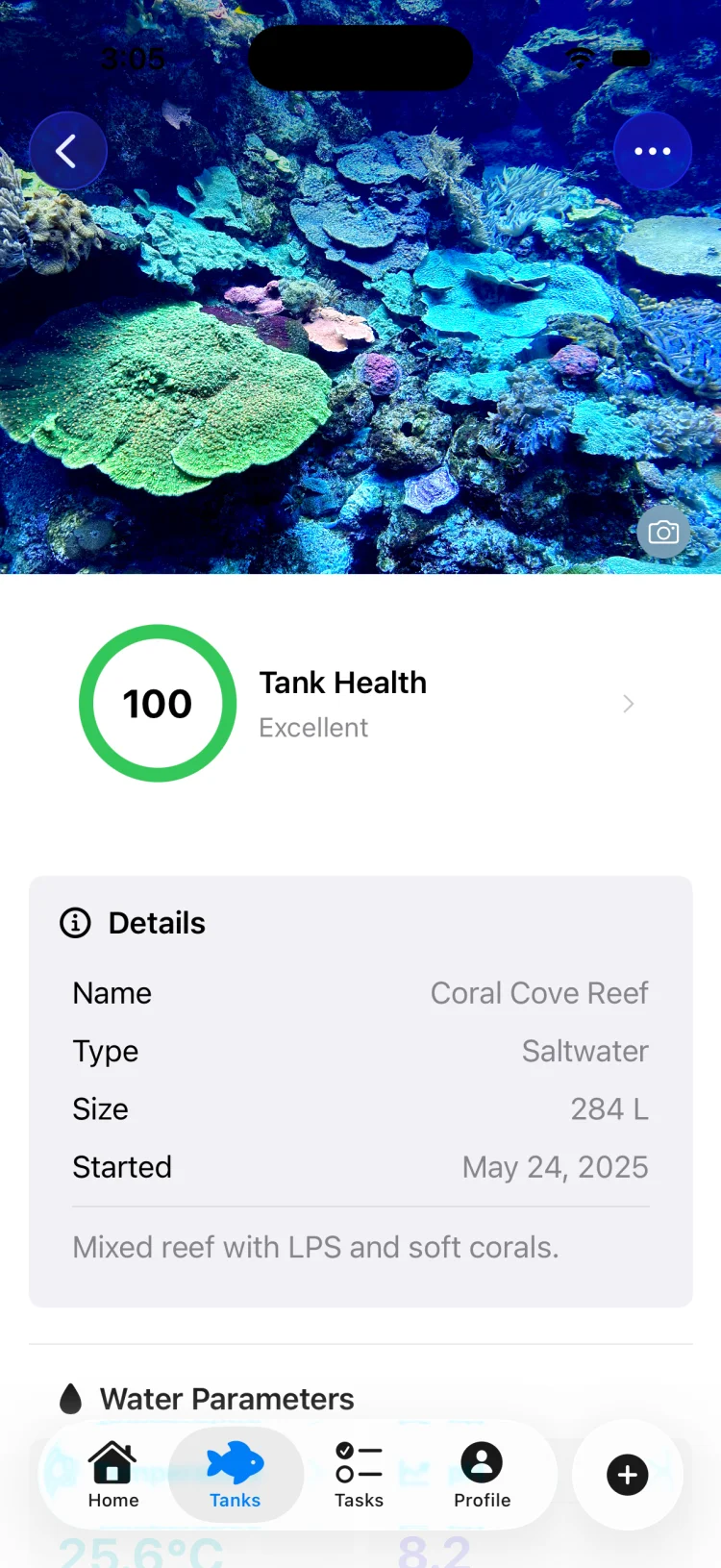
Per-species care data across 857 species
The species database includes temperature range, pH range, hardness, salinity, and aggression level for 173 freshwater fish, 179 saltwater fish, 61 freshwater invertebrates, 126 saltwater invertebrates, 82 corals, and 40 plants. Keeping a species outside its range is stress, and stress is the precursor to disease. The species profile tells you what the range is; the parameter logs tell you whether you are in it.
AI species identification and tank insights as a starting point, not a diagnosis
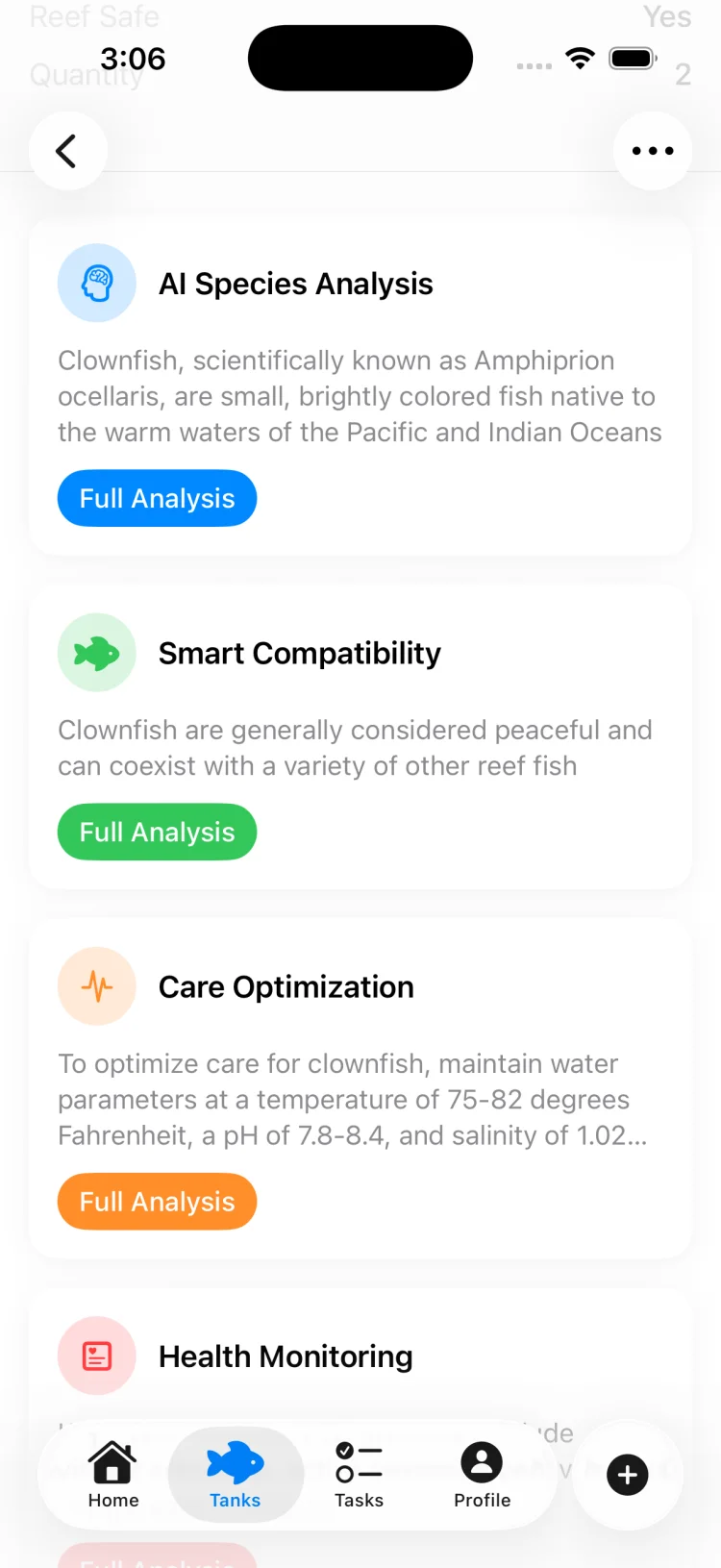
The Pro tier includes photo-based species identification, compatibility analysis, and an AI assistant trained on the species database and general aquarium care. These features are informational. The AI can suggest possible causes for symptoms you describe, but it cannot diagnose ich versus velvet from a description, it cannot dose medications, and it should not be the sole input into a treatment decision.
Use the AI to surface what to research or test next. If it suggests parasites, observe the fish more closely and check for the physical signs listed earlier in this guide. If it suggests parameter issues, test the water. If the fish is visibly sick or dying, consult an aquatic veterinarian, not an app.
Using TankSync to prevent disease outbreaks
Prevention is cheaper and more reliable than treatment. Here is how the app supports it:
- Log water parameters on a consistent schedule — weekly for established tanks, daily for new or sick ones. The trend charts show instability before fish do.
- Add each species to the tank roster with its requirements. The compatibility checker warns about aggression, territory, and parameter mismatches that cause stress.
- Set maintenance reminders for water changes, filter cleaning, and testing schedules. Skipped maintenance is the most common trigger for parameter swings.
- Use the cycling dashboard on new or quarantine tanks to confirm the biological filter is stable before adding more fish.
- Check the tank health score regularly. A sudden drop flags something worth investigating before symptoms appear.
- Use the journal to document treatments, observations, and outcomes so you have a record the next time something goes wrong.
Informational guide, not veterinary advice
This guide is informational and does not constitute veterinary or medical advice. TankSync, including its AI features, species database, and health score, is an informational tool for hobbyists and does not diagnose, treat, or prevent disease. It does not replace professional veterinary consultation.
Medication selection, dosing, and administration should follow product instructions, local regulations, and where appropriate the guidance of an aquatic veterinarian. Some medications are restricted or unavailable in certain regions. Some diseases are not treatable without prescription medications. Some zoonotic diseases, particularly mycobacteriosis, can infect humans through open wounds or contaminated water.
If you have a sick or dying animal, consult an aquatic veterinarian. If you are injured by aquarium equipment or bitten by an animal, seek medical attention. Species requirements, symptoms, and treatments vary. The ranges, protocols, and timelines in this guide are typical but not universal.
Frequently asked questions
What is ich and how do I treat it?
Ich, or white spot disease, is a protozoan parasite that appears as salt-grain dots scattered across the body and fins. Freshwater ich responds to raised temperature and aquarium salt in a bare quarantine tank, but marine ich requires copper-based medication and cannot be heat-treated. The parasite has a life cycle where it falls off the fish to reproduce, so treatment must continue for the full cycle — typically ten to fourteen days — even after spots disappear. Never medicate a display reef tank; copper kills invertebrates and disrupts biological filtration.
Why are my fish scratching against decorations?
Flashing or scratching behaviour usually signals gill or skin irritation from parasites, high ammonia, or nitrite. Ich and velvet both cause intense itching before visible spots appear, so scratching can be the earliest symptom. Test water first — ammonia above 0.25 ppm burns the gills and triggers scratching even with no disease present. If parameters test clean and scratching persists for more than a day or two, isolate the affected fish in a quarantine tank and observe closely for white spots, a gold or rust dust, or rapid gill movement.
What causes fin rot?
Fin rot is a bacterial infection, usually secondary to stress, injury, or poor water quality. Fins develop white or red edges, fray progressively, and in severe cases recede toward the body. The bacteria involved — often Pseudomonas or Aeromonas — are present in most tanks but only become a problem when the fish's immune system is compromised. Fixing water quality stops mild cases on their own. Advanced cases need antibacterial treatment in a quarantine tank, but the underlying cause — aggression, overfeeding, infrequent water changes — must also be addressed or the infection returns.
How long should I quarantine a new fish?
Four weeks is the standard. Most parasites and diseases show symptoms within two weeks, but some, particularly internal parasites and certain bacterial infections, take longer to become visible. Set up the quarantine tank before you buy the fish, not after you notice a problem. A bare ten-gallon tank with a sponge filter, heater, and daily observation is enough. If the fish remains healthy and eating normally for the full period, move it to the display tank. If anything appears — spots, clamped fins, loss of appetite — treat in quarantine and restart the clock.
Can I treat fish in my display tank?
In freshwater-only tanks with no invertebrates and no live plants, limited treatments are possible, but a quarantine tank is always safer. In a reef or planted tank, most medications will kill invertebrates, harm beneficial bacteria, or damage plants. Copper, malachite green, and formalin are all toxic to inverts. Antibiotics can crash the biological filter. Even salt, often considered safe, harms many freshwater plants and soft-water species. Treating the display risks killing everything else in it. Quarantine the sick fish, treat there, and leave the display untouched.
How do I tell a disease from a water quality problem?
Test first, because the symptoms overlap. Ammonia burn looks like red patches or bleeding gills. Nitrite poisoning causes gasping and brown gills. Both mimic disease but have different causes and fixes. If ammonia or nitrite reads above zero, do an immediate water change and address the source — overfeeding, overstocking, or a stalled cycle. If all parameters test within range and symptoms persist, then consider disease. Watch for patterns: sudden symptoms after a water change suggest chlorine or temperature shock, while gradual onset over days points to parasites or infection. Multiple fish affected simultaneously usually indicates environmental problems, not contagious disease.