New tank syndrome follows a script. Week one looks fine. The fish explore the tank, eat normally, and the water stays clear. Around day eight to twelve something shifts. One or two fish start hanging at the surface. Fins clamp. Appetites disappear. Within 24 hours the water turns cloudy white, and by the next morning there is a dead fish stuck to the filter intake. It feels sudden, but the problem was building from the day the first fish went in. The filter simply could not keep up.
The short version
New tank syndrome is ammonia or nitrite poisoning in a filter that is not cycled or not fully cycled. Test ammonia and nitrite immediately. Do a water change large enough to bring both below 0.25 ppm. Stop feeding heavily — half portions once a day or skip feeding for 24 to 48 hours entirely. Do not add more fish. Test daily and repeat water changes whenever readings climb. Wait. The bacterial colony needs one to three weeks to catch up.
What new tank syndrome actually is
It is not a disease. It is not an infection. It is water poisoning caused by the filter's inability to process fish waste at the speed the fish produce it. Fish excrete ammonia constantly. Uneaten food breaks down into ammonia. Dead plant matter becomes ammonia. In an established tank, nitrifying bacteria in the filter convert that ammonia into nitrite and then nitrate fast enough that ammonia never accumulates to dangerous levels. In a new tank, or in a tank stocked faster than the bacteria can multiply, the ammonia climbs unchecked.
Ammonia burns gill tissue, interferes with osmoregulation, and at concentrations above about 0.5 ppm begins causing irreversible damage. Nitrite is just as bad. It binds to haemoglobin and blocks oxygen transport, which is why fish suffering nitrite poisoning gasp at the surface even when the water is well oxygenated. The lack of oxygen is in their blood, not the tank.
The syndrome gets its name because it almost always shows up in tanks less than six weeks old, right around the time someone assumed the cycle was complete when it was not. But it can happen in older tanks too — any time the bacterial colony is knocked back or the bioload jumps beyond what the colony was supporting. See the section on mini cycles for that.
The symptoms, in the order they appear
If you catch it early, most fish survive. If you miss the early signs, they do not. Here is the sequence, in the order you will see it.
Bacterial bloom: cloudy white water
The water goes milky or greyish-white, sometimes overnight. This is heterotrophic bacteria multiplying on dissolved organics. It looks terrible but is harmless to fish and usually clears on its own in three to seven days. The bloom itself is not the syndrome, but it is often the first visible sign that ammonia or nitrite is climbing, because both spikes and blooms are driven by excess waste in a young tank.
Fish at the surface gasping
Fish that normally occupy the middle or bottom start hanging near the top, gulping air. This is especially telling if the tank has surface agitation and no reason for low oxygen. When nitrite is the problem, fish gasp because their blood cannot carry oxygen even though the water is full of it.
Clamped fins and lethargy
Fins that should be spread are held tight against the body. Fish sit still on the bottom or wedge themselves behind decor. They stop reacting to movement outside the tank and ignore food.
Loss of appetite
Fish that were eating well a day ago now refuse food entirely or spit it out immediately. Ammonia and nitrite both suppress appetite because the fish is in physiological distress.
Red or inflamed gills
Lift the gill plate gently — if you can — and the gills may look bright red, swollen, or covered in excess mucus. Ammonia burns the delicate gill filaments, and the tissue responds by inflaming and producing mucus to try to protect itself. By the time gills are visibly damaged, the exposure has been severe.
Sudden deaths
Fish that looked fine yesterday are dead this morning. Often there is no warning. Small fish, young fish, and sensitive species go first. Hardier species may survive longer but with permanent gill damage.
| Symptom | Test first | Likely reading | What it means |
|---|---|---|---|
| Cloudy white water | Ammonia, nitrite | Ammonia 0.25–2 ppm, nitrite 0–0.5 ppm | Bacterial bloom responding to organics; ammonia climbing |
| Gasping at surface | Nitrite, then ammonia | Nitrite 0.5–5 ppm | Blood oxygen transport blocked; nitrite poisoning |
| Clamped fins, lethargy | Ammonia, nitrite | Either above 0.25 ppm | Stress response to toxin exposure |
| Loss of appetite | Ammonia, nitrite | Either above 0.5 ppm | Physiological distress suppressing feeding behaviour |
| Red, inflamed gills | Ammonia | Ammonia 1–4 ppm or prolonged 0.5+ ppm | Chemical burn to gill tissue |
| Sudden death | Ammonia, nitrite | Either above 2 ppm, or moderate levels for days | Acute poisoning or cumulative organ failure |
The emergency response
If you suspect new tank syndrome, act the same day. Waiting to see if it improves on its own costs fish.
1. Test all three nitrogen parameters
Use a liquid test kit to measure ammonia, nitrite and nitrate. If you do not have one, buy one or take a water sample to a shop that tests for free. Test strips are not accurate enough where precision determines whether you need a 30 percent water change or a 70 percent one.
Write down the exact readings. You will need the trend over the next week, and you cannot see a trend in numbers you did not record.
2. Water change sized to the reading
The goal is to bring ammonia and nitrite below 0.25 ppm as quickly as possible without stripping so much water that you remove the small bacterial colony already trying to establish. Match the change to the severity.
- Ammonia or nitrite under 0.5 ppm: 25 to 30 percent
- Ammonia or nitrite 0.5 to 1.0 ppm: 50 percent
- Ammonia or nitrite above 1.0 ppm: 50 to 75 percent
- Ammonia or nitrite above 2.0 ppm: 75 percent, consider a second change six hours later
Use dechlorinated water. Match the temperature to the tank within a degree or two. Large temperature swings stress fish almost as much as the toxins. Pour the new water in slowly — dump it in all at once and you risk shocking already-compromised fish.
3. Stop feeding for 24 to 48 hours
Every meal produces ammonia. Fish tolerate not eating far better than they tolerate poison. Skip all food for one to two days. When you resume, feed half the normal portion once a day until ammonia and nitrite hold at zero for three consecutive days. Then return to the normal schedule.
Remove any uneaten food sitting on the bottom. It is decomposing into more ammonia.
4. Do not clean the filter
The bacteria you are trying to grow live in the filter media, on the surfaces of ceramic rings, sponges and bio-wheels. Rinsing media in tap water kills them. Replacing a cartridge removes them entirely. During new tank syndrome, leave the filter completely alone unless flow has stopped.
If you absolutely must clean it — if debris is blocking flow — rinse the media very gently in a bucket of old tank water, not under the tap.
5. Do not add more fish
The filter cannot support the fish already in the tank. Adding more livestock, even a single snail, increases the waste load and makes the spike worse. No new fish, no inverts, nothing living until the cycle completes and readings stay stable for two weeks.
6. Retest daily and repeat water changes as needed
Test every 24 hours at the same time of day. Any reading above 0.25 ppm for ammonia or nitrite means another water change. Log every result so you can see whether the problem is improving, plateauing or getting worse. A single good reading means nothing. Three consecutive days at zero for both ammonia and nitrite means the colony has caught up and the emergency is over.
Ammonia binders as a stopgap
Products like Seachem Prime or API Ammo-Lock temporarily bind ammonia into a less toxic form. They do not remove it, and most test kits will still register it, so your readings will not drop even though fish are safer. Use an ammonia binder if you cannot do an immediate water change or if toxins remain high despite frequent changes. Do not use it as a substitute for fixing the problem. Water changes and time are the solution. Binders are just a way to keep fish alive while the bacteria grow.
| Reading (ppm) | Water change size | Frequency | Notes |
|---|---|---|---|
| 0.25 | 25–30% | Daily until under 0.25 | Early intervention; most fish tolerate this briefly |
| 0.5 | 50% | Daily, sometimes twice daily | Moderate toxicity; stress visible but reversible |
| 1.0 | 50–75% | Immediately, then daily | High toxicity; gill damage likely if prolonged |
| 2.0+ | 75%, repeat after 6h if still high | Twice daily until under 1.0 | Severe; deaths probable without aggressive intervention |
The mistakes that make it worse
Good intentions wreck more tanks during new tank syndrome than neglect does. Here are the interventions that feel helpful but set you back.
Replacing filter media or cartridges
The bacteria live in the media. Replacing a cartridge because it looks dirty removes the very colony you are trying to establish. If your filter uses disposable cartridges, cut a slit in the old one and slide it over the new one so bacteria can transfer. Better, replace cartridge filters with sponge or ceramic media that lasts years.
Deep-cleaning the gravel
Substrate holds a meaningful portion of the bacterial colony, especially in undergravel or low-flow systems. Pulling all the gravel out and scrubbing it under the tap kills that colony. Light siphoning of visible waste is fine. Sterilising the entire substrate is not.
Adding more fish to "test" the water
Some people hear the tank is not cycled and decide to add a hardier fish to see if it survives. This makes no sense. The filter is already overwhelmed. More fish means more waste, which drives ammonia even higher. The hardy fish dies too, or survives with permanent damage.
Dosing multiple chemicals at once
Ammonia binder, pH adjuster, stress coat, bacterial supplement, water clarifier — the impulse is to throw the entire shelf at the problem. Most of these do nothing useful, some actively interfere with the test kit, and the combination can stress fish more than doing nothing. Pick one thing if you must intervene chemically — an ammonia binder — and otherwise rely on water changes.
Rinsing media in tap water
Chlorine and chloramine kill nitrifying bacteria within seconds. If you must rinse filter media, do it in a bucket of old tank water siphoned out during a water change. Never under the tap, even briefly.
Medicating a water quality problem
Fish gasping, clamped fins and lethargy look like disease symptoms. People dose antibiotics or antifungals without testing the water first. If the cause is ammonia poisoning, the medication does nothing except add more stress and potentially kill beneficial bacteria. Test first. Medicate only if water quality is confirmed safe and symptoms persist.
Mini cycles in established tanks
New tank syndrome is not limited to new tanks. Established systems can spike ammonia or nitrite if something disrupts the bacterial colony or suddenly increases the bioload beyond what the colony was supporting.
Common triggers
- Replacing all filter media at once. This is the most common cause. People assume cartridges need monthly replacement because the packaging says so. Replace them all and the colony is gone. Stagger replacements, or switch to reusable media.
- A big fish addition. Adding ten new fish to a tank that had five doubles the waste overnight. The colony needs one to two weeks to scale up. Until then, you get a mini cycle.
- A dead fish decomposing out of sight. A fish dies behind a rock or in dense planting and is not found for a week. The decomposing body dumps a huge ammonia load all at once.
- Antibiotics or anti-parasitic medications. Some medications kill nitrifying bacteria along with the pathogen. The packaging rarely warns you. A medicated tank can crash mid-treatment and require daily water changes to keep ammonia and nitrite in check.
- Power outage lasting more than six hours. The bacteria need oxygenated water flowing through the media. If the filter stops for half a day, portions of the colony die. When power returns, ammonia can spike until the colony rebuilds.
- Overcleaning during maintenance. Scrubbing every surface, replacing substrate, rinsing all media and doing a 90 percent water change in one session can strip enough bacteria to trigger a mini cycle even in a five-year-old tank.
Recognising a mini cycle
It looks the same as new tank syndrome: fish showing stress, cloudy water, ammonia or nitrite registering on a test when they have read zero for months. The difference is you know the tank was stable, so the spike tells you something specific changed recently. Trace it back. What was different in the last week? New fish, filter maintenance, medication, a big water change? That is your cause.
Treatment
Identical to new tank syndrome. Test daily, water change to keep ammonia and nitrite under 0.25 ppm, do not add livestock, do not clean the filter again, and wait. A mini cycle in an established tank usually resolves faster than a full cycle — one to two weeks instead of four to six — because some portion of the bacterial colony survived and is regrowing from a higher baseline.
How long it lasts and when it is over
With daily testing, appropriately sized water changes and no new stressors added, expect one to three weeks before ammonia and nitrite both hold at zero without intervention. If the tank was completely uncycled when fish were added, it can take four to six weeks. Seeded media, bottled bacteria or higher temperatures can shorten it. Cold water, low pH, overstocking or continuing to add fish will stretch it longer.
You know it is over when both ammonia and nitrite test at zero for three consecutive days and you have not done a water change in that window. A single zero reading can be timing — you tested right after a water change, or right before the next spike. Three days at zero means the filter is processing waste faster than it is being produced. That is a cycled tank.
At that point, go back to the cycling guide and run the 24-hour confirmation test if you want to be certain. Dose ammonia to 2 ppm, wait 24 hours, and test again. If ammonia and nitrite are both zero and nitrate has risen, the cycle is complete. If not, wait another week and try again.
How TankSync fits into managing new tank syndrome
The hardest part of dealing with new tank syndrome is not the water changes. It is maintaining a clear record of what the water is doing across ten or fourteen days when each individual test looks almost identical to the last. TankSync turns those individual readings into a trend you can see.
Logging ammonia and nitrite against safe ranges
Ammonia, nitrite and nitrate are tracked on a single screen with each parameter's safe range drawn in. You can see at a glance which values are in the red and which are safe. Test results go straight onto a trend chart so you can see whether yesterday's 1.0 ppm ammonia is climbing, holding or falling. That pattern tells you if your intervention is working or if you need to increase water change frequency.
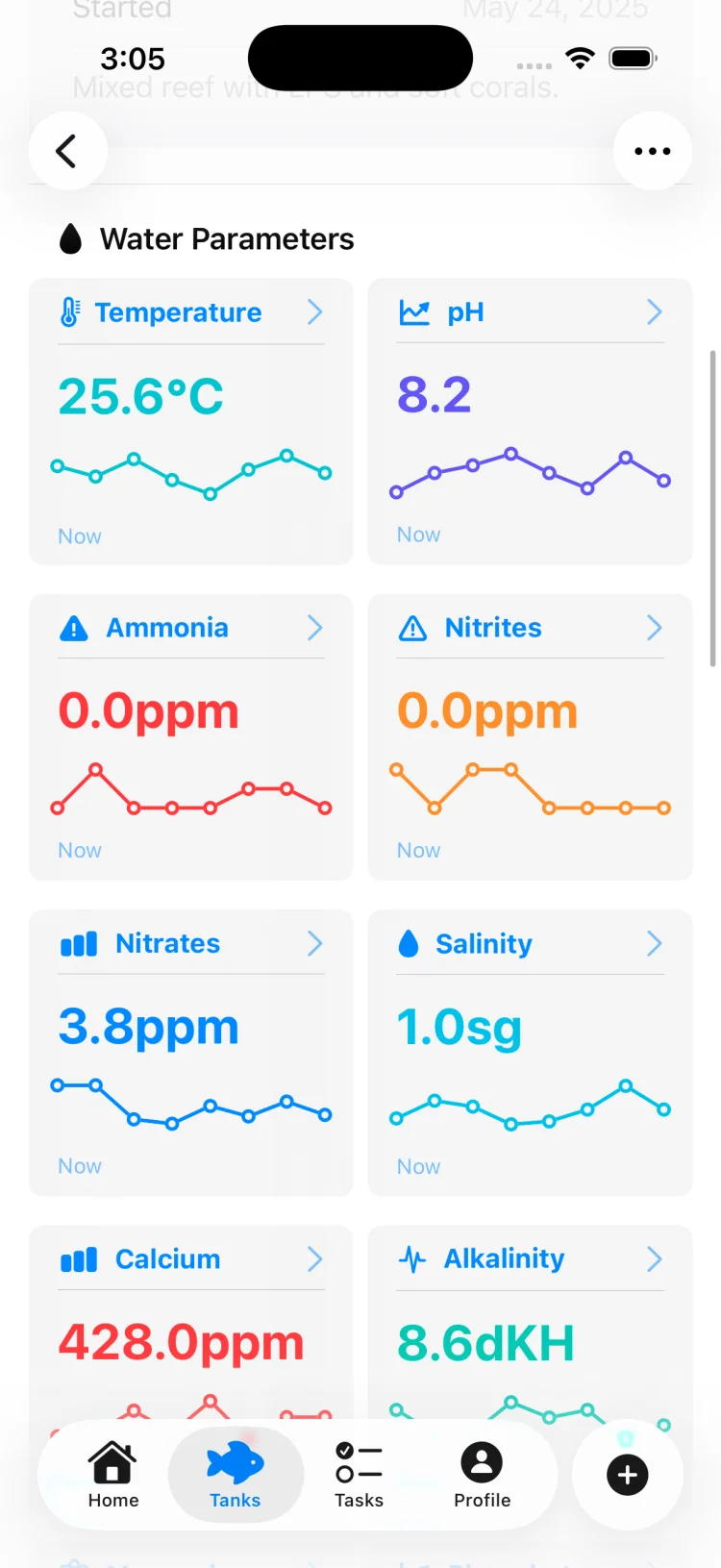
Trend charts making spikes visible before fish react
Ammonia and nitrite charts show the last day, week or month on a line graph with the safe band shaded. A spike building over three days is obvious on a chart where it might be missed if you are just reading today's number in isolation. Catching a 0.5 ppm reading on day two instead of waiting until it hits 2.0 ppm on day five saves fish.
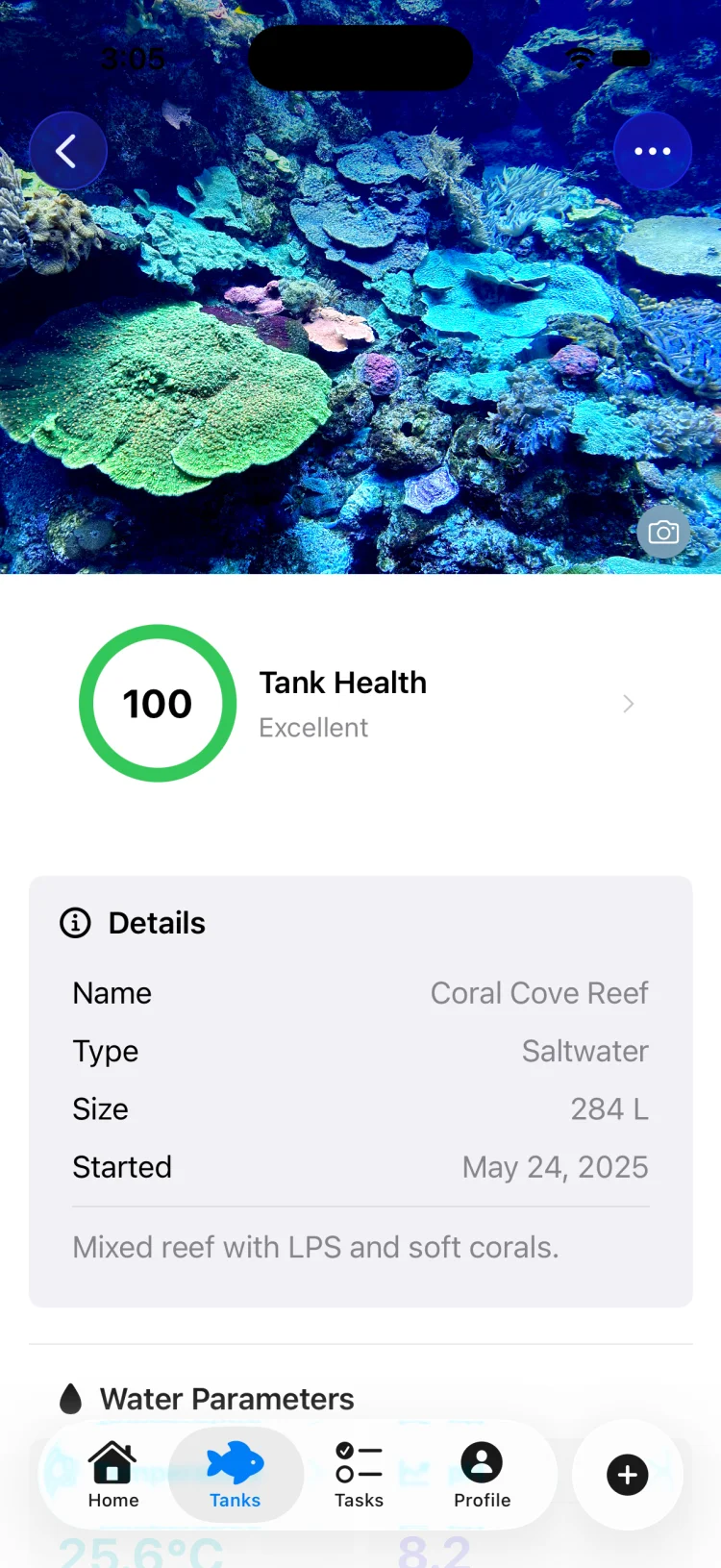
Tank health score drops when water quality degrades
The health score algorithm weights water quality at 40 percent of the total score. If ammonia or nitrite climbs into the unsafe range, the score drops and the app flags it. You do not have to remember to test — the score dropping is the reminder that something is wrong and testing is overdue.
The cycling dashboard
If you are cycling with fish in the tank — which you should not do, but many people already have — the cycling dashboard tracks the same stages as a fishless cycle and marks progress toward completion. It detects the ammonia spike, the nitrite spike and eventual completion automatically from your logged test results. You can see where you are rather than guessing whether the numbers you are seeing mean the cycle is halfway done or has stalled.
Tracking new tank syndrome in TankSync
Set up daily test logging the moment you suspect a spike, and the app builds the record automatically:
- Add your aquarium with its volume and water type. The safe ranges for ammonia, nitrite and nitrate are set automatically.
- Log the first emergency test result immediately — ammonia, nitrite and nitrate together.
- Turn on daily test reminders for ammonia and nitrite so you do not forget during the critical window.
- After each water change, log the post-change reading so you can see how much the change brought levels down.
- Check the trend charts daily. If the line is flat or climbing, increase water change size or frequency.
- When ammonia and nitrite both hold at zero for three days, the crisis is over. Run the 24-hour confirmation test from the cycling dashboard to verify the cycle is complete.
Preventing new tank syndrome before it starts
The fix is mechanical and reliable, but the far better approach is to never trigger it in the first place.
- Cycle the tank before adding fish. A fishless cycle using ammonia or fish food takes four to eight weeks and produces a filter that can support a full bioload from day one. See the cycling guide for the process.
- Stock slowly even after cycling. Add a few fish, wait two weeks, test, add a few more. The bacterial colony scales to the waste it receives, and a sudden bioload jump can outrun even an established filter. The stocking guide covers how to calculate appropriate numbers.
- Seed new filters with media from an established tank. A sponge or handful of ceramic media from a healthy, cycled filter carries viable bacteria and can reduce cycling time to one to two weeks. Most local fish shops will give you a squeeze of sponge if you ask.
- Do not replace all filter media at once. Stagger cartridge changes, replacing half at a time with at least two weeks between swaps. Better, convert to reusable media that you rinse in old tank water rather than replace.
- Test before and after any major change. New fish, filter maintenance, medication courses, large water changes — test ammonia and nitrite 24 hours after any intervention that could affect the cycle. Catch a mini cycle at 0.25 ppm instead of 2.0 ppm.
General guidance, not a prescription
The readings and timelines in this guide are typical for most community aquariums, not universal. Toxicity thresholds vary with pH, temperature and species sensitivity. Some fish tolerate 0.5 ppm ammonia for days; others show stress at 0.1 ppm. The target of keeping ammonia and nitrite below 0.25 ppm is conservative and safe for the majority of commonly kept species.
TankSync's water quality tracking, health scoring and species data are informational tools, not veterinary or medical advice. Water quality emergencies affecting fish health should be verified with your own test kit and, where fish show severe distress or illness, assessed by an aquatic veterinarian. Trend data and safe ranges in the app are guidelines derived from established aquarium literature and user-reported species tolerances, not prescriptive treatment protocols.
Frequently asked questions
What is new tank syndrome?
New tank syndrome is ammonia or nitrite poisoning caused by a biological filter that cannot yet process the waste produced by the fish in the tank. It happens when livestock is added before the filter has developed a large enough colony of nitrifying bacteria. The ammonia produced by fish waste climbs unchecked, or is converted to nitrite faster than the second bacterial stage can process it. Both toxins cause gill damage, suppress the immune system and frequently kill fish outright. It is not a disease. It is a water quality crisis with a predictable cause and a mechanical fix.
How do I fix an ammonia spike fast?
Test to confirm the ammonia level, then do a water change sized to the reading. For ammonia between 0.25 and 0.5 ppm, change 25 to 30 percent. For 0.5 to 1.0 ppm, change 50 percent. Above 1.0 ppm, change 50 to 75 percent. Use dechlorinated water matched to the tank temperature. Stop feeding for 24 to 48 hours to reduce new waste. Retest daily and repeat water changes whenever ammonia climbs back above 0.25 ppm. An ammonia spike cannot be fixed in one day — the bacterial colony needs time to grow, and that takes a week or more.
Why is my new aquarium water cloudy?
Cloudy white or grey water in a new tank is usually a bacterial bloom. Heterotrophic bacteria multiply rapidly on dissolved organics in the water column, turning it milky. It looks alarming but is harmless to fish and typically clears on its own within three to seven days as the nutrient spike is consumed. A bloom often coincides with the early stages of new tank syndrome because both are driven by excess organics, but the cloudiness itself is not the problem. Do not treat it with clarifiers or UV. Test for ammonia and nitrite instead, and address those if they are elevated.
How long does new tank syndrome last?
With daily testing, appropriately sized water changes and no new fish added, symptoms usually resolve in one to three weeks as the bacterial colony catches up to the bioload. If fish were added to a completely uncycled tank, expect closer to four to six weeks before the filter is stable. The timeline depends on how far into the cycle the tank was when fish arrived, how heavily it was stocked, temperature, and whether seeded media or a bacterial starter was used. New tank syndrome is over when ammonia and nitrite both read zero consistently for at least three consecutive days without intervention.
Can an established tank get new tank syndrome?
Yes, and it is called a mini cycle. An established tank can spike ammonia or nitrite if the bacterial colony is suddenly reduced or the bioload is suddenly increased beyond what the colony can handle. Common causes include replacing all filter media at once, deep-cleaning the substrate, adding a large number of new fish, an unnoticed dead fish decomposing behind decor, or a medication that kills nitrifying bacteria. The fix is the same: test daily, water change to keep toxins under 0.25 ppm, stop adding livestock, and wait for the colony to rebuild.
Should I use an ammonia detoxifier?
Ammonia binders such as products containing sodium hydroxymethanesulfonate can temporarily convert free ammonia into a less toxic form, buying you time between water changes. They do not remove ammonia or substitute for fixing the underlying problem. Use them as a stopgap if you cannot do an immediate water change or if readings remain dangerously high despite frequent changes, but do not rely on them as the primary treatment. Most test kits still register bound ammonia as ammonia, so your readings will not drop even though toxicity has been reduced. Water changes and time are the actual solution.