Most aquarium advice tells you to do regular water changes without explaining why, and without being specific about what "regular" means. The result is people doing 50 percent changes once a month, or 10 percent changes every day, or nothing for three months followed by a 90 percent rescue mission that shocks every fish in the tank. The water change is not complicated, but doing it wrong — in volume, frequency or preparation — is responsible for more unexplained deaths than any disease.
The short version
Change 10 to 25 percent of the water weekly. Match the temperature to within a degree or two. Treat tap water with dechlorinator. Siphon from the substrate to remove settled waste. Refill slowly. For saltwater, mix new water 12 to 24 hours in advance and match the salinity to within 0.001. Consistency matters more than volume — a small change every week is safer and more effective than a large change once a month.
What a water change is actually for
The biological filter converts ammonia to nitrite, and nitrite to nitrate, but it does not make nitrate disappear. In a tank without fast-growing plants or specialised denitrifying media, nitrate accumulates indefinitely. Water changes export it. Nitrate itself is not acutely toxic at the levels most tanks reach, but chronic exposure above 40 ppm in freshwater or above 20 ppm in saltwater suppresses the immune system, stunts growth, and shortens lifespan.
Nitrate is the headline, but not the whole story. Dissolved organics — the tannins, proteins, hormones and breakdown products of everything that has ever decayed in the tank — also accumulate. They do not show up on most test kits, but they yellow the water, lower pH over time in soft-water tanks, and eventually reach concentrations that stress fish in ways you cannot measure directly. Water changes dilute whatever you cannot test for.
In saltwater, water changes also replenish calcium, alkalinity, magnesium and trace elements consumed by corals and coralline algae. A reef tank running on water changes alone instead of dosing or a calcium reactor needs more frequent changes — often 20 to 30 percent twice weekly — to maintain stable chemistry.
The water change is the simplest tool you have for resetting the tank toward clean, stable conditions. Nothing else you do has the same reach.
How much and how often
The standard advice is 10 to 25 percent weekly, and it is standard for a reason: it keeps nitrate from climbing without shocking the tank through sudden chemistry or temperature swings. A 20 percent change exports one fifth of the nitrate and dissolved organics. Do it weekly and the accumulation never runs away from you.
The mistake is waiting too long and then compensating with a very large change. A tank left for six weeks will have high nitrate, pH drift in soft water, and possibly a build-up of dissolved organics that has shifted the chemistry substantially from tap water. Changing 80 percent of that water returns the parameters to tap values instantly, and the fish that have been acclimating to the drift for weeks now experience whiplash. This is "old tank syndrome" — not the age of the tank itself, but the shock of correcting months of neglect in a single session.
Small, regular changes prevent the drift. The fish never experience a large swing because nothing ever drifts far enough to create one.
Why not just change more water to be safe?
Because the larger the change, the more critical the match becomes. A 10 percent change with tap water half a degree cooler than the tank is barely noticeable. A 60 percent change with the same temperature difference is a cold shock. The same applies to pH, hardness and salinity. Frequency lets you change less per session, which gives you more margin for error in matching.
Change size by situation
Not every tank runs on the same schedule. Bioload, filtration, stocking density, whether the tank is planted, and whether it is freshwater or reef all affect what "regular" means.
| Situation | Recommended % | Frequency | Notes |
|---|---|---|---|
| Healthy freshwater community | 15–25% | Weekly | Standard baseline for moderate stocking |
| Heavily stocked freshwater | 20–30% | Twice weekly | Nitrate climbs faster, needs more frequent export |
| Planted tank, low bioload | 10–15% | Every 10–14 days | Plants consume nitrate; less frequent changes acceptable if nitrate stays under 20 ppm |
| Saltwater fish-only | 15–25% | Weekly | Similar to freshwater; nitrate tolerance is lower |
| Reef tank | 20–30% | Weekly to twice weekly | Replenishes trace elements; keeps nitrate and phosphate near zero |
| Quarantine or hospital tank | 25–50% | Daily to every other day | Removes medication breakdown products and waste from stressed fish |
| Neglected tank recovery | 25% initially, then 15–20% | Every 2–3 days for two weeks, then weekly | Gradual correction avoids pH or temperature shock; do not attempt 80% rescue changes |
| During fishless cycling | 0% unless nitrite inhibits cycle | N/A | Water changes dilute the ammonia and nitrite the bacteria need; avoid unless stalled |
The equipment worth owning
A siphon is not optional. Pouring out water from the top leaves all the settled waste on the substrate, which defeats half the purpose. A gravel vacuum — a siphon with a wide rigid tube on the intake end — lets you lift debris from between the gravel or sand as the water drains. Size it to the tank: a 5 cm diameter tube works for tanks over 200 litres, a 2.5 cm tube works for anything under 100 litres.
Buckets dedicated to the tank prevent contamination from soap, detergent or whatever the bucket was used for last week. Mark the volume on the inside so you know exactly how much water you are removing and replacing. For large tanks a Python-style hose system that connects to a tap and refills directly saves the back-and-forth with buckets, but you lose the ability to pre-mix and temperature-match the replacement water unless you have a mixing station.
A second thermometer for measuring the temperature of the replacement water before it goes in is cheap insurance. Trusting your hand is how fish get cold-shocked.
For saltwater, a refractometer for measuring salinity is more accurate and faster than a hydrometer. Calibrate it with RO or distilled water — tap water will throw the zero point off.
Step by step
The procedure is the same every week, which is the point. Consistency in method produces consistency in results.
1. Turn off heater and pumps if the water line will drop below them
A heater running in air will overheat and crack when you refill with cool water. A pump or powerhead intake above the water line will suck air, and air in some pump designs destroys the impeller. If your change is small enough that the equipment stays submerged, leave it running. If not, turn it off.
2. Siphon and vacuum the substrate in sections
Start the siphon into a bucket, then push the gravel vacuum tube into the substrate and lift it slightly to fluidise the top layer. Debris floats up and gets siphoned out; gravel falls back down. Work through one quarter to one third of the substrate area, not the whole bed. Vacuuming everything every week strips out the beneficial bacteria living in the substrate, and it is unnecessary — waste settles unevenly, mostly where the fish congregate.
Rotate which section you vacuum each week so the whole bed gets covered over the course of a month. Stop when you have removed the target volume — 10 to 25 percent of the tank's total. Measure this by bucket count, not by eyeballing the water line.
3. Prepare replacement water
Fill buckets with tap water and bring it to within a degree or two of the tank temperature. Letting it sit for an hour in the same room usually gets it close. Add dechlorinator at the dose recommended on the bottle — do not halve it to save money, chloramine in particular needs the full dose to neutralise.
For saltwater, this step happens the day before. Mix RO or DI water with salt to the target specific gravity — 1.025 to 1.026 for most reef tanks, 1.020 to 1.023 for fish-only systems — and run a powerhead or airstone in the mixing container for 12 to 24 hours. Salt takes time to dissolve completely, and the mixing process generates heat, so the temperature and salinity both need time to stabilise. Test with the refractometer before you use it.
4. Refill slowly
Pour replacement water slowly to avoid blasting substrate into the water column or hitting fish with a jet of cold water. If you are using a hose, drape it over the edge and let it run at a trickle, or aim it at a rock or the glass to diffuse the flow. For saltwater, never add dry salt directly to the tank — it will not dissolve evenly, and concentrated brine settling on a coral will burn tissue.
5. Restart equipment
Turn the heater and pumps back on once the water line is back above them. Check that the filter is flowing, the heater light is on, and nothing is making a grinding noise from having ingested air.
6. Test parameters after the change
Log nitrate, pH, temperature and salinity if applicable. The point is to confirm the replacement water matched the tank and the change had the effect you expected. If nitrate went from 40 ppm to 30 ppm after a 25 percent change, the math checks out. If it went from 40 to 38, either you did not change as much as you thought or nitrate is climbing faster than you are exporting it.
7. Log the water change
Record the date, the volume changed, and any observations — water clarity, fish behaviour, anything unusual. Three months from now, when you are trying to diagnose a algae bloom or a pH crash, this log is the difference between knowing what changed and guessing.
Saltwater differences
The mechanical steps are the same, but the chemistry is less forgiving. Salinity, calcium, alkalinity and magnesium all need to match within tighter tolerances than anything in freshwater.
Mix salt in advance
Salt does not dissolve instantly, and the dissolution process releases heat. New saltwater mixed and used immediately will read a different salinity an hour later when it cools, and the temperature of the water going into the tank will not match the tank. Mix it the night before, circulate it with a powerhead, and let it come to room temperature. Test salinity and temperature right before you add it, not when you mixed it.
Never add salt to the tank
Always mix to the target salinity in a separate container and add mixed saltwater. Adding dry salt to the tank means concentrated brine sinking through the water column and onto whatever is below it. On sand or rock it is mostly harmless. On coral tissue it is a chemical burn.
Top off evaporation with fresh water, not saltwater
Water evaporates. Salt does not. If you top off evaporation with more saltwater, salinity climbs. Top off with RO or DI fresh water to replace only what evaporated, then do your normal water change with full-salinity water to export waste. This is one of the most common mistakes in new reef tanks — salinity creeping up over weeks because every top-off was done with mixed saltwater.
Match salinity to within 0.001
Fish and corals tolerate slow salinity changes but not fast ones. A difference of 0.003 specific gravity is enough to stress sensitive species if it happens in the space of a water change. Measure the tank and the replacement water with the same refractometer, at the same temperature, and get them within 0.001 before you pour.
RO/DI water matters
Tap water contains phosphate, silicate and heavy metals that will not harm fish but will fuel algae, precipitate out of solution in high-pH saltwater, and interfere with coral calcification. Most successful reef tanks use reverse osmosis or deionised water for all mixing and top-off. Freshwater tanks usually tolerate treated tap water; saltwater generally does not.
Common mistakes and how to avoid them
Most water-change disasters are not random bad luck. They follow predictable patterns.
| Mistake | What happens | Do this instead |
|---|---|---|
| Using untreated tap water | Chlorine or chloramine kills fish and beneficial bacteria, sometimes within hours | Add dechlorinator to every drop of tap water that enters the tank, including top-offs |
| Temperature mismatch of more than a few degrees | Fish go into shock, breathing rate spikes, immune system suppressed for days afterward | Measure replacement water temperature with a thermometer, not your hand; bring it to within 1–2°C of the tank |
| Changing 90% at once on a neglected tank | pH and hardness snap back to tap values, shocking fish acclimated to the drifted chemistry | Do 25% every two to three days for two weeks to bring chemistry back gradually |
| Vacuuming the whole substrate every week | Strips beneficial bacteria from the substrate, reducing biological filtration capacity | Vacuum one quarter to one third of the bed per session, rotating zones weekly |
| Rinsing filter media in the same session | Temporarily reduces biological filtration, causing a small ammonia or nitrite spike | Rinse filter media on alternate weeks from the water change, not the same day |
| Topping off saltwater evaporation with more saltwater | Salinity creeps upward over weeks as salt concentration increases | Top off evaporation with fresh RO or DI water only; replace volume and export waste with full-salinity water during changes |
How TankSync fits into the routine
Water changes are recurring maintenance, and tracking them matters more than most people assume. A log of what was changed and when becomes critical when something goes wrong weeks later and you need to know whether the schedule slipped or the volume was inconsistent.
Water changes as scheduled tasks
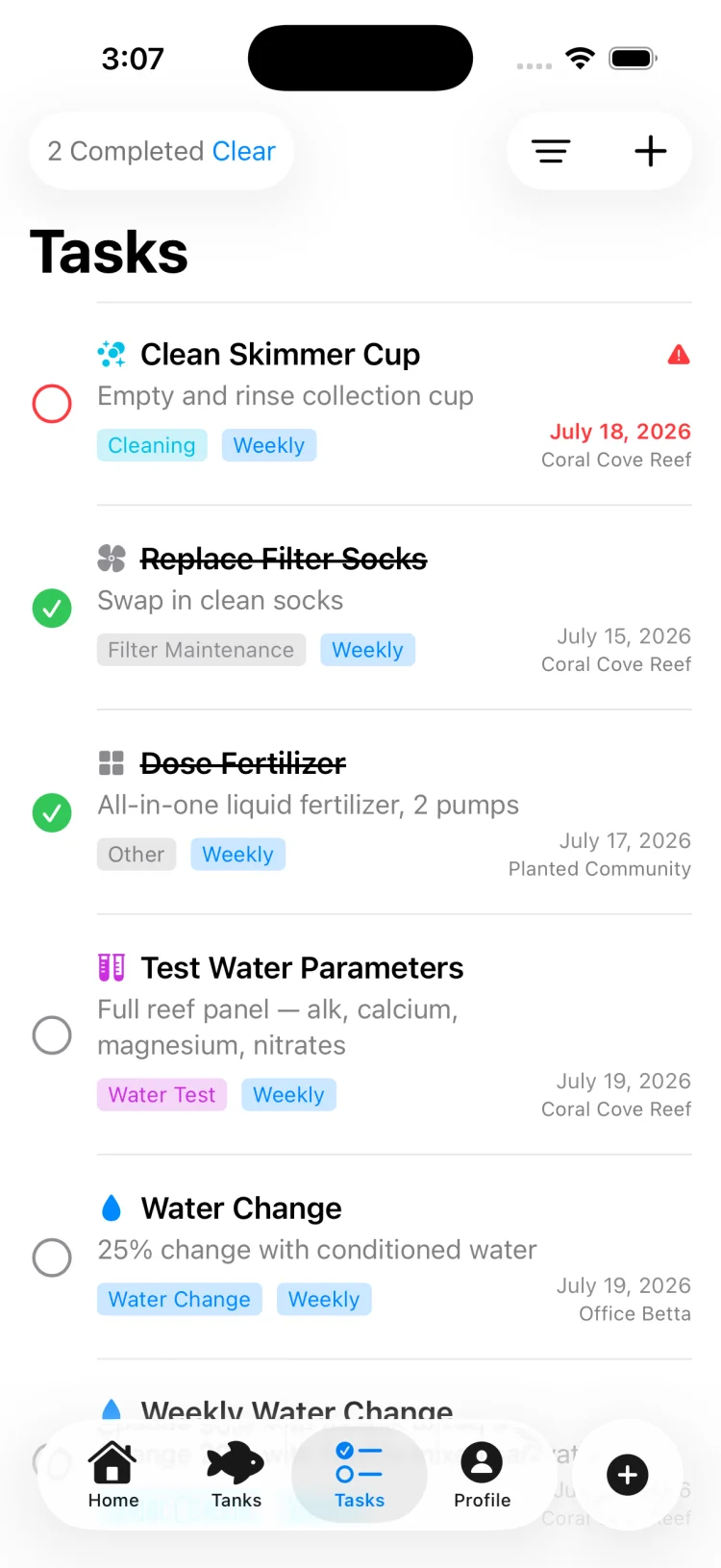
TankSync treats water changes as recurring maintenance tasks with due dates. Set the interval — weekly, every ten days, twice weekly — and the task appears in the maintenance list when it is due. Completing it logs the date and resets the timer. Miss it and the overdue counter starts, which becomes visible immediately in the tank health score since maintenance accounts for 20 percent of the total.
Logging parameters before and after
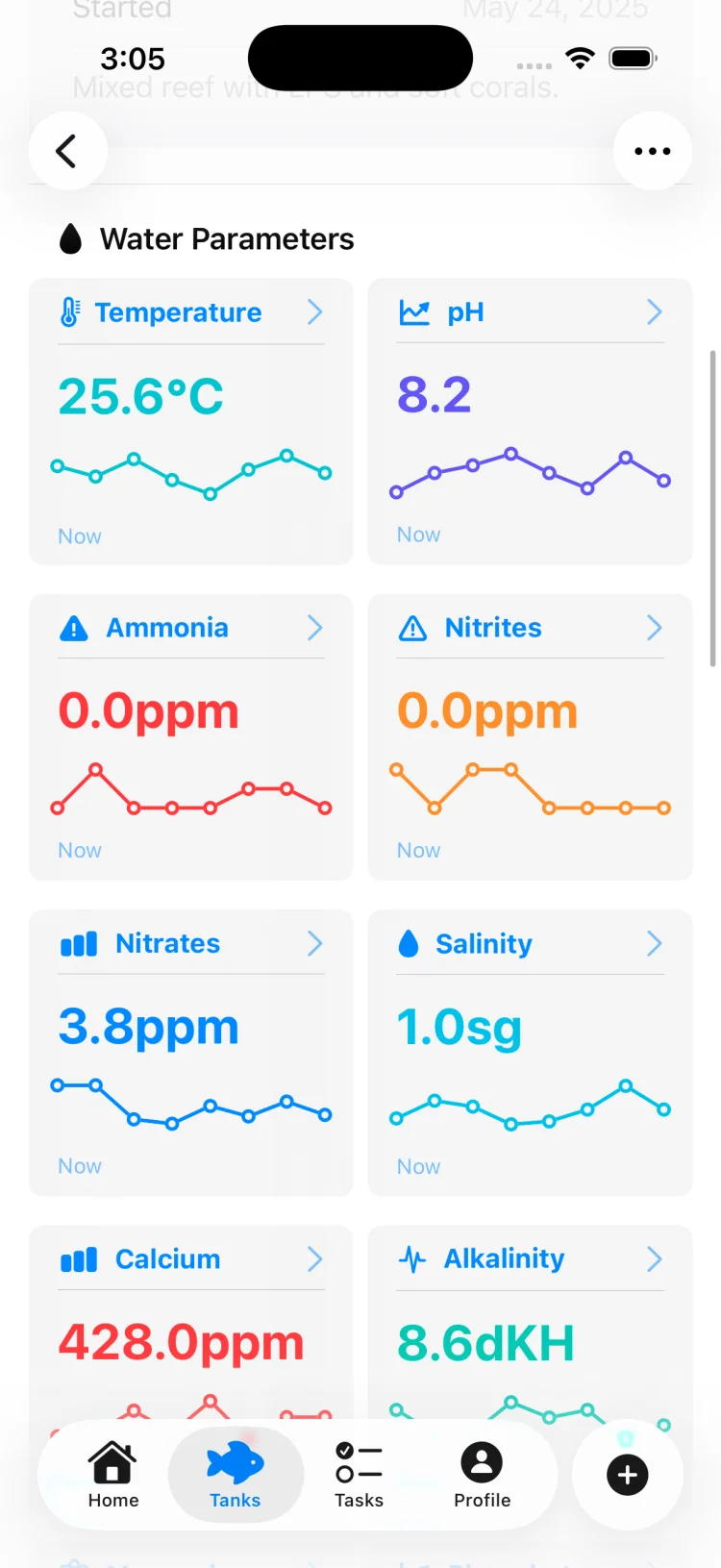
The parameter grid in TankSync logs temperature, pH, nitrate and salinity before and after the change, so you can see the effect in the same view. If a 20 percent change is only dropping nitrate by 10 percent, that tells you nitrate is climbing faster than you thought and the interval may need shortening. If pH is drifting lower every week despite regular changes, that points to a buffering problem the water changes are not addressing.
Tracking the trend over months turns water changes from a chore you do on autopilot into a diagnostic tool.
Maintenance contributes to the health score
The tank health score in TankSync weights maintenance at 20 percent of the total, behind water quality at 40 percent and stocking at 25 percent. A missed water change reduces the score visibly, and a pattern of missed changes compounds. The score does not tell you to do a water change — you already know that — but it makes the cost of skipping one visible in a way that a mental note to "do it next week" does not.
Tracking water changes in TankSync
Set it up once and the routine builds itself:
- Add a recurring water change task with the interval you have chosen — weekly, every ten days, or twice weekly.
- Before you start, log the current temperature, pH, nitrate and salinity from your test kit.
- Do the water change as described above.
- Test again after refilling and log the new readings.
- Mark the maintenance task complete. The due date resets automatically.
- Add a journal entry if anything was unusual — cloudy water, fish hiding, equipment problems.
- Check the trend charts weekly to confirm nitrate is staying under control and pH is not drifting.
General guidance, not a prescription
The volumes and intervals in this guide are starting points, not fixed rules. The ideal water change schedule depends on tank size, bioload, filtration, whether the tank is planted, and the species being kept. A heavily stocked reef tank and a lightly planted freshwater tank will not run on the same routine.
TankSync's reference content, including parameter ranges and maintenance recommendations, is informational and is not veterinary or professional aquaculture advice. Test your own water, observe your own fish, and adjust the routine to what the numbers and behaviour tell you. When in doubt or when an animal is unwell, consult an aquatic veterinarian.
Frequently asked questions
How much water should I change in my aquarium?
Ten to twenty-five percent weekly is the standard recommendation for most freshwater and saltwater community tanks. Heavily stocked systems, reef tanks with sensitive corals, or quarantine tanks may benefit from 20 to 30 percent twice weekly. Planted tanks with low bioload can often run on 15 percent every ten days. The goal is to export enough waste to keep nitrate under control without causing a chemistry or temperature swing large enough to stress the inhabitants. Consistency matters more than volume.
How often should I do a water change?
Weekly is the baseline for most tanks. Small, heavily stocked or reef systems benefit from twice weekly. Lightly stocked planted tanks may stretch to every ten to fourteen days if nitrate stays low. The interval you choose should keep nitrate below about 20 ppm in freshwater and under 10 ppm in most reef systems, and should never be so long that a single change requires removing more than about 30 percent at once. Regularity prevents the chemistry drift that leads to old tank syndrome.
Do I need to remove the fish during a water change?
No. Routine water changes of 10 to 25 percent do not require removing fish, and netting them out causes far more stress than leaving them in during the change. The exception is if you are doing a rescue change of 50 percent or more on a neglected tank where the pH has drifted significantly — in that case the swing can be large enough that acclimating the fish back into their own tank becomes necessary. For normal maintenance, leave them in and work around them.
Can I use tap water for a water change?
Yes, if it is treated with a dechlorinator that neutralises both chlorine and chloramine. Most municipal tap water contains one or both, and both will kill fish and beneficial bacteria if added untreated. Well water may be safe if it contains no chlorine and no heavy metals, but test it first. Saltwater systems often require reverse osmosis or deionised water because tap water minerals interfere with reef chemistry, particularly calcium, alkalinity and phosphate. Freshwater planted tanks usually tolerate treated tap water without issue.
How do I do a water change on a saltwater tank?
Siphon out 10 to 25 percent of the water as you would in freshwater. Mix replacement saltwater to the target salinity — typically 1.025 to 1.026 specific gravity for reef, slightly lower for fish-only — using reverse osmosis or deionised water and a quality salt mix. Mix it 12 to 24 hours in advance with a powerhead or airstone so the salt fully dissolves and the temperature stabilises. Match the salinity to within 0.001 of the tank reading and the temperature to within a degree. Refill slowly. Never add dry salt directly to the tank, and top off evaporation with fresh RO or DI water, not saltwater.
Will a big water change crash my cycle?
No, if the bacteria are in the filter and substrate where they belong. The nitrifying bacteria live in biofilm on surfaces, not free-floating in the water column, so removing 50 or even 80 percent of the water does not remove the biological filtration. What can shock a tank is the chemistry or temperature swing that comes with a very large change after weeks of neglect. If the pH or temperature of the replacement water differs substantially from what the tank has drifted to, the fish experience whiplash even though the water itself is cleaner. This is why small, regular changes are safer than infrequent large ones.