Most aquarium maintenance guides describe what ought to happen. This one describes what actually does happen in tanks that stay healthy for years. The difference is not complexity — the tasks themselves are simple — it is consistency. A tank maintained adequately every single week will outlast one maintained heroically every third week. The problem is that heroic maintenance feels more thorough, and adequate maintenance feels like you are getting away with something.
You are not. The filter bacteria, the fish immune systems, the algae balance, all of it adapts to the schedule you keep, not the one you wrote down. A pattern you can hold for six months beats a better pattern you will abandon in six weeks.
The short version
Daily: sixty-second visual check of head count, behaviour, temperature and equipment. Weekly: 10 to 25 percent water change, glass wipe, parameter test, top off evaporation with fresh water. Monthly: rinse filter media in old tank water, clean impeller, inspect tubing, replace chemical media if used, check heater calibration. Quarterly: consider heater replacement, inspect pump rebuild needs, deep substrate work if needed, replace RO membrane, check test kit expiry. Write it down or it does not happen.
Why a schedule beats vigilance
The invisible-drift argument. You look at the tank every day, so you assume you would notice when something changes. What actually happens is adaptation. The fish lose a bit of colour over two weeks and you do not see it because you saw them yesterday and they looked like they look today. Algae grows a millimetre a day and after a month the glass is opaque but you cannot recall the exact day it stopped being clear.
Parameters shift the same way. Nitrate does not go from 10 to 80 ppm overnight. It climbs a few ppm a week, and if you are not testing on a schedule you never see the trend, only the emergency at the end of it. The solution is not better vigilance, it is removing vigilance from the equation. Test on the same day every week whether the tank looks fine or not. Change water on a calendar, not a feeling.
Small consistent work compounds differently than periodic rescue missions. Fifteen minutes weekly for a year is 13 hours of maintenance spread so thin the tank never swings. Two hours every six weeks whenever things look bad is the same 13 hours concentrated into events the tank has to recover from. The hobbyists with 20-year-old systems are not doing more work. They are doing less work more consistently and catching drift before it becomes a crisis.
Daily: the sixty-second check
This is the only task that genuinely needs to happen every day, and it is not maintenance in the scrubbing sense. It is a walk-by inspection. Stop in front of the tank, count the fish, watch them respond to your presence. If something is sick, hiding, or dead, this is when you notice.
Check feeding behaviour. Healthy fish come to the front when you approach because they have learned you mean food. A fish that used to be first to the glass and now stays in the back corner is telling you something before any test will.
Glance at the thermometer. Temperature crashes and spikes happen because heaters stick on, stick off, or fall off their mounts into the substrate. You will not catch it with weekly checks. You catch it by knowing the tank sits at 25°C every morning and noticing the day it reads 30°C.
Listen to the equipment. Filters, air pumps and powerheads make a consistent ambient hum. When the noise changes, something is coming loose, clogging, or failing. A rattling impeller gives you a week's warning. A silent filter gives you none.
Check the surface. An oily film means insufficient surface agitation or overfeeding. Foam means protein buildup, which in freshwater tanks usually means overstocking or a dead animal decomposing somewhere. Both are easier to fix on day two than day ten.
Weekly maintenance
Pick one day. Sunday morning, Wednesday evening, it does not matter, but it needs to be the same slot every week. Tanks tolerate routine better than they tolerate optimisation.
Water change: 10 to 25 percent
This is the single most important task on the whole schedule. Remove 10 to 25 percent of the tank volume with a gravel vacuum, siphoning waste from the substrate as you go. Replace with dechlorinated water matched to the tank's temperature. Saltwater tanks get replacement water mixed to the same salinity; evaporation is topped off separately with fresh RO water, not saltwater, because evaporation leaves the salt behind.
The percentage depends on stocking density and feeding rate. Lightly stocked planted tanks can stretch to 10 percent. Heavily stocked or overfed tanks need 25 or more. If you are doing 50 percent weekly, the tank is overstocked or something died and has not been found yet.
The water change guide has the mechanics. The point here is the schedule: same day, same percentage, every single week. Skipping one week is not a disaster. Skipping becomes a pattern, and the pattern is what crashes tanks.
Clean the glass
Wipe the inside glass with an algae pad or magnet cleaner during the water change session. Algae film is cosmetic at this stage. Left for three weeks it becomes a scraping job, and scraping risks scratching acrylic or stirring enough detritus to cloud the water. Weekly is easier than monthly.
Test the core parameters
At minimum, test ammonia, nitrite, nitrate and pH. Established tanks should read zero ammonia, zero nitrite, under 40 ppm nitrate for most fish. Any detectable ammonia or nitrite in a cycled tank means something has broken — a dead animal, a filter failure, an overfeed, a medication that killed the bacteria. You want to know about it the week it happens, not the week after half the stock is dead.
Reef tanks add calcium, alkalinity and magnesium to the weekly test list. The reef parameters guide has the targets. Freshwater planted tanks often track phosphate and sometimes iron if dosing fertilisers.
Log the readings. The number today means little. The trend across eight weeks means everything. This is covered in the parameters guide, but the short version is: write it down or you are just making the water change colour.
Top off evaporation
Freshwater tanks lose a few litres a week to evaporation depending on surface area, temperature and airflow. Top off with dechlorinated fresh water. Saltwater and brackish tanks top off with RO or distilled water, never saltwater, because the salt does not evaporate and adding more salt to replace lost water volume will push salinity up over time.
Check the heater against a second thermometer
Most tank thermometers are stuck to the glass in one corner. The heater might be in the opposite corner or inside the filter. Put a second thermometer near the heater once a month and compare the readings. A discrepancy of more than 1°C means water is not circulating well, or the heater thermostat is drifting and needs replacement.
Monthly equipment service
This is where equipment failures get caught early instead of discovered as emergencies. The tasks take thirty minutes once every four weeks.
Rinse filter media in old tank water
Pull the mechanical and biological media — sponges, ceramic rings, bio-balls — and rinse them in a bucket of old tank water siphoned out during a water change. The goal is to clear accumulated debris, not to sterilise the media. The brown biofilm on the surface is beneficial bacteria. Leave it there.
Never rinse filter media under the tap. Chlorine and chloramine will kill the bacterial colony and crash the cycle. Never replace biological media unless it is physically disintegrating. Sponges and ceramics last years.
Clean the impeller and impeller housing
Shut off the filter, remove the impeller, and rinse it under the tap. Calcium deposits, algae and detritus build up on the impeller blades and shaft, increasing friction and reducing flow. A neglected impeller will seize or overheat the motor.
Check the impeller shaft for wear. If it wobbles or the ceramic pin is chipped, replace the impeller before it fails. Most filter manufacturers sell impeller assemblies separately and they are cheaper than a new filter.
Inspect tubing and airline
Rigid tubing becomes brittle with age and UV exposure. Flexible tubing kinks, cracks or grows algae inside if it is clear. Airline tubing perishes and leaks. Check every connection for cracks, stiffness or visible algae growth. Replace any section that looks questionable. Tubing is cheap. Floods are not.
Replace chemical media on schedule
Activated carbon exhausts in four to eight weeks depending on the bioload and what it is removing. Phosphate removers and nitrate-absorbing resins last a similar interval. If you are running chemical media, mark the install date on the bag with a permanent marker and swap it out on the schedule the manufacturer recommends.
Biological and mechanical media stay in the filter for years. Chemical media has a service life and then it is done. Leaving exhausted carbon or resin in the filter does nothing helpful and can leach absorbed compounds back into the water if it degrades.
Service the hood and lights
Condensation, salt creep and dust accumulate on the underside of hoods and light fixtures. Wipe them down monthly. Corroded electrical contacts and water ingress into light housings both start as minor cosmetic issues and end as shorts or failures. Clean it when it is still cosmetic.
LED fixtures do not need bulb replacement, but they do accumulate algae and salt on the diodes, which reduces output. Fluorescent and metal halide bulbs lose spectrum over time even when they still produce visible light. Replace fluorescent bulbs every 12 months, metal halide every 9 to 12 months, regardless of whether they appear dim.
Calibrate salinity measurement
Hydrometers drift. Refractometers need calibration against RO water or a calibration solution. Check your instrument against a reference standard monthly. An uncalibrated refractometer reading 1.025 might be measuring 1.020, and the discrepancy kills inverts and stresses fish while you assume everything is fine.
Quarterly and annual tasks
These are the tasks easy to forget because they happen infrequently and the tank does not immediately punish you for skipping them. That is exactly why they need to be written into the schedule with specific dates.
Evaluate heater replacement
Heaters should be replaced every two to three years as a matter of policy, not because they have failed. Thermostats drift. A heater stuck on will boil the tank overnight. A heater stuck off will let a tropical tank drop to room temperature, and by the time you notice the fish are lethargic and diseased. If the heater is over three years old, replace it before winter when failure has the worst consequences.
Consider pump rebuild or replacement
Powerheads, circulation pumps and return pumps wear out. Impeller shafts develop play, seals perish, magnets weaken. Many pumps have rebuild kits with new impellers, shafts and seals for a third the cost of a new pump. Check the manufacturer's service interval recommendation — it is usually 12 to 24 months for continuously running pumps.
Deep substrate work
Gravel and sand beds compact over time, trapping detritus in anaerobic pockets that produce hydrogen sulfide. Once or twice a year, use a deep gravel vacuum to turn over the substrate and break up compacted areas. Planted tanks with nutrient-rich substrates may skip this if the plant roots are doing the aerating work.
Replace reverse osmosis membrane and resin
RO membranes last 12 to 36 months depending on source water quality and throughput. Deionisation resin exhausts faster, often every 6 to 12 months. Monitor TDS on the output. When it starts creeping up from near-zero, the membrane or resin is done. Continuing to use exhausted filtration defeats the point of using RO water at all.
Check test kit expiry dates
Liquid test reagents degrade over time, especially once opened. Most kits have a 12-month usable life after the bottle is opened, and accuracy falls off after that. Using an expired nitrate test is worse than not testing, because you will dose or change water based on a number that is wrong and you have no reason to doubt it. Mark the purchase date on the box and replace annually.
The full maintenance schedule
Here is every task in one table, with frequency and notes for freshwater versus saltwater setups.
| Task | Frequency | Freshwater notes | Saltwater / Reef notes |
|---|---|---|---|
| Visual check | Daily | Head count, behaviour, temperature | Same, plus check skimmer output |
| Water change | Weekly | 10–25%, gravel vac, match temp | 10–25%, match salinity and temp |
| Glass cleaning | Weekly | Algae pad or magnet cleaner | Same, coralline may need scraper |
| Test parameters | Weekly | Ammonia, nitrite, nitrate, pH | Add calcium, alk, mag, salinity |
| Top off evaporation | Weekly or as needed | Dechlorinated tap or RO | RO or distilled only, not saltwater |
| Filter media rinse | Monthly | Old tank water, not tap | Same |
| Impeller cleaning | Monthly | Remove calcium and debris | Same, salt creep more aggressive |
| Tubing and airline inspection | Monthly | Check for cracks, kinks, algae | Same, replace sooner in high salt |
| Chemical media replacement | Monthly or per product | Carbon, Purigen, nitrate removers | Carbon, GFO, nitrate/phosphate media |
| Light fixture cleaning | Monthly | Wipe condensation and dust | Same, clean salt off diodes/bulbs |
| Heater calibration check | Monthly | Compare to second thermometer | Same |
| Salinity calibration | Monthly | N/A | Refractometer against RO or standard |
| Protein skimmer cleaning | Weekly to monthly | N/A | Empty cup weekly, deep clean monthly |
| Deep substrate work | Quarterly to biannual | Turn over gravel to release pockets | Sand beds need gentle turning |
| Heater replacement evaluation | Every 2–3 years | Replace before it fails | Same |
| Pump rebuild or replacement | Every 1–2 years | Check for rebuild kits | Same, more frequent in reef systems |
| RO membrane replacement | Every 1–3 years | If using RO | Essential, monitor TDS output |
| DI resin replacement | Every 6–12 months | If using RO/DI | Essential for reef, watch TDS |
| Test kit expiry check | Annually | Replace opened kits after 12 months | Same, reef kits degrade faster |
Equipment servicing and replacement intervals
TankSync tracks eight equipment types because these are the ones with service and replacement schedules worth logging. Here is what those intervals typically look like.
| Equipment type | Service interval | Typical replacement interval |
|---|---|---|
| Filter | Monthly: rinse media, clean impeller | Media: years. Motor/housing: 5–10 years |
| Heater | Monthly: calibration check | 2–3 years, regardless of function |
| Light | Monthly: clean fixture, check spectrum | LEDs: 5+ years. Fluorescent bulbs: 12 months. MH bulbs: 9–12 months |
| Pump (circulation/return) | Monthly: impeller clean | Rebuild kit: 12–24 months. Full replacement: 3–5 years |
| Protein skimmer | Weekly: cup clean. Monthly: full clean | 5–10 years, replace impeller as needed |
| UV steriliser | Quarterly: clean quartz sleeve | UV bulb: 6–12 months. Unit: 5+ years |
| CO2 system | Monthly: check pressure, bubble rate | Solenoid/regulator: 3–5 years. Diffuser: 1–2 years |
| Air pump | Monthly: check diaphragm, airflow | Diaphragm kit: 12–24 months. Pump: 3–5 years |
These are the equipment types worth tracking because they have moving parts, wear out, or directly affect water quality. Decorative items, nets, thermometers and algae scrapers are tools, not equipment on a service schedule.
The eight kinds of maintenance task
Not all maintenance is the same work. Breaking tasks into categories makes it easier to spot what you are neglecting. TankSync uses eight categories, described here generically as the ones that cover almost everything worth doing.
1. Water change
Partial water changes, full water changes, emergency dilution changes after an ammonia spike. This is its own category because it is the highest-impact task and the one most often delayed.
2. Filter service
Media rinsing, impeller cleaning, replacing cartridges or chemical media, intake cleaning. If it involves the filter and is not an equipment repair, it goes here.
3. Equipment service
Heater checks, light fixture cleaning, pump maintenance, air pump diaphragm replacement, CO2 system pressure checks, protein skimmer cup emptying. Anything that keeps a device functioning.
4. Cleaning
Glass, substrate vacuuming, decoration scrubbing, algae removal. Cosmetic work that also removes nutrient sources.
5. Testing
Parameter tests logged for trend tracking. One-off tests to diagnose a problem can go here or under general depending on whether you want them in the testing history.
6. Dosing
Adding calcium, alkalinity buffer, magnesium, trace elements, fertilisers, medications. Reef tanks generate a lot of dosing entries. Freshwater planted tanks have fewer but they still matter for the nutrient record.
7. Feeding-related
Cleaning automatic feeders, replacing food that has gone stale, adjusting feeding amounts. Feeding itself is not maintenance, but the tasks around feeding are.
8. General / Other
Anything that does not fit the other seven. Replacing airline tubing, recalibrating instruments, re-sealing a leaking overflow, moving rockwork. The catch-all.
Why categorising matters: if you log 30 maintenance entries over three months and none of them are filter service, your filter has not been serviced in three months. The category breakdown makes neglect visible before it becomes a failure.
Scaling the schedule to the tank
The baseline schedule above assumes a mid-sized tank, moderate stocking, standard equipment, and a goal of stability with minimum fuss. Real tanks vary. Here is how to adjust.
Nano tanks under 40 litres
Small volume means faster parameter swings. Weekly water changes often need to be larger, 20 to 30 percent instead of 10 to 15. Testing may need to happen twice a week during the first few months until the tank stabilises. Evaporation is proportionally higher, so top-offs may be needed every few days. Equipment is simpler, so the monthly service list is shorter, but the need for it is more urgent because there is no buffer when something fails.
Large tanks over 200 litres
Large volume is forgiving. Weekly changes can drop to 10 percent or even less if the tank is lightly stocked and well-planted. Equipment count goes up, which lengthens the monthly service session, but each individual task matters less because the system has redundancy. Testing weekly is still important, but a single missed week is less likely to turn into a crisis.
Heavily stocked tanks
More waste means more water changes and more frequent filter service. Consider 20 to 25 percent weekly, and rinse mechanical media every two weeks instead of monthly. Test twice weekly during the first month after adding new stock to confirm the bioload has not outrun the filter. Heavily stocked tanks are less forgiving of skipped maintenance and will tell you loudly if you try.
Lightly stocked tanks
A ten-fish load in a tank sized for thirty can run on 10 percent weekly changes indefinitely. Nitrate often stays under 10 ppm without effort. You can get away with more, but do not use that as permission to defer everything — the equipment still needs monthly service, and parameters still need weekly confirmation even when they look stable.
Planted tanks
Heavy plant growth consumes nitrate and phosphate, sometimes faster than fish produce it. Water changes can often drop to 10 percent weekly or even fortnightly in a well-balanced planted system. Add fertiliser dosing to the weekly routine, and test iron and phosphate if you are dosing them. Skip deep substrate work if the plants are rooted — the roots do the aerating work and disturbing them does more harm than good.
Reef tanks
Equipment count is higher: protein skimmer, reactors, dosing pumps, circulation pumps. The weekly routine adds calcium, alkalinity and magnesium testing and dosing. Monthly service includes skimmer deep clean, reactor media inspection, and powerhead cleaning. Salinity calibration becomes monthly instead of occasional. The time commitment for a reef tank is roughly double that of a comparable freshwater system, and the cost of neglect is higher because corals show stress slower and recover slower than fish.
How TankSync fits into maintenance tracking
The hard part of a maintenance schedule is not deciding what to do. It is remembering to do it, logging that you did it, and noticing when you have not. TankSync has a maintenance system built for exactly that.
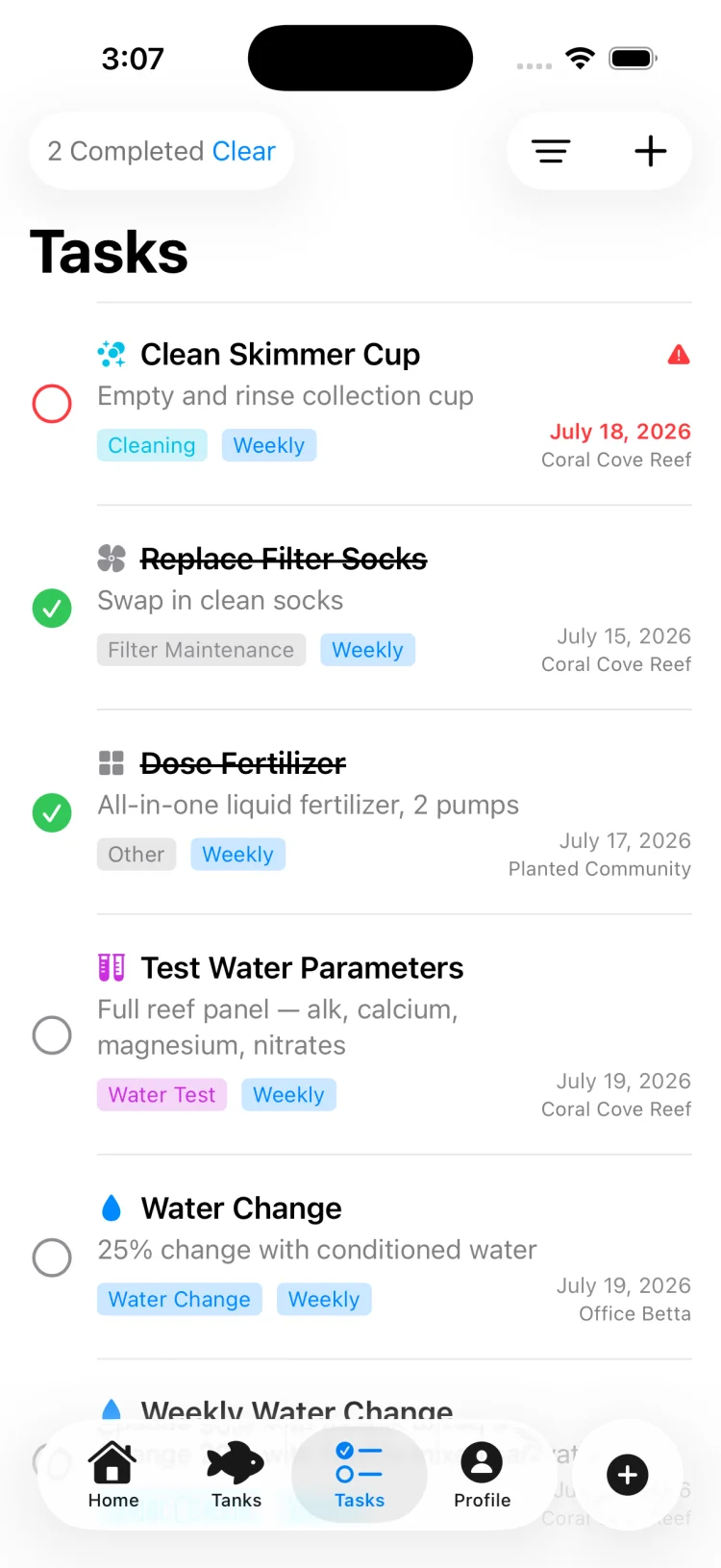
Recurring tasks with due dates and overdue flags
Set up a task once — "Weekly water change, 20 percent" — with a recurrence interval, and TankSync tracks when it is next due. Overdue tasks flag red. The list tells you what needs doing this week without you having to remember or calculate intervals. Complete a task and it schedules the next occurrence automatically.
The eight maintenance categories
Every task gets tagged with one of the eight categories: water change, filter service, equipment service, cleaning, testing, dosing, feeding-related, or general. The category breakdown in the maintenance history lets you see at a glance if you have been skipping entire classes of work. If you have logged 15 tasks in two months and none of them are equipment service, your equipment has not been serviced.
Equipment records with service history
Each piece of tracked equipment — filter, heater, light, pump, protein skimmer, UV steriliser, CO2 system, air pump — has an install date, a service log, and optional replacement reminders. The service log records every time you cleaned an impeller, replaced media, or calibrated a heater. When the heater is three years old and you are trying to remember if it has ever been replaced, the record tells you.
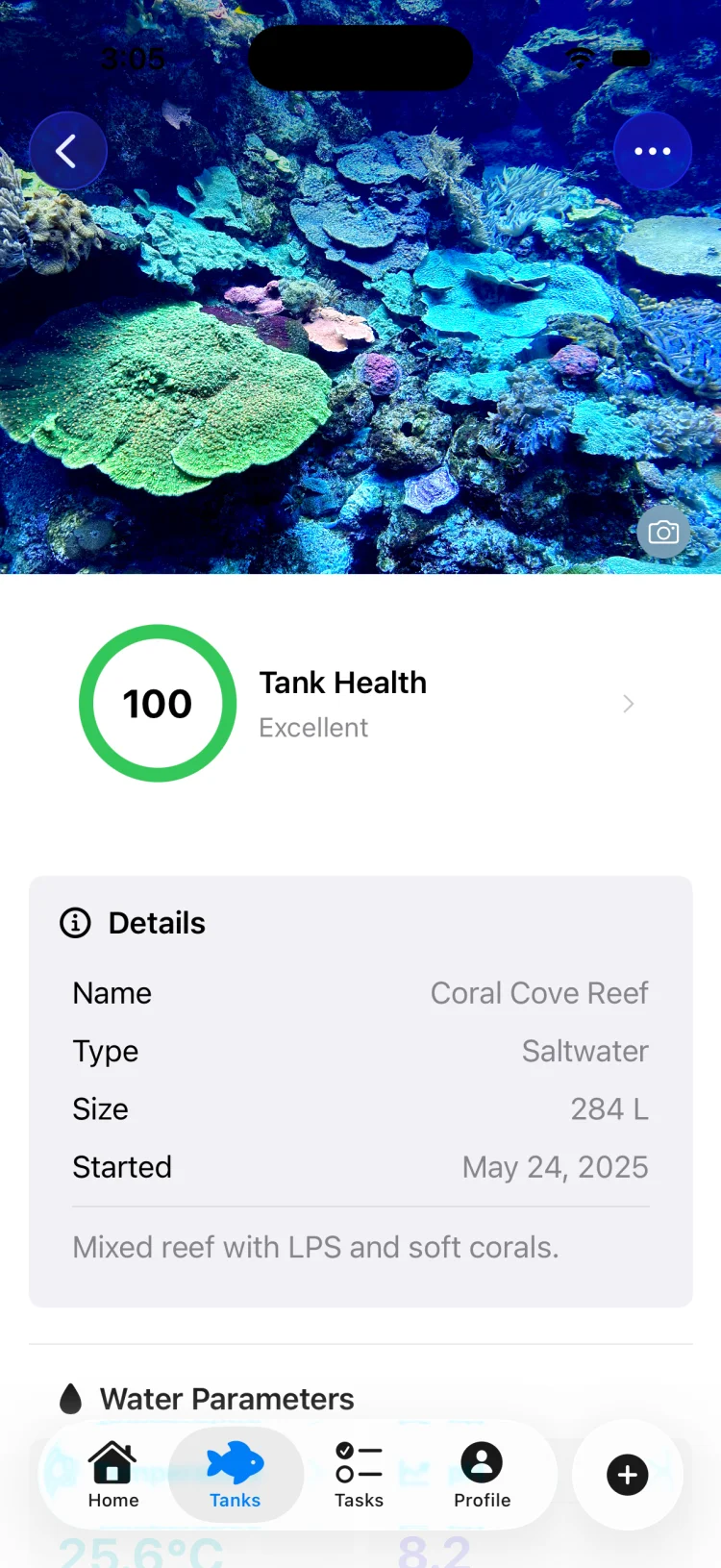
Maintenance is 20 percent of the tank health score
The tank health score is weighted: water quality 40 percent, stocking 25 percent, maintenance 20 percent, cycling 15 percent. A tank with perfect parameters but no logged maintenance in six weeks scores lower than one with adequate parameters and a consistent routine, because the app knows the one with no maintenance record is living on borrowed time.
This is not punitive. It is predictive. Tanks with maintenance gaps crash more often than tanks with parameter drift, because maintenance gaps lead to equipment failures and equipment failures cause parameter crashes. The score reflects that.
Building a maintenance schedule in TankSync
Set the schedule up once, then let recurrence and due dates hold you accountable:
- Add your equipment to the tank with install dates. The app will prompt for service when intervals are reached.
- Create recurring maintenance tasks for the weekly and monthly work: water change, testing, glass cleaning, filter media rinse, impeller clean.
- Set the recurrence interval and the category for each task. Weekly tasks recur every 7 days. Monthly tasks every 28 or 30 days depending on preference.
- Turn on maintenance reminders. The app will notify you when tasks come due.
- Log each task as completed when you finish it. The next occurrence schedules automatically.
- Check the health score and maintenance history monthly. If the maintenance score is falling or entire categories are missing from the log, the schedule has drifted.
General guidance, not veterinary prescription
The intervals and task lists in this guide are typical starting points, not universal requirements. Maintenance needs vary with tank size, stocking density, equipment type, water source, and the species kept. A task schedule that works for a lightly stocked planted tank may be inadequate for a heavily stocked reef system.
TankSync's maintenance tracking, equipment records and health scoring are tools for organising your own decisions, not prescriptions. The app does not know if your particular filter needs service every three weeks instead of four, or if your local water is hard enough to foul an impeller faster than average. Use the logged history and parameter trends to adjust the baseline schedule to what your specific tank actually needs.
Where livestock health is concerned, verify anything that matters against your own test results and observations, and consult an aquatic veterinarian for illness or injury rather than relying on generalised guidance.
Frequently asked questions
How often should I clean my fish tank?
A weekly partial water change of 10 to 25 percent is the baseline for most tanks. The glass gets wiped during that same session. Filter media gets rinsed in old tank water once a month, not weekly — overcleaning the filter strips the beneficial bacteria. Monthly tasks include cleaning the impeller, checking tubing and replacing chemical media if you use it. Deep cleaning the substrate and doing a full equipment audit happens quarterly or less. Tanks fail more often from over-maintenance that disrupts the biological stability than from slight neglect.
How often should I change aquarium filter media?
Mechanical and biological media — sponges, ceramic rings, bio-balls — should never be replaced unless physically breaking apart, which often means years of service. Rinse them in old tank water monthly to clear debris but leave the bacterial biofilm intact. Chemical media like activated carbon or phosphate removers exhaust after four to eight weeks and need replacement on that interval if you are using them. Disposable cartridges marketed as monthly replacements are a revenue model, not a biological requirement. Most experienced hobbyists replace only the outer mechanical sponge or pad and keep the biological media indefinitely.
What maintenance does a saltwater tank need that a freshwater tank does not?
Saltwater tanks require salinity checks and top-ups with fresh RO water to counter evaporation, since evaporation leaves salt behind and raises concentration. Reef tanks add calcium, alkalinity and magnesium testing and dosing to maintain skeletal growth for corals. Protein skimmers need weekly cleaning of the collection cup and monthly impeller service. Powerheads and circulation pumps accumulate salt creep and need more frequent inspection. Reverse osmosis membranes and DI resin need replacement on a schedule tied to TDS readings. The testing load and equipment count are both higher, which makes a written schedule more important, not less.
Can I skip a water change if the parameters look fine?
Occasionally, yes, but it should not become a pattern. Nitrate and phosphate accumulate below the resolution of most test kits, and trace pollutants that no kit measures build up over time. The fish adapt to gradual degradation and appear fine until they are not. A single skipped week in a stable, lightly stocked tank is not a crisis. Skipping water changes for a month because the numbers looked acceptable at week two is how old tank syndrome develops. Consistency beats optimization — a tank on a regular 15 percent weekly schedule tends to outlast one on an irregular 30 percent schedule guided by testing alone.
How often should I replace a heater?
Most aquarium heaters should be replaced every two to three years regardless of whether they appear to be working. Thermostats drift, and a heater that stuck on will cook a tank overnight. Cheaper heaters fail sooner and less predictably. If a heater is over three years old, replace it before winter when failure has the worst consequences. Keep a backup heater on hand and check the main heater against a separate thermometer monthly. A reading that drifts more than two degrees from the set point is a replacement signal even if the heater is new.
What is a realistic weekly time commitment for an aquarium?
Twenty to thirty minutes per week is typical for an established tank in the 40 to 200 litre range, split between a daily 60-second check and a single 20-minute weekly session covering the water change, glass, testing and visual inspection. Heavily stocked tanks, reef systems, or those with more than basic equipment can push that to 45 minutes weekly. Nano tanks under 40 litres often need more frequent intervention despite the smaller volume because parameters shift faster. The monthly deep service adds another 30 minutes once every four weeks. If your schedule consistently requires over an hour weekly, the tank is either overstocked, over-equipped, or the maintenance approach needs simplifying.