Walk into any aquarium shop and the equipment aisle runs for twenty metres. Filters in a dozen formats, heaters with controllers and without, UV sterilisers, protein skimmers, dosing pumps, wave makers, reactors, auto top-off units. Half of it is genuinely useful. A quarter is useful only for specific tank types. The rest is solving problems most tanks will never have or creating new ones to justify the purchase.
The question is not what exists, it is what your tank actually needs and when each piece stops doing the job it was bought for. A canister filter does not announce that the impeller shaft is worn — it just moves less water and the tank chemistry drifts. A heater thermostat does not send an alert before it fails — it sticks on or sticks off and you find out when the thermometer reads 18°C or 35°C. A light does not visibly dim when the spectrum shifts, it just stops growing the coral and starts growing hair algae instead.
The short version
Filter, heater, thermometer, light and a test kit are the real minimum. Everything else depends on the tank type. Buy the filter one size up and replace the heater before it fails, not after. Most equipment earns its keep through scheduled maintenance, not by being left alone until something goes wrong.
The equipment that is genuinely required
Strip a tank down to what it cannot function without and you are left with four things: filtration, heating, temperature measurement, and lighting. Water movement is a fifth if the filter outlet alone is not enough. Everything else is conditional.
Filtration
A filter does three jobs, not one. Mechanical filtration traps solid waste — uneaten food, fish waste, plant debris — before it decomposes in the water. Biological filtration is the surface where nitrifying bacteria colonise, converting ammonia to nitrite and nitrite to nitrate. Chemical filtration is optional activated carbon or resin removing dissolved organics, medication residue or specific ions. Most filters handle all three, though the biological stage is the only one you cannot skip.
The formats differ in where they sit and how much media they hold. A hang-on-back filter clips to the rim, pulls water up through an intake tube, passes it through stacked media, and dumps it back via a waterfall return. They are simple, cheap, accessible for maintenance, and limited in media volume because the whole unit has to hang on the glass without tipping. Flow rates are modest.
A canister filter sits in the cabinet below the tank. Intake and return are separate hoses running over the rim or through drilled holes. Media capacity is far higher, flow is stronger, and the unit is silent because it is not splashing water. The downside is accessibility — servicing means shutting valves, disconnecting hoses, lifting a heavy canister, and reversing the process afterwards. Canisters also fail more dramatically when they fail, usually via a siphon break that dumps the canister contents onto the floor.
A sponge filter is an air-driven foam block. Air rising through the centre creates suction that pulls water through the sponge. There is no pump to fail, no impeller to clog, and no risk of sucking up fry. Media capacity is low and flow is gentle, which makes them ideal for fry tanks, quarantine tanks, shrimp tanks, or as a backup biological filter running in the main tank. They do not provide enough filtration for a fully stocked display tank on their own.
A sump is a separate tank below the display, connected by an overflow and a return pump. The sump holds the heater, the skimmer, the media, the top-off reservoir, the refugium — everything that would clutter the display. Sumps give you the most flexibility and the most media volume, and they require drilling the display tank or using an overflow box, which introduces new failure modes. Reef tanks almost always run sumps. Freshwater rarely needs them unless the tank is very large or heavily stocked.
Turnover rate is the number that matters. The filter should cycle the full tank volume four to six times per hour for a typical community tank, more for messy fish like goldfish or heavily stocked cichlid tanks. A 200-litre tank needs 800 to 1200 litres per hour of actual flow, measured at the outlet after head height and media resistance have reduced it from the pump rating. This is why buying a filter rated for exactly your tank volume leaves no margin — measure flow, not marketing claims.
Never replace all the filter media at once. The bacteria live in the biofilm coating every surface. Replacing a sponge is replacing the entire biological filter, and the tank will cycle again from scratch. When mechanical media is clogged past saving, replace half, wait two weeks for bacteria to colonise the new piece, then replace the other half. Clean media in old tank water squeezed into a bucket during a water change, never under the tap. Chlorine kills nitrifying bacteria in seconds.
Heaters and thermometers
Tropical fish need stable warmth. Most species are comfortable in the range from 24°C to 27°C, with specific preferences within that. The heater's job is not to make the water hot, it is to hold the temperature steady within one degree either way of the target regardless of what the room does overnight or when the heating is off.
Sizing is straightforward: 3 to 5 watts per gallon, or roughly 0.8 to 1.3 watts per litre, adjusted for the difference between room temperature and target temperature. A 150-litre tank in a room at 18°C targeting 25°C needs around 150 watts. If the room is 22°C the same tank can run on 100 watts. Undersizing means the heater runs continuously and struggles to recover after a water change. Oversizing is not dangerous if the thermostat is working — the heater just cycles on and off more abruptly — but it becomes dangerous the moment the thermostat sticks on, because a 300-watt heater in a 100-litre tank will hit 35°C before you notice.
For tanks above about 200 litres, two heaters each sized for half the volume are safer than one large one. If one fails off, the other keeps the tank warm enough that you have time to notice and replace it. If one fails on — the more dangerous mode — the other is not contributing to the runaway. Spread them at opposite ends of the tank near water flow so you are not heating one corner and hoping circulation does the rest.
A built-in thermostat is standard. External controllers exist and add a second layer of protection — the controller cuts power if the temperature exceeds a set limit even if the heater thermostat has stuck. For high-value tanks or species with tight temperature tolerances, a controller is cheap insurance. For a typical community tank, a quality heater with a readable thermostat dial is enough.
Replace heaters on a schedule, not on failure. A thermostat that sticks on will kill a tank faster than almost any other single failure. Three years is a reasonable service life for a heater running year-round. Five if the tank is in a warm room and the heater only runs in winter. This is one of the few pieces of equipment where "still working" is not the same as "safe to keep using."
The heater's own dial is not a thermometer. It is a target setting, and the calibration drifts. Put a separate glass or digital thermometer at the opposite end of the tank from the heater and make that your reference. Check it daily. A thermometer is the cheapest early warning system in the entire setup.
Lighting
Lighting does three things depending on what lives in the tank. For fish-only setups, the light is for you — the fish can see fine in dim conditions, and many prefer it. For planted tanks, the light drives photosynthesis, and intensity and spectrum matter because plants that do not get enough usable light simply stop growing. For reef tanks, corals are photosynthetic animals and the light is as critical as the water chemistry.
A basic fish-only freshwater tank can run on almost anything that produces white light on a timer. Six to eight hours a day is enough to see the fish and keep algae under control. More than ten hours and you are feeding algae for no benefit to the livestock. Use a timer. Consistency matters more than intensity — the same eight hours at the same time every day lets the fish regulate their behaviour by a predictable day-night cycle.
Planted tanks need more intensity and a spectrum skewed toward red and blue, which chlorophyll absorbs most efficiently. Measure light in PAR — photosynthetically active radiation — rather than lumens or watts, because only PAR tells you how much usable energy is reaching the plants. Low-tech planted tanks with slow-growing species run fine on moderate lighting, around 30 to 50 PAR at substrate level. High-tech tanks with CO2 injection and fast-growing stems need 80 to 120 PAR or more, along with the nutrient dosing to match.
Reef lighting is its own category. Corals span a huge range of light requirements, from deep-water LPS corals happy under 100 PAR to shallow-water SPS demanding 300 PAR and very specific spectrum. Reef lights are almost always LED now, programmable for intensity and colour, often with sunrise and sunset ramps. A reef light is not an accessory, it is life support, and the running cost of a quality reef LED over five years is less than replacing a cheaper one twice.
Replace or upgrade lighting when the spectrum shifts. LEDs do not burn out suddenly like old fluorescent tubes, they fade. Intensity drops slowly and blue wavelengths degrade faster than others, shifting the spectrum toward yellow-white. If algae starts outcompeting coral that was previously growing well, test your PAR and check the light age. Most reef LEDs are past their best output after four to five years of daily use. The fixture still turns on, it just is not growing coral anymore.
Water movement
Water movement does two things: it circulates heated and filtered water so the whole tank stays uniform, and it creates surface agitation for gas exchange. In a simple freshwater community tank the filter return often provides enough of both. In a larger tank, a heavily stocked tank, or a reef, you need dedicated flow.
A powerhead is a submersible pump that moves water in a straight line. Point it across the tank to create a current, or angle it upward to break the surface and drive oxygenation. Powerheads are cheap, silent, and effective. Flow rate should turn over the tank volume ten to twenty times per hour in a reef, more in SPS-dominant systems where corals depend on constant flow to deliver food and remove waste. Freshwater rarely needs that much unless you are keeping hillstream loaches or other current-loving species.
A wavemaker is a powerhead with programmable flow patterns — pulses, waves, alternating bursts. Reef tanks use them to simulate tidal movement, which keeps detritus in suspension so the filter and skimmer can remove it rather than letting it settle into the rockwork. Freshwater tanks gain little from wave modes unless the species specifically need current variation.
Surface agitation is critical in tanks without strong water movement. A still surface limits gas exchange — oxygen in, carbon dioxide out. Fish in a poorly circulated tank can suffocate even if the water chemistry is perfect, because the oxygen never reaches them and the CO2 builds up. If your filter return does not visibly ripple the surface, add an air stone or angle a powerhead upward.
Saltwater and reef additions
Saltwater tanks add complexity and equipment because marine fish and corals are far less tolerant of parameter drift than most freshwater species. What is optional in a planted tank becomes mandatory in a reef.
A protein skimmer removes dissolved organic waste before it breaks down into ammonia. A column of fine bubbles pulls proteins, oils and other organics out of the water via foam fractionation. The waste collects in a cup that you empty weekly. Skimmers are not strictly required in a lightly stocked fish-only marine tank, but they are standard in any serious setup and mandatory in a reef. Corals are intolerant of dissolved waste, and skimming is the primary way to export it before it affects parameters. Size the skimmer for the tank volume, and run it continuously.
A return pump and sump configuration gives you space for the skimmer, heaters, media reactors, auto top-off reservoir, and a refugium growing macroalgae to export nutrients. The return pump moves water from the sump back to the display. Flow rate needs to match the overflow capacity — if the return pushes more water than the overflow can drain, the display overflows onto the floor. Five to ten times the display volume per hour is typical. Sump-based systems are more complex to set up and more flexible once running.
Auto top-off replaces evaporated water automatically, keeping salinity stable. Evaporation removes pure water and leaves the salt behind, so salinity creeps up unless you add fresh water to compensate. In a small tank you can do this manually every few days. In a larger tank or one running a sump with high evaporation, an ATO with a float valve or optical sensor maintains the level within a few millimetres. This is not essential but it is convenient, and it eliminates one of the daily checks.
An RO/DI unit produces pure water by forcing tap water through a reverse osmosis membrane and then a deionisation resin. Tap water contains phosphates, silicates, nitrates, chlorine, chloramine and heavy metals, many of which cause algae problems or parameter issues in a reef. Mixing salt into RO/DI water instead of tap gives you control over what goes into the tank. The units are not expensive and the membrane lasts a year or more with regular filter changes. For reef keepers, RO/DI water is not optional.
A refractometer measures salinity accurately. Hydrometers are cheap and imprecise. A refractometer uses light refraction to measure specific gravity or salinity directly in parts per thousand, and it does it to two decimal places. Target salinity for a reef is 35 ppt, or 1.026 specific gravity. Being half a point off stresses coral, and a hydrometer cannot reliably tell you if you are half a point off.
Dosing pumps add calcium, alkalinity and magnesium on a schedule to replace what corals consume. In a mixed reef with significant stony coral growth, daily manual dosing becomes a chore and inconsistent dosing causes parameter swings. Dosing pumps deliver precise volumes at set times, keeping parameters stable. For a fish-only or soft coral tank, manual dosing once or twice a week is fine. For SPS-dominant reefs, dosing pumps are part of the life support.
A UV steriliser passes water through a chamber with an ultraviolet bulb, killing free-floating bacteria, algae spores and parasites. UV does nothing to established infections or anything not in the water column, but it reduces pathogen load and helps control green water or bacterial blooms. Freshwater tanks rarely need UV unless they are outdoor ponds or have recurring disease issues. Reef tanks sometimes run UV to suppress algae or as an extra disease barrier, but it is not standard equipment.
Equipment worth skipping, at least at first
Some equipment is marketed as essential when it is anything but. Others are fine in principle but a poor first purchase.
Undergravel filters use the substrate as the filter media, pulling water down through the gravel with an air lift or powerhead. They work, they are cheap, and they trap waste under the gravel where you cannot clean it without tearing the tank down. Anaerobic pockets form, hydrogen sulphide builds up, and the substrate turns into a slow-release ammonia source every time you disturb it. Modern filters are better in every way except price.
Air-driven ornaments as a filtration plan look appealing because they bubble and they are cheap. An air stone or bubbling decoration provides surface agitation and oxygenation, both useful, but it provides no mechanical or biological filtration. The air pump is an accessory, not a replacement for a real filter.
Cheap unbranded heaters save ten pounds now and cost you a tank when the thermostat sticks. Pay for a mid-range heater from a known brand with a history of not burning down aquariums. The difference in price is trivial compared to the value of the livestock.
Bowls and tanks under about 20 litres are sold as beginner setups and they are the exact opposite. Small volumes have no thermal or chemical stability. A 10-litre bowl swings five degrees with a window open. A water change is half the volume. Waste accumulates faster than the cycle can handle it. Beginners need stability, and small tanks provide none. Start with at least 60 litres.
Automatic feeders can work well once a tank is established and the feeding routine is dialled in. As a substitute for attention they are terrible. Feeders jam, over-dispense, drop food into a filter intake, or keep running while you are gone for two weeks and the tank is cloudy with uneaten flake. Feed manually until you trust both the tank and the device, then use a feeder as backup, not primary.
Equipment by tank type
What you actually need depends on what lives in the tank. Here is the breakdown by setup type, with essential equipment marked and optional equipment noted where it adds value.
| Equipment | Freshwater community | Planted | Saltwater fish-only | Reef |
|---|---|---|---|---|
| Filter | Essential | Essential | Essential | Essential, usually sump |
| Heater | Essential | Essential | Essential | Essential |
| Light | Basic, for viewing | Moderate to high PAR | Basic | High PAR, full spectrum |
| Pump / powerhead | Optional | Optional | Often useful | Essential for flow |
| Protein skimmer | Not applicable | Not applicable | Strongly recommended | Essential |
| UV steriliser | Rarely needed | Rarely needed | Optional | Optional |
| CO2 system | Not needed | Optional, high-tech only | Not applicable | Not applicable |
| Air pump | Optional, for surface agitation | Optional | Optional | Rarely needed |
Service and replacement intervals
Equipment does not last forever, and most failures give no warning. Scheduled maintenance catches problems before they become emergencies. This is what each category needs and when.
| Equipment | Clean / service interval | Consumables to replace | Typical service life | Warning signs of failure |
|---|---|---|---|---|
| Filter | Mechanical media every 2–4 weeks; impeller every 3–6 months | Sponges, pads, carbon if used | Pump/motor: 3–5 years | Reduced flow, noisy impeller, water bypass |
| Heater | Visual inspection monthly | None, replace whole unit | 3–5 years | Temperature drift, stuck on/off, visible cracks |
| Light | Wipe lenses monthly | LED: none; fluorescent tubes yearly | LED: 4–6 years of full output | Algae growth increase, coral colour loss, dim output |
| Pump / powerhead | Impeller clean every 3–6 months | Impeller if worn | 3–5 years | Reduced flow, noise, overheating, stopped rotor |
| Protein skimmer | Clean neck weekly, full clean monthly | Pump impeller if worn | Pump: 2–4 years | Reduced foam, overflow, noisy pump |
| UV steriliser | Wipe quartz sleeve monthly | UV bulb every 6–12 months | Bulb output drops after ~8000 hours | Algae blooms returning, bulb visibly dim or out |
| CO2 system | Check regulator and bubble count weekly | CO2 cylinder refill as needed | Regulator: 5+ years if quality | Pressure drop, bubble rate inconsistent, leaks |
| Air pump | Replace diaphragm annually | Diaphragm, check valve | 2–4 years | Reduced flow, loud vibration, inconsistent bubbles |
Sizing rules that actually hold
Equipment sizing is not guesswork. These are the rules that hold across tank types and sizes.
Filter turnover: Cycle the tank volume four to six times per hour for lightly stocked community tanks, six to ten times for heavily stocked or messy species, ten to twenty times for reef tanks. Measure flow at the outlet, not the pump rating. Head height, media resistance and tubing bends all reduce actual throughput. Buy a filter rated for more than your tank volume to account for this.
Heater wattage: 3 to 5 watts per gallon (0.8 to 1.3 watts per litre) adjusted for the difference between room temperature and target. A 150-litre tank in a 20°C room targeting 26°C needs about 120 to 150 watts. Split into two heaters for tanks above 200 litres. Position near flow so heated water circulates rather than pooling.
Light coverage: Measured in PAR at the substrate or coral level, not at the surface. Freshwater low-tech planted: 30 to 50 PAR. High-tech planted with CO2: 80 to 120 PAR. Reef soft corals and LPS: 100 to 200 PAR. SPS corals: 200 to 400 PAR depending on placement and species. A PAR meter is the only reliable way to measure this — lumens and watts tell you almost nothing useful.
Powerhead flow for reef: Total flow from all pumps should turn over the display volume 10 to 20 times per hour minimum, 20 to 40 times for SPS-heavy tanks. Flow should be turbulent and varied, not a single laminar jet. Use multiple powerheads or a wavemaker to create varied current patterns. Dead zones where detritus settles are a sign of insufficient or poorly directed flow.
The failure modes to plan for
Some failures are inconvenient. Others kill the tank. Plan for the ones that do damage and the rest are just repairs.
Stuck-on heater: The thermostat fails closed and the heater runs continuously until the water boils or something trips the breaker. Most fish die above 32°C. This is why you use a separate thermometer, check it daily, and replace heaters on schedule rather than waiting for failure. An external temperature controller adds a second cutoff and is worth it for high-value tanks.
Stuck-off heater: The thermostat fails open and the heater never turns on. The tank cools to room temperature overnight. Most tropical fish survive short-term cold but stress badly and become disease-prone. This is why two smaller heaters are safer than one large one — if one fails off, the other keeps the tank warm enough to buy you time.
Impeller wear: The impeller shaft or housing wears down and the impeller rattles or does not spin freely. Flow drops by half and you might not notice for weeks because it is gradual. Filtration suffers, water quality drifts, and the filter sounds like gravel in a washing machine. Clean the impeller every few months and replace it when you see wear on the shaft or housing. Impellers are cheap. Tank crashes are not.
Siphon break on a canister: A canister filter depends on siphon to pull water from the tank through the intake hose. If air enters the line — from a loose connection, a valve left open, or the water level dropping below the intake — the siphon breaks and the filter stops pulling water. The return continues running and pumps the canister dry, then runs dry and overheats. Meanwhile the tank has no filtration. Check hose connections every time you service the filter and make sure the intake is well below the waterline.
Power cut: The filter stops, the heater stops, the lights go out. If the power is out for a few hours the tank is fine — the bacteria in the filter can survive without flow for a day and the temperature drops slowly. If the power is out overnight in winter the tank cools and the bacteria start dying from lack of oxygen in the media. A battery-powered air pump running an air stone keeps the bacteria alive and the water oxygenated for a day or more. They cost very little and they are the only piece of equipment that matters during an outage.
Why a battery air pump is cheap insurance: Power cuts are rare and usually short, but when they happen during a heatwave or a freeze the consequences are severe. A small battery air pump keeping an air stone running maintains enough oxygenation to keep fish and bacteria alive. Cost is trivial. A single avoided loss pays for it many times over. Keep one charged and in the cupboard.
How TankSync fits
Equipment tracking is half of what keeps a tank stable long-term. TankSync structures it so nothing gets forgotten and service intervals are visible.
Recording equipment with purchase and service dates
TankSync tracks up to eight equipment types per tank: filter, heater, light, pump or powerhead, protein skimmer, UV steriliser, CO2 system, and air pump. Each entry records the purchase date, the last service date, and notes. The free tier supports up to three equipment items; Pro supports unlimited. Knowing when a heater went in tells you when it is due for replacement. Knowing when you last cleaned the impeller tells you when to do it again.
Maintenance tasks tied to equipment
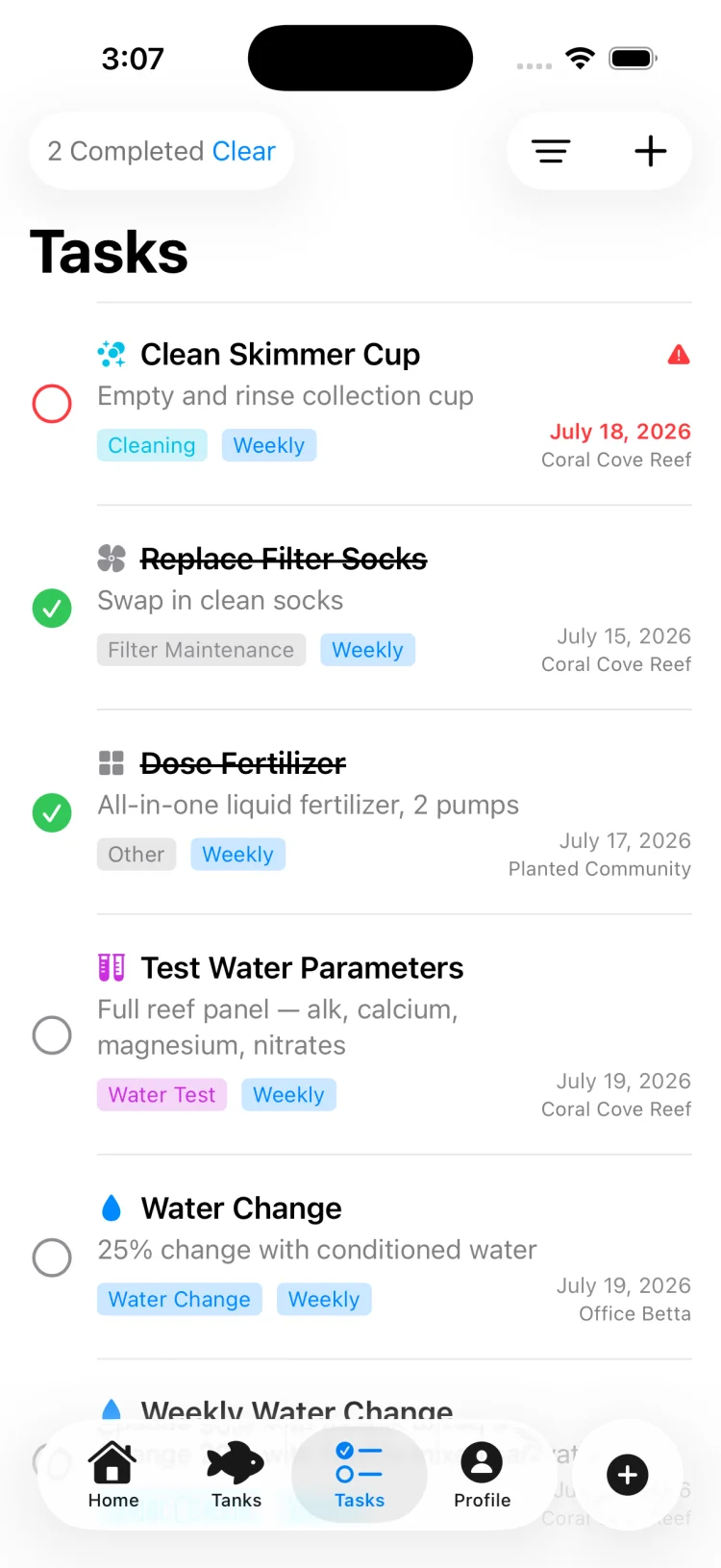
Maintenance tasks link to specific equipment so servicing has context and a due date. A task reading "clean filter sponges" with a two-week interval reminds you before flow drops and tells you which filter if you run more than one. Completed tasks log the date so the history is there when you need to work out whether the current problem correlates with a missed service.
Maintenance contributes 20 percent of the tank health score
The tank health score weights maintenance at 20 percent, behind water quality at 40 percent and stocking at 25 percent. Overdue tasks drop the maintenance score, and a low maintenance score signals that neglected equipment is going to become a water quality problem soon if it has not already. The score is not a game, it is a checklist with consequences attached.
Tracking equipment in TankSync
Set up equipment tracking when you set the tank up, so the service history builds from day one:
- Add the aquarium and open the equipment section from the tank detail screen.
- Record each piece of equipment with its type, purchase date, and any notes about model or wattage.
- Create maintenance tasks linked to each equipment item — filter cleaning every two weeks, impeller service every three months, heater inspection monthly.
- Set task intervals and turn on reminders so service dates do not slip.
- Mark tasks complete as you do them, so the last-serviced date updates and the next due date calculates automatically.
- Check the tank health score. If maintenance is pulling it down, the overdue task list tells you what needs attention.
General guidance, not a prescription
The sizing and service intervals in this guide are typical, not universal. Actual requirements vary with tank size, stocking density, equipment brand and model, water chemistry, and usage patterns. Species requirements differ, and what works for a lightly stocked community tank may be insufficient for a heavily stocked reef or a high-tech planted setup.
Electrical equipment should be installed and maintained according to manufacturer instructions. Use a drip loop on all power cables to prevent water running into outlets. Install RCD or GFCI protection on circuits powering aquarium equipment. Do not operate heaters, pumps or lights outside of water unless the device is specifically rated for dry operation.
TankSync's equipment tracking and maintenance scheduling is informational and does not replace manufacturer guidance or professional judgement. TankSync does not connect to, monitor or control hardware. Verify equipment condition and operation directly, and replace anything showing signs of failure regardless of recorded service life.
Frequently asked questions
What equipment do I need for a first aquarium?
A filter rated for at least the tank volume, a heater sized at roughly 3 to 5 watts per gallon, a separate thermometer, a light suitable for your livestock, and a liquid test kit for ammonia, nitrite and nitrate. Everything else depends on the type of tank. Freshwater community tanks rarely need more. Planted tanks add a timer and possibly CO2. Saltwater adds a protein skimmer, a refractometer and usually a powerhead. Reef tanks add even more, but start with the basics and expand as the stock requires it.
What size filter do I need?
Buy a filter rated for at least your tank's volume, and preferably one size up. A filter rated for 200 litres on a 150-litre tank gives you margin for heavy stocking and means the pump is not working flat out all the time, which extends its life. Turnover rate is the useful number — the filter should cycle the full tank volume four to six times per hour for most community setups, more for heavily stocked tanks or messy fish. Measure flow at the outlet, not the pump rating, since media resistance cuts the actual throughput.
How many watts should an aquarium heater be?
The standard sizing is 3 to 5 watts per gallon, or roughly 0.8 to 1.3 watts per litre, adjusted for how much colder the room is than the target temperature. A 150-litre tank in a room at 18°C aiming for 25°C needs around 150 watts. For tanks over about 200 litres, two smaller heaters are safer than one large one — if a heater fails on it removes only half the heating capacity, and if one sticks on the other is not adding to the problem. Place heaters near the filter outlet so the heated water circulates immediately.
How often should I clean my aquarium filter?
Clean mechanical media like sponges and filter pads every two to four weeks, or when flow drops noticeably. Clean only in old tank water, never tap water, because chlorine kills the bacterial colony doing the biological work. Clean biological media like ceramic rings or bio-balls only when flow is blocked, which might be every few months or longer. Replace chemical media like activated carbon monthly if you run it, though most tanks do not need it continuously. Never replace all the media at once — doing so removes the entire bacterial colony and crashes the cycle.
Do I need a protein skimmer?
For saltwater, yes, unless the tank is very lightly stocked or heavily planted with macroalgae doing the same job. A protein skimmer removes dissolved organic waste before it breaks down into ammonia, which reduces the load on the biological filter and keeps the water clearer. Freshwater tanks do not use protein skimmers because the chemistry does not work in the absence of salt. In a reef tank a skimmer is not optional — corals are far less tolerant of dissolved waste than fish, and skimming is the main way to export it before it becomes a parameter problem.
How long should aquarium lights be on each day?
Eight to ten hours for most setups, on a fixed schedule set by a timer. Longer than about ten hours encourages algae without benefiting the fish or plants, and an inconsistent schedule stresses both. Planted tanks lean toward ten hours with enough intensity to support photosynthesis. Reef tanks often run a more complex schedule with sunrise and sunset ramps, but total peak lighting is still around eight to ten hours. Fish-only tanks can run shorter if algae is a problem. The key is consistency — the same duration at the same time every day, because both plants and fish regulate their behaviour by the light cycle.