Ask whether saltwater is harder than freshwater and the answer you get is almost always yes, delivered with the kind of certainty that suggests the question has been settled for decades. It has not been settled. It has been oversimplified. The chemistry is not harder. A nitrogen cycle is a nitrogen cycle, ammonia is toxic in both, and the test kit works the same way. What is different is the consequence of neglect. Freshwater drifts slowly when you stop paying attention. Saltwater crashes.
This is not about capability or experience. It is about forgiveness. If you test weekly, change water on schedule and dose what needs dosing, saltwater is no harder than fresh. If you test when you remember and skip a water change because life intervened, freshwater will tolerate it and saltwater often will not. The real question is not which is harder. It is which matches the time and consistency you can actually provide.
The short version
Freshwater is cheaper, more forgiving of a missed week and more tolerant of tap water. Saltwater costs more up front, needs more parameters watched and punishes drift faster. Neither is difficult if you test and keep a schedule. The difference is what happens when you do not.
What is genuinely the same
Start with what does not change, because the list is longer than most summaries suggest.
The nitrogen cycle works identically. Fish produce ammonia, bacteria convert it to nitrite, different bacteria convert nitrite to nitrate, and you export nitrate with water changes. Cycling a saltwater tank takes the same four to eight weeks, follows the same ammonia-nitrite-nitrate curve, and finishes when the same 24-hour test confirms the bacteria can process a day's waste in a day. The species of bacteria differ slightly, but the process and timeline do not.
You cannot skip cycling. Both tank types need a fully cycled filter before livestock goes in, and both will spike ammonia and kill fish if you stock an uncycled tank. There is no saltwater shortcut.
Water changes are the core export mechanism. Freshwater and saltwater both rely on regular water changes to remove nitrate and replenish trace elements. The percentage and frequency are similar: 20 to 30 percent weekly for a moderately stocked tank, more if stocking is heavy or nitrate climbs fast.
Stocking limits apply. Bioload is bioload. Saltwater fish produce waste, the filter processes it, and overstocking crashes water quality just as fast as it does in fresh. The often-quoted guideline of one inch of fish per gallon is too crude for either system, but the principle holds: stock slowly, test as you go, and stop before the filter is overwhelmed.
Quarantine protects the display tank. New fish carry disease whether they came from a freshwater farm or a saltwater retailer. Quarantine procedure is the same: separate tank, two to four weeks of observation, treatment if anything shows, then transfer. Skipping it is the same gamble in both environments.
What is genuinely different
The differences are real, but they are narrower and more specific than "saltwater is harder" implies.
Salinity as a parameter you must hold steady
Freshwater fish live in water that is roughly 0 parts per thousand dissolved solids. Saltwater fish live at 35 ppt, and reef invertebrates tolerate almost no variance from that. You measure it with a hydrometer or refractometer, and you hold it at 1.025 or 1.026 specific gravity by topping off evaporation with fresh water and making up water changes with pre-mixed saltwater at the correct salinity. This is not difficult, but it is one more number to track and freshwater does not have it.
RO/DI water instead of dechlorinated tap
Most tap water has phosphate, silicate, nitrate and trace metals that are harmless to freshwater fish but become problematic in saltwater. Phosphate and silicate feed algae. Nitrate imported with every water change makes it nearly impossible to keep reef nutrient levels low enough for corals to thrive. You can dechlorinate tap and run a lightly stocked fish-only tank on it if your municipal supply is clean, but reef and most serious saltwater setups use reverse osmosis or RO/DI water. That means buying it by the container or installing a unit, both of which cost money and add a step freshwater mostly skips.
Protein skimming and nutrient export
Protein skimmers pull dissolved organic waste out of the water before it breaks down into nitrate. They are common in saltwater and nearly absent from freshwater, because saltwater's higher density lets organic molecules foam effectively. A skimmer is not strictly required for fish-only tanks, but it makes nutrient control far easier, and reef tanks almost all run one. This is another piece of equipment, another thing to clean, and another cost.
Alkalinity and calcium in reef tanks
Coral builds its skeleton from calcium carbonate, which it pulls from the water. A reef tank must supply calcium and maintain alkalinity, which buffers pH and provides carbonate ions for the skeleton-building process. Freshwater planted tanks may dose some trace elements, but nothing equivalent to the constant calcium and alkalinity demand of stony coral. This means testing and dosing two more parameters, usually daily or every other day, with either a two-part liquid additive or an automatic dosing pump. Fish-only saltwater does not need this. Reef does.
Lighting requirements for corals
Most freshwater fish do well under basic aquarium lighting or even room light. Planted tanks need moderate light, delivered by inexpensive LED fixtures. Reef coral, particularly stony coral, needs high-output lighting in a specific spectrum to support the photosynthetic algae living in its tissue. Reef lights are measurably more expensive than planted-tank lights — often multiples of the cost — and running them 8 to 10 hours daily adds to the electricity bill.
Live rock as biological filtration
Saltwater tanks, particularly reef, often use live rock: porous coral rock colonised with beneficial bacteria and microfauna. It serves as biological filtration, habitat and structure. Freshwater uses gravel, sand, sponge filters and canister media, none of which cost what live rock does. Dry rock is cheaper and works fine once it colonises, but it adds to the initial shopping list.
Topping off evaporation with fresh water
Water evaporates. Salt does not. As the water level drops, salinity climbs. In a freshwater tank you top off with dechlorinated tap and move on. In a saltwater tank you top off with fresh RO/DI water to bring the volume back up without raising salinity, then separately make up water changes with pre-mixed salt at the target salinity. This is straightforward once it is routine, but it is one more task freshwater does not have.
Side-by-side comparison
Here is what the three common tank types ask of you, laid out in the same table.
| Aspect | Freshwater community | Saltwater fish-only | Reef |
|---|---|---|---|
| Parameters to track | Temp, pH, ammonia, nitrite, nitrate | Same five, plus salinity | Same six, plus calcium, alkalinity, magnesium, phosphate |
| Water source | Dechlorinated tap, usually | RO/DI strongly preferred | RO/DI required |
| Equipment beyond basics | Optional: CO2 for plants | Hydrometer or refractometer, often a protein skimmer | Refractometer, skimmer, reef light, dosing pump or two-part, test kits for Ca/Alk/Mg |
| Typical setup cost | Low baseline | Moderate, roughly double freshwater | High, three to five times freshwater |
| Weekly time | 30–60 minutes for testing, water change, basic maintenance | 45–75 minutes, salt mixing adds time | 60–120 minutes, more testing and dosing |
| Stocking density tolerance | Moderate | Light to moderate, less forgiving than fresh | Light, coral and inverts need low bioload |
| Livestock cost | Low to moderate | Moderate to high | High, coral often costs multiples of fish |
| Error tolerance | High, drifts slowly | Moderate, less buffer than fresh | Low, coral shows stress within days of parameter drift |
The cost conversation, honestly
Price is where the gap becomes structural. A freshwater tank can start with a glass box, a sponge filter, a heater and a bottle of dechlorinator. Total outlay before fish is modest. Saltwater adds a protein skimmer, salt mix, RO/DI water or a unit to make it, a refractometer, and test kits for salinity and the usual cycle parameters. Reef adds a high-output light fixture that costs what the entire freshwater setup did, calcium and alkalinity test kits, and either manual two-part dosing or an automatic pump.
Livestock compounds it. A school of zebra danios or a few platies costs less than one clownfish. A single soft coral frag often costs what a full school of freshwater fish does. Stock a reef to the same visual density as a freshwater community and the livestock budget alone will be multiples higher.
Running cost tilts the same way. Freshwater uses tap water and basic food. Saltwater uses RO/DI water, salt mix for every water change, and reef adds calcium, alkalinity buffers, and the electricity cost of running high-output lights eight to ten hours a day. Over a year, the consumables gap is significant.
The cheapest saltwater setup is usually the most expensive one over two years. Cutting corners on the skimmer, the light, or the RO unit means fighting algae, losing coral, and replacing dead livestock. The up-front cost is real, but it buys stability, and stability is what keeps the animals alive and the ongoing cost down.
The time conversation
Daily checks are the same duration in both systems: a glance at the heater, a look at the fish, confirmation that the filter is running. Weekly maintenance is longer for saltwater because of salt mixing. You cannot pour pre-mixed saltwater into the tank from the tap; you mix RO/DI water with salt in a separate container, let it circulate and reach temperature, test the salinity, and then use it for the water change. This adds 15 to 30 minutes compared to filling a bucket from the tap, adding dechlorinator and pouring it in.
Reef adds more frequent testing. Calcium and alkalinity can shift detectably in 48 hours in a tank with fast-growing stony coral, so many reef keepers test every other day or daily. Dosing itself is quick if you use a two-part solution, and fully automated if you run a dosing pump, but checking that the dose is working takes time.
The time gap is not enormous. A freshwater tank might take 30 minutes a week. A fish-only saltwater tank might take 50. A moderately stocked reef might take 90. But it is a gap, and it is consistent, and if your free time is genuinely constrained it is worth accounting for.
Which to choose
Here is the decision laid out by situation rather than preference.
| Your situation | Recommendation | Why |
|---|---|---|
| First tank ever | Freshwater | Lower cost to learn on, more tolerance for early mistakes, skills transfer completely to saltwater later |
| Small space, under 40 litres | Freshwater or no tank | Small volumes swing parameters fast; saltwater in a nano is expert-level difficult, freshwater is merely hard |
| Tight budget | Freshwater | Saltwater setup cost is multiples higher and ongoing cost is higher; freshwater can run well on modest outlay |
| Want to keep coral | Reef, no alternative | Coral is saltwater-only and requires reef-specific equipment and parameter control; accept the cost and commitment |
| Travel often, or unpredictable schedule | Freshwater | Freshwater tolerates a missed week better; reef can crash from a skipped test or top-off while you are gone |
| Young children, limited uninterrupted time | Freshwater | The maintenance window is shorter and the cost of a parameter swing is lower if a child pulls you away mid-task |
| Want the widest species choice | Freshwater, narrowly | Freshwater species diversity is enormous; saltwater diversity is high but constrained by collection sustainability and shipping cost |
Brackish, the third option nobody mentions
Brackish water sits between fresh and salt: higher salinity than a river, lower than the ocean, typically 1.005 to 1.015 specific gravity. It suits species from estuaries and coastal swamps — certain gobies, mollies, archerfish, some pufferfish, fiddler crabs. The livestock list is shorter than either pure freshwater or full saltwater, but the species you can keep are often odd, hardy and entertaining.
Brackish costs less than saltwater because salinity is lower, so you use less salt mix, and most brackish fish tolerate dechlorinated tap as the water source. It costs slightly more than freshwater because you still need salt mix and a way to measure salinity. Maintenance sits between the two: you top off evaporation with fresh water like saltwater, but parameters drift more slowly than reef and faster than fresh.
Brackish suits someone who wants something different, does not mind a constrained species list, and is comfortable with salinity as a parameter but does not want the full reef workload. It is not common, information is harder to find, and you will spend time explaining to visitors that no, it is not saltwater and no, those are not freshwater fish either.
Switching later
Most of the skills you learn on a freshwater tank apply directly to saltwater. You leave freshwater knowing how to cycle a filter, interpret test results, diagnose a parameter swing, treat common diseases, and quarantine new stock. All of that carries over. The habits matter more than the equipment, and if you built good habits in fresh you will use them in salt.
What does not carry over is most of the physical setup. The tank and stand work fine. The heater works. A canister filter can be reused if you replace the media. Almost everything else stays behind. Substrate swaps from gravel to sand or bare bottom. Lighting swaps from basic LEDs to reef-capable output. You add a protein skimmer, a refractometer, test kits for the reef triad, and either a dosing pump or bottles of two-part. The livestock obviously does not transfer, and if you grew attached to the community that is the hardest part.
The cycle starts over. You cannot carry nitrifying bacteria from freshwater into saltwater because the species are different. Empty the tank, clean it, fill it with saltwater, and cycle it from day one as if it were new. Budget six weeks before the first fish goes in.
How TankSync fits both worlds
TankSync tracks freshwater and saltwater equally. The distinction happens at the aquarium level: when you create a tank, you choose its water type, and the safe ranges and parameter set adjust to match.
Setting the water type so the correct safe ranges apply
A freshwater tank does not ask you to log salinity, calcium, alkalinity or magnesium because freshwater does not track them. A saltwater tank does. A reef tank surfaces all ten parameters and expects you to test the full set. The safe range for nitrate in a freshwater community is higher than in a reef, because coral needs near-zero nutrients and a molly does not. TankSync applies the correct range to the correct tank type, so the warnings and health scoring reflect what actually matters.
Tracking freshwater and saltwater side by side
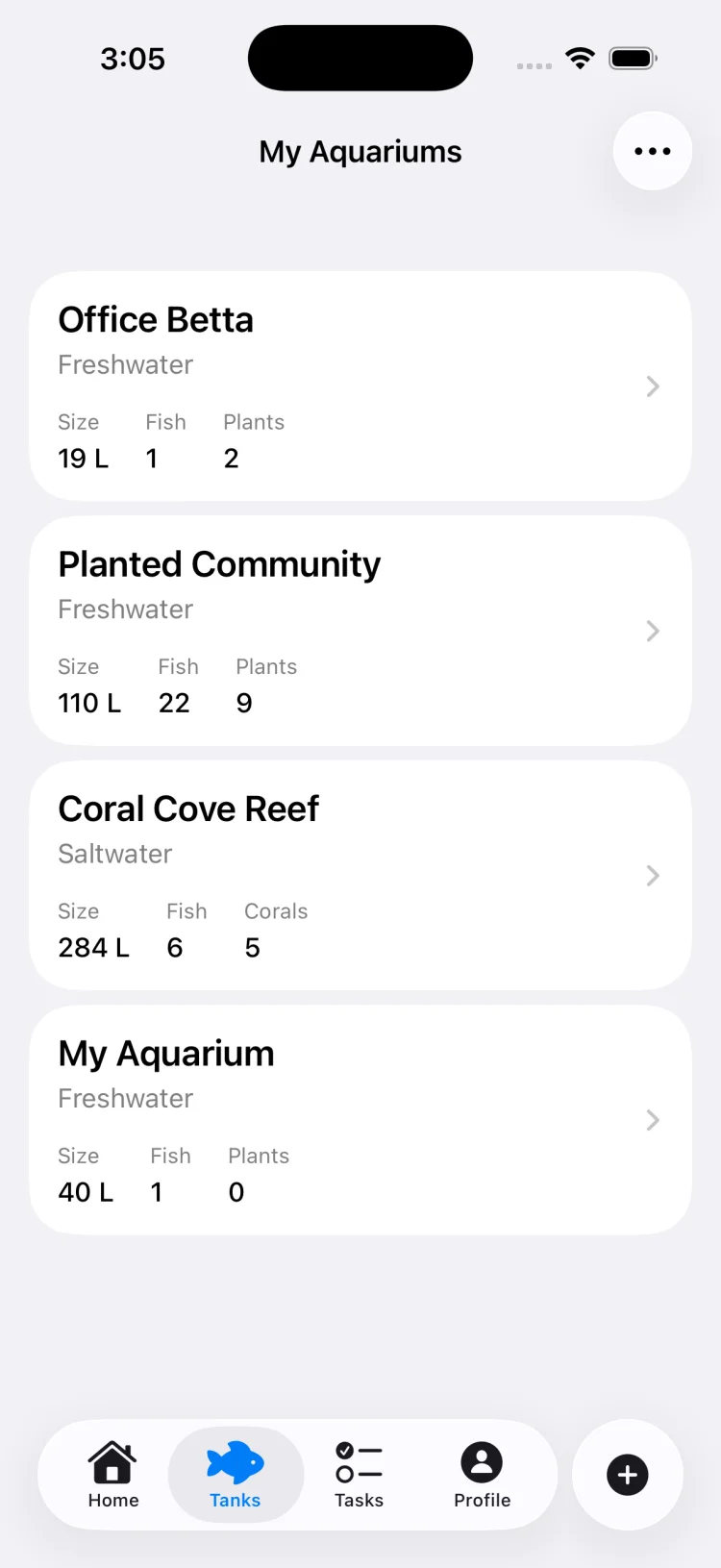
You can run a freshwater community in the living room and a reef in the office, log both in the same app, and view them together in the aquarium list or separately in their own dashboards. Maintenance tasks, parameter history, and livestock all stay organised by tank. If you convert a tank from fresh to salt, archive the old tank and create a new one with the saltwater type; the old data stays searchable and the new one starts clean.
The species database covers both worlds
TankSync's species library includes 173 freshwater fish, 179 saltwater fish, 61 freshwater invertebrates, 126 saltwater invertebrates, 82 corals and 40 plants. Filter the database by water type and you see only what suits the tank you are stocking. Compatibility checks work within type: a freshwater fish is checked against other freshwater species, a saltwater fish against saltwater, and coral gets reef-specific guidance on light, flow and nutrient tolerance. The database does not mix types, so you will not accidentally receive advice to pair a clownfish with a betta.
Tracking a saltwater tank in TankSync
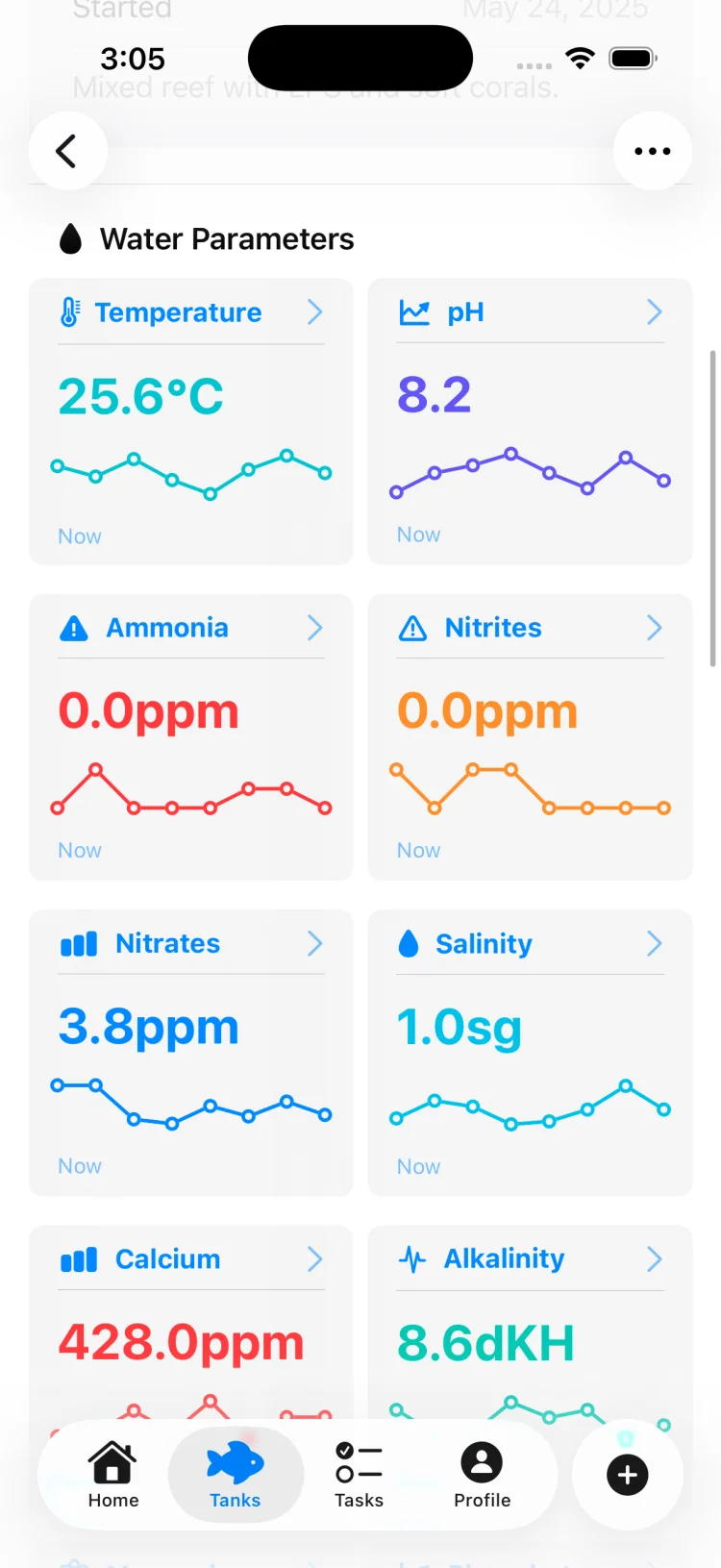
Set the water type once, and the app handles the rest:
- Create a new aquarium and set the water type to saltwater or reef. The parameter list and safe ranges switch automatically.
- Log temperature, pH, ammonia, nitrite, nitrate and salinity as you test. Reef adds calcium, alkalinity, magnesium and phosphate.
- Add saltwater species from the filtered database. Compatibility checks, bioload calculations and care requirements all reflect marine livestock.
- Turn on test reminders for the parameters that drift fastest — alkalinity and calcium in a reef, salinity if you have high evaporation.
- Track maintenance like salt mixing, skimmer cleaning, dosing and top-offs the same way you would log a freshwater water change.
- Review tank health scoring weighted for the parameters that matter in your tank type.
General guidance, not a prescription
The cost ranges, timelines and parameter targets in this guide are typical, not universal. Equipment prices vary by region and brand. Maintenance time depends on tank size, automation level and stocking density. Safe parameter ranges vary by species, and reef coral in particular shows wide variance in light, flow and nutrient tolerance.
TankSync's reference content, including its species data and AI features, is informational and is not veterinary advice. Verify anything that affects an animal's health against your own test results and, where the animal is unwell, an aquatic veterinarian.
Frequently asked questions
Is a saltwater aquarium harder than a freshwater one?
It is less forgiving, not intrinsically harder. The nitrogen cycle works the same way, testing is no more difficult, and the core maintenance loop is identical. The difference is tolerance for neglect. Miss a water change in a freshwater tank and nitrate climbs slowly. Miss it in a saltwater tank and alkalinity can crash over a week or two, which stresses coral and fish far faster. Reef tanks add more parameters to track, and marine livestock is usually more expensive, which makes mistakes feel costlier. If you test consistently and hold a schedule, saltwater is not harder, but if you tend to forget for a fortnight it punishes you harder.
Is saltwater more expensive than freshwater?
Yes, and the gap is structural. A freshwater setup can run on a sponge filter, a heater and dechlorinated tap water. Saltwater requires the same baseline filtration, plus a way to make or buy purified water, salt mix, a hydrometer or refractometer, and usually a protein skimmer for anything beyond the lightest stocking. Reef adds high-output lighting, dosing pumps or two-part solutions, and test kits for calcium, alkalinity and magnesium. Livestock costs more too: a clownfish costs multiples of what a zebra danio does, and a single soft coral often costs what a school of tetras would. Over the first year, a modest reef setup typically costs three to five times what an equivalent-sized freshwater community does.
Can a beginner start with a saltwater tank?
Yes, but the consequence of error is higher. The process of cycling, testing and doing water changes is not more complex in saltwater; it just requires more precision and the livestock tolerates less variance. A beginner who can commit to weekly testing and water changes, who is comfortable spending more up front and who accepts that their first coral might die while they learn will do fine. A beginner who wants to test monthly and skip a water change when life gets busy should start with freshwater. The skills transfer completely, so starting fresh and switching to salt later is a common and sensible path.
What is the difference between a reef tank and a fish-only saltwater tank?
A fish-only saltwater tank keeps marine fish without coral or invertebrates, which removes the need for high-intensity reef lighting, stable calcium and alkalinity levels, and the dosing regime that goes with it. The parameter list shrinks to the same basics as freshwater plus salinity. Cost drops substantially because you do not need expensive LED fixtures or two-part additives. A reef tank adds coral, which are live animals with their own requirements. Coral needs stable alkalinity, calcium and magnesium, strong lighting in the correct spectrum, low nutrient levels, and steady water flow. Reef is significantly more involved and expensive than fish-only, which is itself more involved than freshwater.
Do I need RO water for a saltwater aquarium?
Not strictly, but most tap water will cause problems eventually. Saltwater mixing amplifies everything in the source water. Tap water with moderate phosphate or silicate becomes high-phosphate or high-silicate saltwater, which feeds algae that smother coral and cloud the glass. Chlorine, chloramine and heavy metals that a dechlorinator handles in freshwater are present in higher effective concentration once salt is added. RO or RO/DI water gives you a blank slate: zero phosphate, zero silicate, no chlorine, predictable results. You can run a fish-only tank on dechlorinated tap if your municipal supply is good and you stay on top of algae. Reef strongly prefers RO/DI, and most long-term saltwater keepers use it for everything.
Can I convert a freshwater tank to saltwater?
The tank, stand, heater and possibly the filter housing carry over. Almost everything else does not. Freshwater substrate needs replacing with sand or bare bottom because gravel traps detritus in saltwater and most planted substrates leach nutrients that fuel algae. The filter media should be replaced or sterilised because it is colonised with bacteria suited to freshwater parameters. Lighting for a planted tank is not enough for coral. You will need to add a protein skimmer, a way to produce or source RO/DI water, and test kits for the additional parameters. Empty the tank, clean it thoroughly, start from scratch with the cycle, and you have a saltwater tank in the same glass box. The process is straightforward, but very little of the original equipment and none of the livestock makes the jump.