Walk into any aquarium shop and ask for beginner fish, and you will be shown goldfish, bettas, a common pleco, perhaps a bala shark if they are feeling optimistic about your tank size. Half of those will outgrow anything you own. The other half come with problems the sales assistant either does not know about or is choosing not to mention. The result is that most people's first tank is stocked with fish that were never going to work, and they conclude that fishkeeping is hard when the actual issue was the list.
The short version
Pick hardy species that stay small at adult size, tolerate the pH and hardness of your untreated tap water, school peacefully in groups of six or more, and are available as captive-bred stock. Cycle the tank first. Buy six of one thing rather than one of six things. Avoid anything the shop describes as staying small, growing to the tank, or being fine alone.
What makes a fish genuinely beginner-friendly
Beginner-appropriate is not the same as indestructible. No fish tolerates being kept in an uncycled tank, overfed, or housed at twice the sensible stocking density. What a beginner fish does is survive the smaller mistakes — the week you forgot to do a water change, the day the heater failed and nobody noticed until evening, the month you were dosing food for ten fish into a tank with three.
Tolerance of parameter swings
A beginner fish handles a pH shift of half a point and a temperature swing of three or four degrees without developing ich or going off its food. Sensitive species such as discus or Sulawesi shrimp require stable parameters within a narrow band, which is a skillset most people do not have in month two. Wild-caught fish are often far less tolerant than captive-bred individuals of the same species, which is one reason availability of captive stock matters.
Small adult size
Most beginners start with a tank between 40 and 100 litres. A beginner fish is one that reaches adult size in that volume and stays there. Anything sold at five centimetres that grows to twenty is not a beginner fish, it is a problem deferred. Ask for the adult size, then add thirty percent because the stated size is often the male and your fish may be female, and females of many species are noticeably larger.
Peaceful temperament
Aggression is manageable if you know what you are doing. If you do not, a territorial fish will kill half your tank before you realise something is wrong. Beginner fish are species that can share a seventy-litre community tank with five other species without anyone getting shredded. This rules out most cichlids, many barbs, and anything with the word shark in the common name.
Availability of captive-bred stock
Captive-bred fish tolerate a wider range of conditions, arrive healthier, and do not carry the parasite load common in wild-caught imports. They also do not collapse your beginner tank because the pH is half a point off what they had in the river. If the species is only available wild-caught, it is probably not a beginner species.
Willingness to eat prepared food
A beginner fish eats flake, small pellets, or frozen food without a fuss. Anything that requires live food, or only eats after weeks of coaxing, or needs its diet supplemented with vegetables you do not stock, is adding a layer of complexity a first tank does not need.
Disease resistance
Some species are prone to specific diseases that wipe them out regardless of care quality. Dwarf gourami and the iridovirus problem is the textbook example. A beginner fish is one where, if you keep the water clean and the parameters stable, it does not develop something untreatable six months in.
Freshwater species worth starting with
The species below are grouped by type. Within each group, pick one or two species for your first tank, not one of everything. A tank stocked with twelve cardinal tetras and six corydoras will be calmer, healthier, and easier to manage than a tank with two of six different species.
Small tetras and rasboras
Cardinal tetras, neon tetras, ember tetras, harlequin rasboras, and chili rasboras are small, peaceful, colourful, and available as captive-bred stock. They school, which means you need at least six and ideally eight to ten. Adult size is three to five centimetres. Minimum tank is 40 litres for the smaller species, 60 litres for cardinals. They tolerate a pH from 6.0 to 7.5 and are soft-water fish, so they suit tanks where the tap water is naturally low in hardness. Feed micro pellets or crushed flake once or twice daily.
The common mistake is buying three. A shoal of three tetras hides constantly, shows washed-out colour, and the dominant individual often harasses the other two. Buy eight.
Danios
Zebra danios, leopard danios, and celestial pearl danios are active, hardy, and tolerate cooler water than most tropical species. Zebra and leopard danios reach about five centimetres and need a 60-litre tank minimum because they are fast, active swimmers that stress in cramped spaces. Celestial pearl danios stay under three centimetres and suit a 40-litre tank. Temperature range is 18 to 26 degrees Celsius for zebras, slightly warmer for celestials. They tolerate hard or soft water and accept flake or micro pellets.
The common mistake is assuming their hardiness means you can skip the cycle. You cannot. They survive parameter swings better than most species, but they still die in an uncycled tank.
Corydoras catfish
Panda corydoras, bronze corydoras, peppered corydoras, and albino corydoras are peaceful bottom-dwellers that clean up leftover food and look good doing it. They need groups of six or more, stay under six centimetres at adult size, and suit a 60-litre tank. They prefer soft, slightly acidic water but tolerate a fairly wide range. Temperature is 22 to 26 degrees. Feed sinking pellets or wafers in the evening after the lights go out, when they are most active.
The common mistake is keeping them on gravel sharp enough to damage their barbels. Use sand or smooth rounded gravel, and keep the substrate clean — corydoras sift through it constantly and will develop infections if it is layered with detritus.
Platies and other livebearers
Platies, variatus platies, and Endler's livebearers are colourful, active, hardy, and breed enthusiastically. Adult size is four to six centimetres. Minimum tank is 60 litres. They prefer hard, alkaline water — pH 7.0 to 8.0 — so they suit tanks where the tap water comes out at pH 7.5 or higher. Temperature range is 20 to 28 degrees. Feed flake or small pellets.
The common mistake is not understanding that livebearers breed. A pair will turn into thirty fish in three months. If you do not want fry, keep males only, or accept that the population will grow and plan accordingly. Guppies and mollies are also livebearers, but guppies are fragile in most tap water and mollies grow large and produce spectacular amounts of waste.
Honey gourami as the dwarf gourami alternative
Honey gourami are peaceful, beautiful, stay under five centimetres, and do not carry the iridovirus that kills dwarf gourami. They suit a 40-litre tank, prefer soft slightly acidic water, and tolerate being kept singly or in pairs. Temperature is 24 to 28 degrees. They eat flake, micro pellets, and frozen food. Males develop a striking orange throat when mature.
The common mistake is buying dwarf gourami instead because they are more widely stocked. Dwarf gourami iridovirus has no treatment and a mortality rate approaching one hundred percent in affected populations. Honey gourami are harder to find but worth the search.
Bristlenose pleco
Bristlenose plecos are one of the few plecos that stay small — twelve to fifteen centimetres maximum. They are efficient algae-eaters, peaceful, and hardy. Minimum tank is 80 litres. They tolerate a wide pH range and temperatures from 20 to 28 degrees. Feed algae wafers and blanched vegetables. They need driftwood in the tank to rasp on for digestive health.
The common mistake is assuming any pleco stays small. The common pleco reaches 45 centimetres and needs tanks in the many hundreds of litres. If the shop cannot tell you the species name, do not buy it.
Betta as a species-tank option
Betta splendens — the Siamese fighting fish — is hardy, beautiful, and suitable for a beginner provided it is kept alone or with carefully chosen tank mates in a tank of at least 20 litres with a heater and a gentle filter. They do not belong in bowls. Temperature is 24 to 28 degrees. Feed betta pellets or frozen food. Males cannot be housed together. Females are less aggressive but still territorial.
The common mistake is the bowl, or pairing them with long-finned slow-moving fish they will shred, or keeping the tank unheated. Bettas are tropical fish. They need warm water.
Cherry shrimp and nerite snails as first invertebrates
Cherry shrimp are small, colourful, breed readily, and are entirely peaceful. They need a cycled tank with stable parameters, no fish large enough to eat them, and some plant cover. Minimum tank is 20 litres. Temperature is 18 to 28 degrees. They eat biofilm, algae, and leftover food.
Nerite snails are the best algae-eating snail for beginners because they do not breed in freshwater, so you will not end up with two hundred snails. They reach about two centimetres, tolerate a wide range of conditions, and need hard water to maintain shell health. Feed algae wafers if algae runs low.
Beginner freshwater picks
| Species | Adult size | Minimum tank | Group size | Temperature range | Notes |
|---|---|---|---|---|---|
| Cardinal tetra | 5 cm | 60 L | 8+ | 24–28°C | Soft water, peaceful, schooling |
| Harlequin rasbora | 4 cm | 40 L | 8+ | 22–26°C | Hardy, accepts most water |
| Zebra danio | 5 cm | 60 L | 6+ | 18–26°C | Very hardy, active swimmers |
| Panda corydoras | 5 cm | 60 L | 6+ | 22–26°C | Needs sand substrate |
| Platy | 6 cm | 60 L | 3+ | 20–28°C | Hard water, breeds readily |
| Honey gourami | 5 cm | 40 L | 1–2 | 24–28°C | Peaceful, soft water preferred |
| Bristlenose pleco | 12 cm | 80 L | 1 | 20–28°C | Needs driftwood |
| Cherry shrimp | 3 cm | 20 L | 5+ | 18–28°C | Breeds in freshwater |
| Nerite snail | 2 cm | 20 L | 1+ | 20–28°C | Does not breed in freshwater |
Popular beginner fish that are a worse idea than they look
The species below are stocked in every aquarium shop, recommended constantly, and responsible for a large proportion of the beginner tanks that fail within six months. They are not bad fish. They are bad beginner fish, for reasons that are predictable and well documented but somehow never make it onto the sales pitch.
Goldfish in small tanks
Common goldfish and comet goldfish reach 25 to 30 centimetres and produce waste at a rate that requires heavy filtration and large weekly water changes. They need ponds or tanks over 200 litres. Fancy goldfish — orandas, ryukins, fantails — stay smaller at fifteen to twenty centimetres but still need at least 150 litres for the first fish and 50 litres for each additional one. All goldfish are coldwater fish that do not belong in heated tropical community tanks.
The myth that goldfish grow to the size of the tank is a misunderstanding of stunting. A goldfish in a bowl does not stay small because the tank is small; it stays small because its growth is suppressed by poor water quality, and it dies young from organ damage caused by that stunting. If you want a coldwater fish for a small tank, white cloud mountain minnows stay at four centimetres and thrive in 40 litres.
Common pleco
Sold at five to eight centimetres as an algae-eater for any tank, the common pleco reaches 45 centimetres and produces more waste than it cleans up. It needs a tank of at least 500 litres at adult size, heavy filtration, and a diet supplemented with algae wafers and vegetables because no tank grows enough algae to sustain one. Most people rehome them or, worse, do not, and the fish spends years in a tank a quarter the size it needs.
Bristlenose plecos stay under fifteen centimetres and do the same job in a fraction of the space.
Bala shark
Bala sharks are beautiful, active, and reach 35 centimetres. They need to be kept in groups and require tanks over 500 litres. They are sold at five centimetres to people with 100-litre tanks, and the outcome is always the same: a stressed, cramped fish that either dies or gets rehomed when it outgrows the tank two years later.
Iridescent shark
Iridescent sharks reach over a metre in length and are active, fast swimmers that need massive tanks or ponds. They are sold as juveniles for a few dollars and grow faster than almost any other commonly sold species. This is not a beginner fish, it is a pond fish sold to people who do not have ponds.
Red-tailed shark and rainbow shark
Both are highly territorial and aggressive, particularly as they mature. They will kill or harass any other bottom-dweller in a tank under 200 litres and often attack fish at all levels. Sold as algae-eaters for community tanks, they are species-tank fish at best.
Dwarf gourami
Dwarf gourami iridovirus is endemic in the commercial breeding population. The disease has no treatment and kills the fish within weeks to months of symptoms appearing. A significant proportion of dwarf gourami sold are either already infected or incubating it. Honey gourami, which are not affected, are harder to find but far less likely to die six weeks after purchase.
Chinese algae-eater
Peaceful and effective as juveniles, Chinese algae-eaters become aggressive as adults and frequently attach themselves to the sides of larger, slow-moving fish to feed on their slime coat. They stop eating algae as they mature and need a meaty diet. Otocinclus catfish or bristlenose plecos are better algae-eaters.
Any fish sold as will stay small
If the shop tells you a fish will not grow, or will grow to the size of the tank, or stays small enough for a bowl, and they cannot or will not tell you the species name and adult size, do not buy it. Most of the disasters in beginner tanks are fish that were sold at five centimetres with assurances they would not get bigger.
The trap list
| Species | Sold at | Actual adult size | Why it fails in a first tank | Better alternative |
|---|---|---|---|---|
| Common goldfish | 3 cm | 25–30 cm | Needs 200+ litres, coldwater only | White cloud mountain minnow |
| Common pleco | 5–8 cm | 45 cm | Needs 500+ litres, heavy waste | Bristlenose pleco |
| Bala shark | 5 cm | 35 cm | Needs 500+ litres, schools | Zebra danio |
| Iridescent shark | 8 cm | 100+ cm | Grows huge, needs ponds | Any actual small species |
| Red-tailed shark | 5 cm | 15 cm | Highly territorial, aggressive | Corydoras catfish |
| Dwarf gourami | 5 cm | 8 cm | Iridovirus kills most within months | Honey gourami |
| Chinese algae-eater | 4 cm | 28 cm | Aggressive as adult, attacks fish | Otocinclus or bristlenose |
If you are starting saltwater
Saltwater is not chemically harder than freshwater — pH and salinity are more stable than in most freshwater setups — but it is far less forgiving of neglect, and every mistake costs more. A heater failure that would stress freshwater fish will kill an entire saltwater tank. Beginner saltwater means starting with hardy species, testing more often, and accepting that restocking after a disaster is five times the price.
Clownfish
Ocellaris clownfish and percula clownfish are hardy, captive-bred, stay around eight centimetres, and do not require an anemone despite what the marketing implies. They tolerate moderate parameter swings, eat pellets and frozen food, and can be kept singly or in pairs. Minimum tank is 80 litres. Temperature is 24 to 27 degrees Celsius, salinity 1.020 to 1.025. They are the single best beginner saltwater fish.
Some damsels, with warnings
Damsels are extremely hardy and will survive conditions that kill everything else, which is why they are often recommended for cycling a new saltwater tank. The problem is temperament. Most damsels are viciously territorial and will harass anything added to the tank after them. If you start with damsels, you often end with damsels, because nothing else survives. Avoid them unless you are setting up a damsel-only tank.
Yellowtail damsel and azure damsel are less aggressive than most, but they are still damsels.
Watchman gobies and firefish
Yellowtail watchman gobies and purple firefish are peaceful, beautiful, small, and suitable for reef tanks. Watchman gobies reach about eight centimetres and spend most of their time near the bottom, often pairing with pistol shrimp. Firefish reach six centimetres and hover in the water column. Both accept frozen and prepared foods. Minimum tank is 60 litres. They are shy and need rockwork with hiding spots.
Cleanup crew before fish
Hermit crabs, turbo snails, and nassarius snails handle algae and detritus better than most beginner fish. Add the cleanup crew first, after the tank is cycled, and let them establish before adding fish. They are cheap, effective, and hard to kill.
The honest warning
Saltwater tanks need more equipment — protein skimmers, powerheads for flow, often a sump — and more testing. Calcium, alkalinity, and magnesium matter in reef tanks. Salinity shifts from evaporation unless you top up with fresh water. The livestock costs five to ten times what freshwater costs, so a single mistake that wipes the tank is financially painful in a way freshwater is not.
If you have never kept a tank before, start freshwater. If you are set on saltwater, read the saltwater versus freshwater guide first, understand what you are signing up for, and budget twice what you think it will cost.
How many to buy and in what order
Stock in groups, stock slowly, and stock species that are compatible with each other and with your water. The order and the numbers matter more than most beginners realise.
Schooling minimums of six
Any species described as schooling, shoaling, or needing to be kept in groups needs at least six. Eight to ten is better. A school of three tetras is not a school, it is three stressed fish. The dominant one bullies the other two, the subdominant fish fades in colour, and all three spend most of the day hiding. A school of eight or more spreads the aggression across enough individuals that no single fish is constantly harassed, and the group behaves like a school — moving together, displaying colour, occupying the tank rather than the back corner behind the filter.
This is the single most common stocking mistake. People buy two neon tetras, two corydoras, two danios, thinking variety is more interesting than numbers. It is not. A tank with ten cardinal tetras and six panda corydoras is more active, more colourful, and healthier than a tank with two each of five species.
Add a few at a time
A newly cycled tank has a bacterial colony sized for the ammonia you dosed during the cycle, which is usually less than the waste produced by a full stocking. Add six to eight small fish, wait two weeks, test ammonia and nitrite, and if both are zero, add the next group. Adding everything at once risks overloading the filter and triggering a mini-cycle, which is an ammonia spike in a supposedly finished tank.
The exception is if you are stocking a species that needs to establish territory simultaneously, such as some cichlids. For most community fish, stagger it.
Quarantine if you can
A quarantine tank is a second small tank — 20 to 40 litres — where new fish spend two to four weeks before joining the main tank. It lets you observe for disease, treat with medications without dosing the main tank, and avoid introducing parasites or infections to an established population. Quarantine is standard practice in saltwater, less common in freshwater, and worth doing if you have the space.
If you cannot quarantine, at least inspect new fish closely before purchase. Avoid any fish with white spots, clamped fins, rapid breathing, visible wounds, or that is hiding while the rest of the tank is active. A sick fish in the shop will still be sick in your tank.
How TankSync fits into choosing and tracking fish
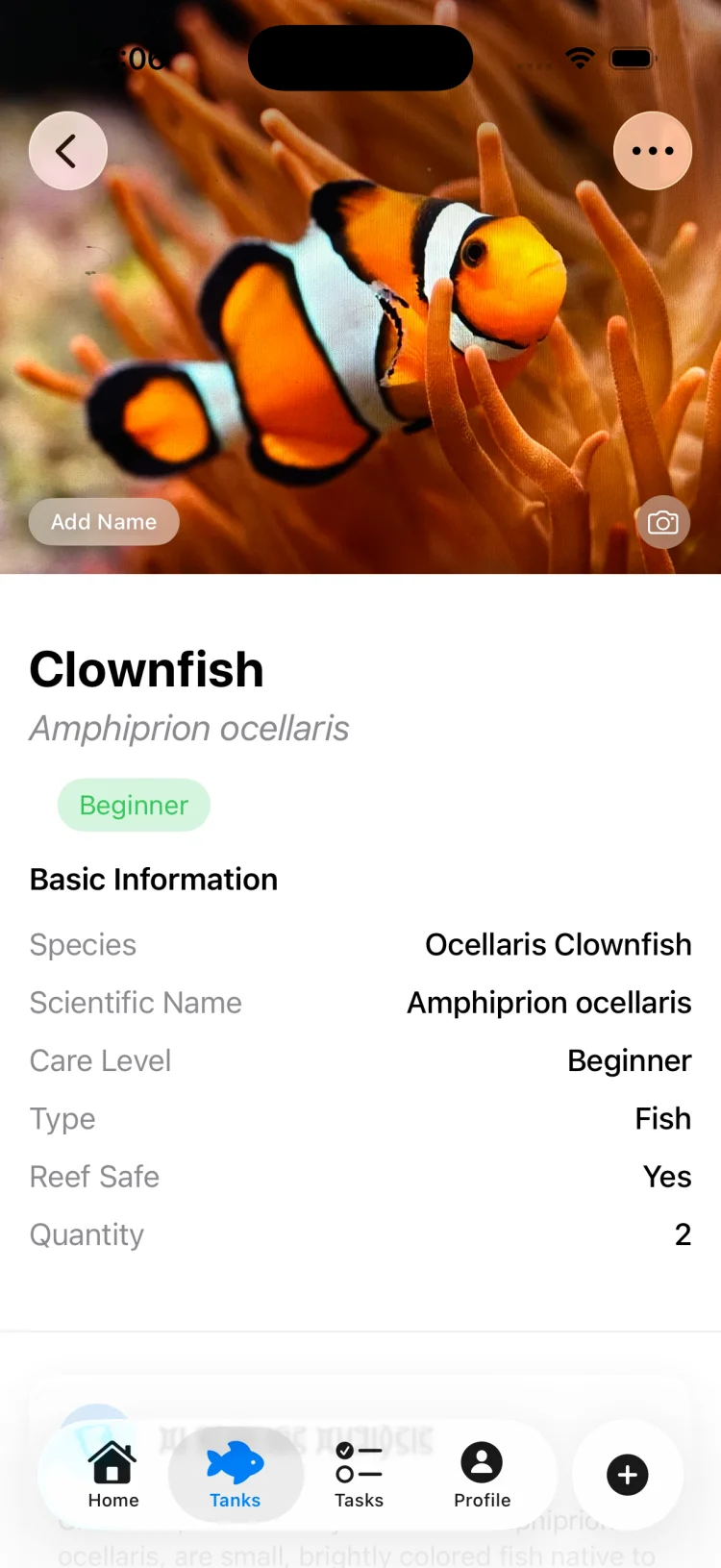
Choosing compatible fish that suit your tank size and water type is easier when the reference data is built in. TankSync has detailed profiles for 857 species across freshwater, saltwater, corals, plants and invertebrates, with per-species care requirements, compatibility scoring, and AI-powered identification for the fish in the shop tank with the illegible handwritten label.
Species database with per-species care requirements
Every species profile includes adult size, minimum tank volume, preferred temperature and pH range, diet, temperament, and reef-safe status for saltwater species. The data is structured so you can filter by tank size, water type, and temperament before you ever leave for the shop. If a species needs 200 litres and you have 60, the app tells you that before you buy it, not six months later when it has outgrown the tank.
Compatibility check before purchase
The compatibility tool cross-checks species against each other for aggression, size mismatch, parameter overlap, and predator-prey relationships. Add the species you already own, then check a prospective new fish against the existing stock. The app scores compatibility and flags specific conflicts — territorial aggression, size-based predation, or parameter incompatibility — so you know what you are adding before you add it.
The fish compatibility guide covers how the scoring works and what the conflict types mean in practice.
AI photo identification for the unlabelled shop tank
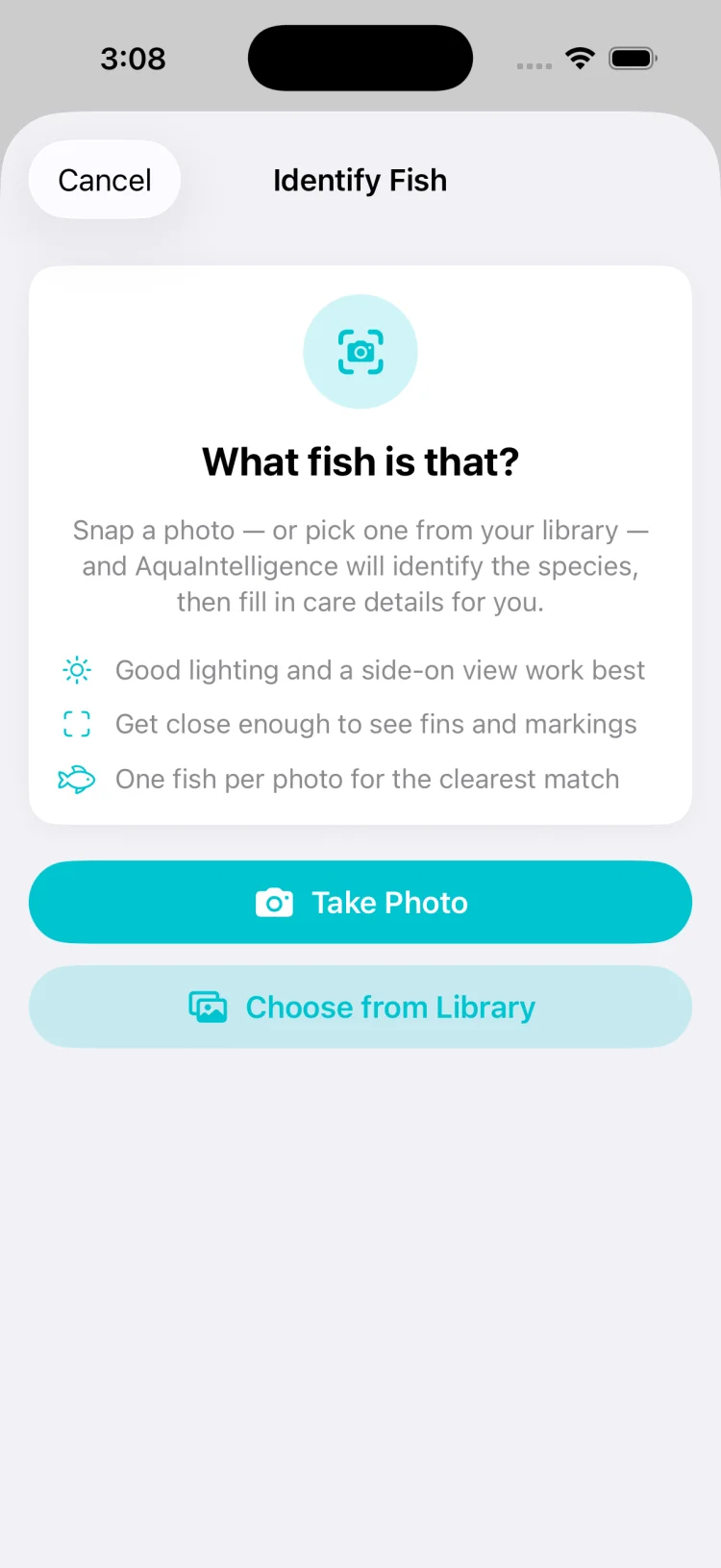
Point your phone at the fish, tap the AI identification button, and TankSync analyses the image against the species database. It returns likely matches with confidence scores, so you can confirm what you are buying even when the shop has labelled it "assorted tetra" or "pleco species." Identification is a Pro feature and works best with clear, well-lit photos of individual fish.
Checking compatibility before you buy
Add your tank to TankSync, then check new species before you leave for the shop:
- Open the species database and filter by freshwater or saltwater, then by your tank size.
- Tap a species to see its full profile: adult size, temperature and pH range, minimum tank, group size, diet, and temperament.
- Add the species to your tank as a potential addition, then run the compatibility check against your existing stock.
- Review the compatibility score and any flagged conflicts. If it shows aggression or parameter mismatch, pick a different species.
- Use AI photo identification in the shop to confirm species when labels are vague or missing.
- Log the fish once purchased, and track population, feeding schedule, and any health observations in the journal.
General guidance, not a prescription
The species recommendations, tank sizes, and parameter ranges in this guide are typical values, not absolute requirements. Individual fish vary in temperament, size at maturity, and tolerance of conditions outside their preferred range. Water chemistry, tank maturity, filtration capacity, and stocking density all affect whether a species thrives or merely survives.
TankSync's species database, compatibility scoring, and AI identification features are informational tools and are not a substitute for research, observation, or professional advice. Species data is compiled from multiple sources and represents general care requirements; verify any critical parameter against your own testing and the specific needs of your livestock. When fish show signs of illness or stress, consult an aquatic veterinarian.
Frequently asked questions
What are the best fish for a beginner?
The best beginner fish are hardy, small at adult size, peaceful, and widely available as captive-bred stock. In freshwater, cardinal tetras, harlequin rasboras, panda corydoras, platies, honey gourami, and bristlenose plecos are all good first choices because they tolerate parameter swings, accept prepared food, and stay small. In saltwater, ocellaris clownfish and firefish are genuinely beginner-appropriate. The critical part is choosing species that match your untreated tap water and stocking in groups of six or more where the species schools, rather than buying one of everything.
What is the hardiest freshwater aquarium fish?
White cloud mountain minnows and zebra danios are the hardiest common freshwater fish, tolerating temperatures from 15 to 28 degrees Celsius and a pH from 6.0 to 8.0. They survive beginner mistakes that would kill more sensitive species. That said, hardiness without consideration of adult size, temperament, and minimum group size still produces a bad outcome — a hardy fish in the wrong setup is still a stressed fish. Cherry barbs, platies, and many corydoras species are nearly as hardy and easier to accommodate in typical community tanks.
Are goldfish good beginner fish?
No. Goldfish are sold as beginner fish because they are cheap and tolerate cold water, but common and comet goldfish reach 25 to 30 centimetres and need ponds or tanks well over 200 litres. Fancy goldfish stay smaller but still need 150 litres or more and produce waste at a rate that overwhelms small filters. The typical goldfish-in-a-bowl setup kills the fish in months from ammonia poisoning and stunted growth. If you want a coldwater fish for a small tank, white cloud mountain minnows are a far better choice.
What is a good first saltwater fish?
Ocellaris clownfish are the best first saltwater fish. They are captive-bred, hardy, stay small at around 8 centimetres, tolerate moderate parameter swings, and do not require an anemone despite what the films imply. Firefish and purple firefish are also good early choices for a peaceful tank. Avoid most damsels — they are hardy but viciously territorial and will make stocking anything else difficult. Saltwater is not harder chemistry than freshwater but it is less forgiving of neglect and far more expensive per mistake, so start with a cycled tank and stock slowly.
How long should I wait before adding fish to a new tank?
Wait until the tank is fully cycled, which takes four to eight weeks for a fishless cycle or one to two weeks if you seed the filter with media from an established tank. The test for completion is functional: dose ammonia to 2 ppm, and if 24 hours later both ammonia and nitrite read zero and nitrate has risen, the filter is ready. Adding fish to an uncycled tank exposes them to ammonia and nitrite poisoning for weeks, which kills many outright and damages the survivors. Patience during the cycle is the single cheapest way to avoid the expensive beginner disasters.
Should I buy one fish or a group?
Buy a group of six or more for any schooling species — tetras, rasboras, danios, corydoras, and most small community fish. Schooling fish kept alone or in twos and threes are visibly stressed, hide constantly, fade in colour, and often become aggressive. A group of six cardinal tetras in a 60-litre tank will be healthier and more interesting to watch than six different species bought one at a time. Stock the first group, wait two weeks and test water parameters, then add the next group. Buying everything at once overloads a newly cycled filter and risks crashing it.