Ask a team after a mock code what their chest compression fraction was, and most will estimate somewhere in the 70s. Then you review the video or the timestamped timeline and the calculated number is 52 percent. Half the session was hands-off time, and nobody in the room noticed. This happens because pauses do not feel long in the moment, and there is no internal clock that totals them up. Chest compression fraction is the metric that separates what people think happened from what the record shows.
The short version
Chest compression fraction is the proportion of session time during which compressions were recorded as active. The formula is compression time divided by total time. A rehearsal target of 80 percent means hands-off time cannot exceed 20 percent. Most teams underperform their estimate by 15 to 25 percentage points because small pauses add up faster than expected. Reviewing the timestamped data from a practice session helps identify which pause categories contributed most to the total hands-off time.
What chest compression fraction means
Chest compression fraction, abbreviated CCF, is the percentage of session time during which compressions were recorded as active. It is a ratio: the numerator is the time compressions were logged as running, and the denominator is the total time from the start of the session to its end. The rest is hands-off time — pauses for rhythm checks, pulse checks, airway procedures, defibrillator charging, compressor swaps, moving the patient, or hesitation.
The metric appears in resuscitation literature and training debriefs as a way to quantify how much of a recorded session was spent compressing versus pausing. Every interruption affects the number, which makes it sensitive to changes in team coordination and pause management. Reviewing CCF from a timestamped timeline shows which pause categories contributed most to the total hands-off time.
Chest compression fraction is expressed as a percentage. A CCF of 80 percent means compressions were recorded for 80 percent of the total session duration and were paused for 20 percent. Unlike compression depth or rate, which reflect individual technique, CCF is a team-level metric. It reflects how the group managed transitions, coordinated roles, and sequenced interventions during the practice session.
How to calculate chest compression fraction
The formula for chest compression fraction is straightforward arithmetic. Start with the total duration of the recorded session. Then review the timestamped timeline to identify every interval during which compressions were not logged as active: rhythm checks, pulse checks, defibrillator charge time, intubation attempts, compressor changes, patient movement, and any other pause. Sum those pauses and subtract the total from the overall session duration. What remains is the compression time. Divide compression time by total time and multiply by 100 to get CCF as a percentage.
Here is a worked example using a recorded 20-minute practice session. The table below breaks the session timeline into compression periods and pauses, showing where the time was allocated.
| Event | Duration | Type |
|---|---|---|
| Initial compressions | 2:00 | Compression |
| First rhythm check | 0:12 | Pause |
| Compressions resume | 2:00 | Compression |
| Second rhythm check, shock delivered | 0:18 | Pause |
| Compressions resume | 2:00 | Compression |
| Compressor swap | 0:08 | Pause |
| Compressions continue | 1:45 | Compression |
| Intubation attempt | 0:35 | Pause |
| Compressions resume | 2:00 | Compression |
| Third rhythm check | 0:14 | Pause |
| Compressions resume | 2:00 | Compression |
| Fourth rhythm check, pulse check | 0:16 | Pause |
| Compressions resume | 1:50 | Compression |
| Move patient to bed | 0:22 | Pause |
| Compressions resume | 2:00 | Compression |
| Fifth rhythm check | 0:13 | Pause |
| Compressions resume | 2:07 | Compression |
Total session time: 20 minutes (1200 seconds). Total pause time: 12 + 18 + 8 + 35 + 14 + 16 + 22 + 13 = 138 seconds (2 minutes 18 seconds). Compression time: 1200 - 138 = 1062 seconds (17 minutes 42 seconds). Chest compression fraction: 1062 / 1200 = 0.885, or 88.5 percent.
This example shows a session with disciplined pause management. Notice that even with rhythm checks held to 12 to 18 seconds and only one extended intubation pause, the hands-off time still totaled more than two minutes. A similar session with rhythm checks that stretch to 20 seconds, a compressor swap that takes 15 seconds, and a second intubation attempt would produce a CCF in the low 70s. Add a prolonged pulse check, a delay while the defibrillator charges, and hesitation after a medication is logged, and the calculated CCF drops below 65 percent.
Where the hands-off time actually goes
Pause time accumulates in categories that feel necessary in the moment but are often longer than anticipated. Reviewing a timestamped timeline shows which pause categories contributed most to the total hands-off time.
Rhythm and pulse checks
Rhythm checks are brief pauses every two minutes to assess the cardiac rhythm on the monitor and determine whether a shock is indicated. Pulse checks follow if the rhythm appears organized. Training programmes commonly teach keeping these checks under 10 seconds. In recorded sessions, many teams take 15 to 20 seconds or longer because the team leader is interpreting the rhythm, deciding the next step, and communicating it to the room while compressions are stopped. Ten rhythm checks at 18 seconds each total three minutes of pause time and reduce CCF by 15 percentage points in a 20-minute session.
Defibrillator charging
Older defibrillators take several seconds to charge. In many recorded sessions, teams stop compressions while waiting for the charge to complete. Resuscitation training programmes commonly teach charging during compressions so that when the rhythm check confirms a shockable rhythm, the shock can be delivered immediately after a brief clear-the-patient pause. Charging after compressions stop adds 5 to 8 seconds to every shock cycle in the timeline.
Intubation attempts
Endotracheal intubation traditionally required stopping compressions so the intubator could visualize the cords without the chest moving. A single attempt can take 30 to 45 seconds, and failed attempts often lead to second or third tries in the timeline. Resuscitation training programmes commonly emphasize continuing compressions during intubation whenever feasible. Even with this approach, recorded sessions often show pauses longer than anticipated because the intubator signals for a stop without a defined time limit.
Compressor swaps
Compressor fatigue sets in quickly, and protocols commonly call for swapping the compressor every two minutes. A well-executed swap takes less than five seconds: the incoming compressor positions themselves, the team leader counts down the transition, and the new compressor takes over immediately. An uncoordinated swap can take 10 to 15 seconds in the timeline because the incoming person was not ready, nobody called the transition, or there was confusion about who was next. Five swaps at 12 seconds each total one full minute of pause time.
Moving the patient
Practice sessions often include moving a manikin from the floor to a bed, stretcher, or transport device. Many teams pause compressions during the move. The pause can last 20 to 40 seconds in the timeline depending on the distance and the number of people helping. Some teams rehearse moving with compressions continuing, either by having the compressor walk alongside or by coordinating a mid-lift swap.
Hesitation and uncertainty
This is the hardest category to measure but one of the most common in recorded sessions. Compressions stop because someone is not sure what comes next, the team leader is thinking, a medication is being drawn up and everyone is waiting, or the defibrillator pads need to be repositioned. These pauses are not always logged as discrete events in the timeline — they just happen, and they add seconds to every transition. Over a 20-minute session, hesitation pauses can total a minute or more.
Common benchmarks and rehearsal targets
Resuscitation guidelines commonly describe a chest compression fraction of at least 60 percent as a baseline, meaning hands-off time should not exceed 40 percent of the total session. Many training programmes set rehearsal targets higher, aiming for 80 percent or above. These benchmarks appear in resuscitation literature and are used in debriefs to evaluate recorded session data.
A calculated CCF of 60 percent means compressions were logged for 12 minutes of a 20-minute session and paused for 8 minutes. Programmes that review CCF from recorded sessions often find that teams without recent practice produce CCF in the 40 to 55 percent range, which is why the metric is emphasized in simulation training and debriefs.
A rehearsal target of 80 percent allows for necessary pauses — rhythm checks, pulse checks, defibrillation — while focusing on the pause categories that can be shortened. Reaching 80 percent in a practice session reflects disciplined pause management: charging during compressions, keeping rhythm checks under 10 seconds, pre-briefing compressor swaps, limiting intubation attempts, and resuming compressions promptly after every pause. Teams that rehearse these coordination patterns in mock codes commonly achieve 75 to 85 percent in recorded timelines.
Some teams aim for 90 percent or higher in simulations where they can test aggressive pause-reduction strategies in a controlled environment. The rehearsal target should be set based on the team's current baseline, the environment they work in, and the measurement tools available to them. Incremental improvement across multiple practice sessions is more practical than setting an aspirational target the team cannot measure.
Coordination patterns commonly rehearsed in practice sessions
Teams that achieve higher CCF in recorded timelines commonly rehearse coordination patterns that shorten pause duration. The following patterns appear frequently in resuscitation training programmes and mock code debriefs as areas of focus.
Charging the defibrillator during compressions
In many training scenarios, teams practice charging the defibrillator while compressions continue, rather than waiting until after compressions have stopped. This pattern eliminates the 5 to 8 second pause that appears in timelines when the team waits for the charge to complete. The defibrillator operator announces the charge to the room, then compressions stop only for the brief all-clear and shock delivery. This coordination pattern is commonly rehearsed in mock codes.
Pre-briefing the compressor swap
Before the two-minute mark, the team leader or timekeeper identifies the next compressor and signals them to get into position. The incoming compressor stands ready with hands hovering near the chest. At the rhythm check or swap point, the leader counts down the transition and the new compressor takes over immediately. This pattern eliminates the dead time that appears in timelines when the swap is unplanned and the incoming person has to move into position after compressions have stopped. Pre-briefing can reduce a 12-second swap to a 5-second swap in recorded data.
Calling the countdown for rhythm checks
Rather than letting compressions drift to a stop while the team leader looks at the monitor, some teams assign someone — the timekeeper or the team leader — to call a countdown for the rhythm check. Compressions stop on the mark, the rhythm is assessed, the decision is made, and compressions restart. The countdown keeps the check disciplined and appears in debriefs as a pattern that prevents the hesitation that stretches a 10-second check into 18 seconds in the timeline.
Hover hands during pulse checks
During a pulse check in a practice session, the person checking the pulse places their fingers on the manikin, but the compressor keeps their hands on the chest in position without pressing. The instant the pulse check is complete, compressions resume without the delay of repositioning. This pattern is sometimes called a "hands-ready" or "hover" technique in training. It saves 2 to 4 seconds per check in recorded timelines.
Continuing compressions once an advanced airway is in place
Once an endotracheal tube, supraglottic airway, or other advanced airway is secured and confirmed in a practice scenario, compressions no longer need to pause for ventilations. The compressor delivers continuous compressions, and the person managing the airway provides asynchronous ventilations without stopping compressions. This is a widely taught protocol shift that eliminates the 30:2 pause pattern and can raise CCF by 10 to 15 percentage points in the latter half of a recorded session. The pattern requires coordination and a clear signal that the airway is definitively placed.
Bounding pauses for procedures and movement
In some practice sessions, teams rehearse setting a time limit for pauses and communicating it to the room. For patient movement, teams practice moving with compressions continuing when feasible, or coordinate the move so the pause is as brief as possible. These patterns appear in debriefs as ways to bound pause duration in the timeline so it does not drift.
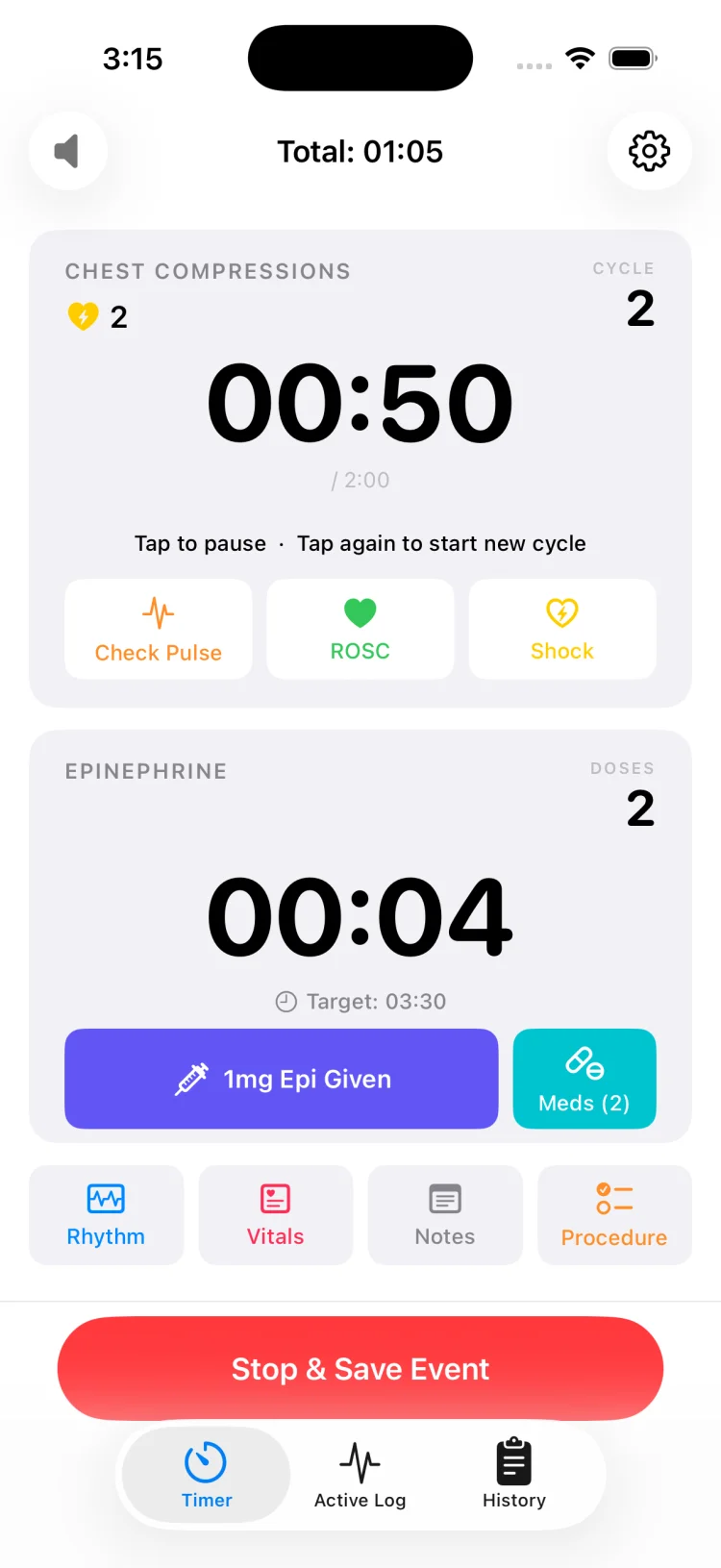
Tracking compression pauses in MedCode
MedCode timestamps every event so you can reconstruct the pause pattern after the session:
- Start the session and the compression cycle timer begins tracking the two-minute intervals.
- Log each rhythm check, shock, intubation attempt, and compressor swap as it happens — every entry is stamped with clock time and elapsed time.
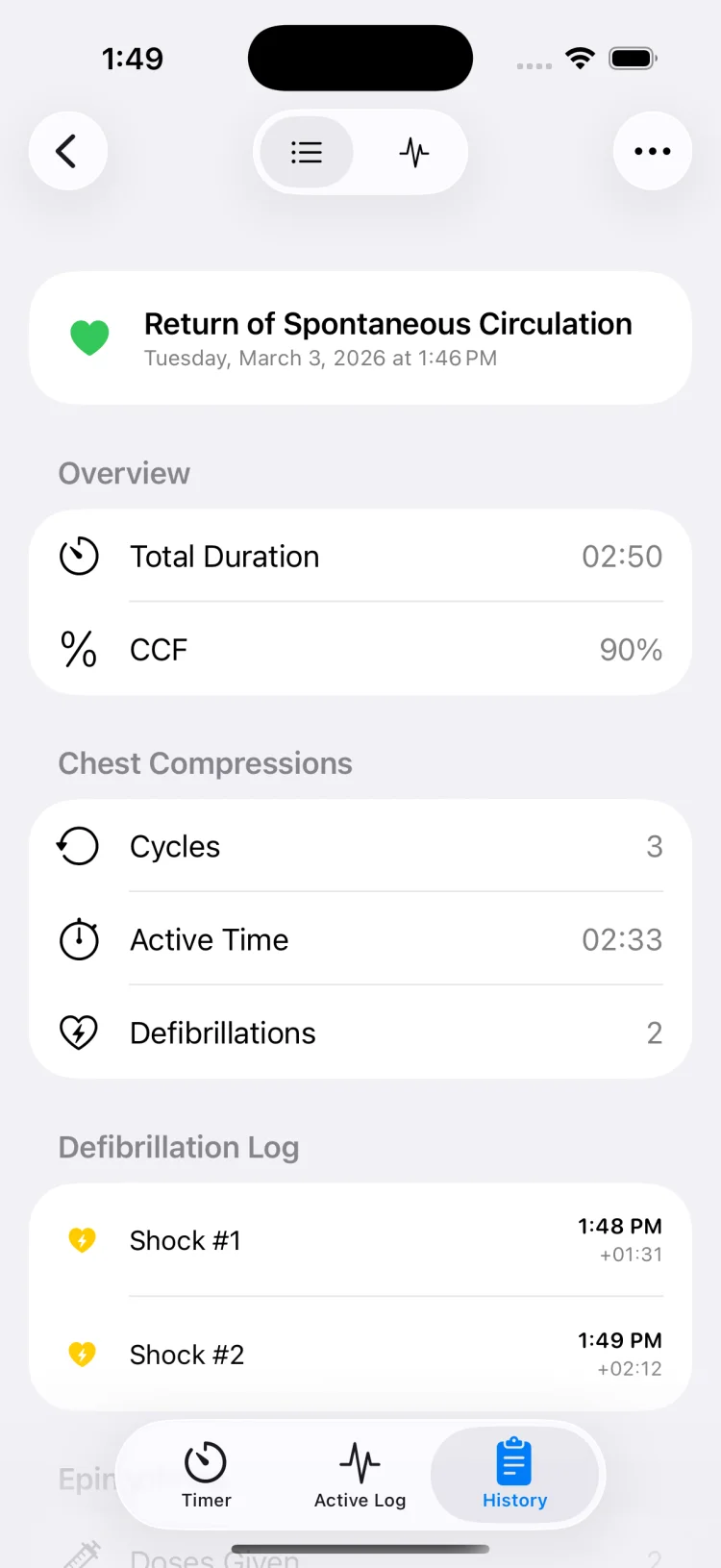
- After the session, review the exported timeline to identify the start and stop of each compression pause.
- Calculate compression time by subtracting total pause time from total session time, then divide by total time to calculate CCF.
- Use the calculated number in the debrief to review which pause categories contributed most to hands-off time.
Calculating chest compression fraction from timestamped data
Most defibrillators with CPR feedback capability can calculate CCF automatically by detecting compression depth with an accelerometer pad or by analyzing transthoracic impedance. These devices display real-time CCF and include it in the post-event summary. Automatic measurement from sensor data is more precise than manual calculation from timestamped logs.
If sensor-based feedback is not available, CCF can be estimated from a timestamped session log. This requires someone in the room or watching the video to note the clock time when compressions start and stop. After the session, add up the compression intervals and divide by total session time. The result is an approximation because human observers may miss brief pauses or misjudge duration. The margin of error is typically 5 to 10 percentage points, which is enough to identify whether the recorded session is in the ballpark of the intended target.
Video review improves the accuracy of manual calculation. If the training programme records simulations, a reviewer can watch the video afterward and timestamp every compression start and stop with a stopwatch or annotation tool. This approach catches pauses that were not logged in the moment. The limitation is that video review is time-intensive, so it is typically reserved for debriefs and quality improvement projects.
Manual calculation from timestamped data is subjective and prone to optimism. Teams tend to overestimate their own CCF because they remember the compressions more vividly than the pauses, and they round brief interruptions down to zero. This is why calculated CCF from reviewed data almost always comes in lower than the team's initial estimate. Use the best measurement tool available, and recognize its limitations when interpreting the number.
Using chest compression fraction in a debrief
Chest compression fraction is most useful when it is calculated and discussed in a structured debrief shortly after the practice session. The number gives the team an objective data point to anchor the conversation. A calculated CCF of 68 percent from the timeline is more concrete than someone saying "I think we paused too much."
Start the debrief by presenting the calculated CCF number. State the target the team was rehearsing and the actual result from the timeline, then ask the group where they think the time went. Most teams can identify one or two major pause categories — extended rhythm checks, a long intubation attempt, an uncoordinated swap — but miss the accumulation of small hesitations. Walk through the session timeline and point out each pause, using the timestamps or video if available. The goal is to build shared awareness of how quickly hands-off time compounds.
Compare the calculated CCF to the intended rehearsal target and pick one coordination pattern to focus on in the next practice session. If the team was aiming for 80 percent and the timeline shows 64 percent, identify the pause category that contributed the most. For example, if rhythm checks averaged 18 seconds in the timeline, the focus for next time might be keeping them under 12 seconds by implementing a countdown. If compressor swaps were uncoordinated, the team might rehearse the hover-and-swap technique. Focusing on one pattern change per training cycle is more practical than attempting multiple changes at once.
Track CCF over time so the team can see whether the rehearsed patterns are reflected in the data. Plot the number on a run chart for each simulation over a quarter or a year. If CCF is rising in successive sessions, the coordination patterns are sticking. If it is flat or declining, the debrief can explore why. Longitudinal tracking also helps normalize variation — a single low CCF in an unusually complex scenario is less informative than a consistent pattern across multiple sessions.
CCF is one metric among several. A session can produce a 90 percent CCF with shallow, slow compressions, which would not reflect the training goals. Compression fraction is typically reviewed alongside compression depth, compression rate, ventilation rate, time to first shock, and time to first epinephrine. CCF is valuable as an indicator of team coordination and pause discipline in a recorded practice session.
Exporting a timeline to calculate CCF
MedCode exports a PDF timeline you can use to calculate and review CCF in a debrief:
- Open the saved session from the history screen and tap Export.
- Choose the timeline format, which lists every logged event in chronological order with clock time and elapsed offset.
- Share the PDF to print it, email it, or review it on screen during the debrief.
- Use the timestamps to identify compression pauses, add them up, and calculate CCF manually.
- Annotate the timeline with pause categories and durations to show the team which categories contributed most to hands-off time.
Important: MedCode is a timer and documentation tool
MedCode is not clinical decision support and is not a medical device. It does not calculate chest compression fraction automatically, does not provide feedback on compression quality, and does not recommend clinical actions. The app records timestamps that allow you to estimate CCF after the event by reviewing the logged pauses. All clinical decisions, including targets for CCF and interventions to improve it, follow your local protocol and current resuscitation guidelines.
MedCode is a practice and training tool. It is not a medical device, not clinical decision support, and not a substitute for your institution's required documentation or protocol. Any use during a real event is the individual clinician's own professional judgement.
Frequently asked questions
What does chest compression fraction tell you about a practice session?
Chest compression fraction is the proportion of the total session time during which compressions were recorded as active. Resuscitation guidelines commonly describe a minimum of 60 percent, with many training programmes using 80 percent or higher as a rehearsal target. A calculated CCF below 60 percent indicates that hands-off time made up more than 40 percent of the recorded session. The number is useful for reviewing which pause categories contributed most to hands-off time and for comparing session data across multiple practice runs.
How do you calculate chest compression fraction from a session timeline?
Chest compression fraction is calculated as compression time divided by total session time, expressed as a percentage. Start with the total duration of the recorded session. Then review the timeline to identify every hands-off interval: rhythm checks, pulse checks, defibrillator charge time, intubation attempts, compressor changes, and any other recorded pause. Sum those pauses and subtract the total from the overall session duration. What remains is the compression time. Divide compression time by total session time and multiply by 100 to get CCF as a percentage. For example, a 20-minute session with 16 minutes of recorded compression time has a CCF of 80 percent. The calculation requires accurate timestamps, which is why reviewing an exported timeline is more reliable than estimating from memory.
What causes a low chest compression fraction in a recorded session?
A low chest compression fraction in a recorded session indicates that hands-off time accumulated across many pauses. Common sources in practice sessions include prolonged rhythm and pulse checks that stretch past 10 seconds, charging the defibrillator after compressions have stopped rather than during them, slow or uncoordinated compressor swaps, extended intubation attempts, moving the patient with compressions paused, and hesitation between steps. Each individual pause may be brief, but the cumulative effect compounds over the session duration. Reviewing the timestamped data helps identify which pause categories contributed most to the total hands-off time.
Does MedCode calculate chest compression fraction automatically?
No. MedCode does not automatically calculate chest compression fraction. It records the timestamps that make manual calculation possible. The compression cycle timer tracks compression intervals, and every logged event carries both clock time and elapsed time from the start of the session. After the session, you can review the exported timeline to identify hands-off intervals and calculate CCF manually or estimate it from the pattern of pauses. Automatic CCF calculation requires sensor data from a defibrillator or CPR feedback device that detects compression depth in real time. MedCode is a timer and documentation tool, not a feedback device.