Every compressor in a practice session is certain they are hitting the intended rate. They feel the rhythm in their shoulders, they count in their head, they remember the training. Then someone reviews the defibrillator's CPR feedback data or the session timeline and the recorded rate was 135 per minute for the first ninety seconds and 88 per minute by the end of the cycle. The compressor is surprised. The phenomenon is not — rate drift is one of the most consistent observations in resuscitation training. A metronome is the straightforward solution: an external, audible beat that the compressor does not have to generate or remember.
The short version
Resuscitation guidelines describe a compression rate range taught in training programmes. Most people drift outside that range without an external cue. A metronome paces the rate, but it does not measure depth, recoil or fraction. It is user-adjustable to match the rate specified in your training or protocol. Pair it with the two-minute cycle timer so the beat runs until the rhythm check, then use it during mock codes to build familiarity with the pacing cue.
Compression rate ranges in resuscitation guidelines
Resuscitation guidelines commonly describe a compression rate range for adult CPR that is taught in BLS and ACLS training programmes. The specific rate range is defined by the guidelines and training protocol your institution follows. MedCode's metronome is user-adjustable from 100 to 120 BPM to accommodate the rate specified in your training programme or institutional protocol. The app does not recommend a specific rate; it provides a configurable pacing cue at whatever rate you set.
The metronome is a tool for rehearsing pacing consistency during practice sessions. It externalizes the timekeeping so the compressor does not have to estimate tempo from memory. The rate you configure should match the rate taught in your current training or specified in your institutional protocol. Real-event use of any tool, including a metronome, is the individual clinician's professional judgment based on their training and the clinical context.
Why compression rate drifts without an external cue
Rate drift is a well-recognized observation in resuscitation training. Most compressors in practice sessions are confident they are maintaining the intended rate, and most are misjudging it. Here is why the rate slips without an external pacer.
Adrenaline pushes the rate up early
In the first minute of a practice session, the compressor is fresh, alert and acutely aware of the urgency. The body's stress response kicks in, and the natural tendency is to move faster than intended. A compressor can start significantly faster than the intended rate without realizing it, because the internal sense of tempo is distorted by adrenaline and the pressure of the scenario.
Fatigue pulls the rate down over the cycle
As the compressor moves through the two-minute cycle, fatigue sets in. The shoulders tire, the pushes require more conscious effort, and the rate begins to slow. By the ninety-second mark, a compressor who started fast may have drifted significantly slower. The compressor feels like they are working harder — and they are — but the rate has dropped.
No internal reference for accurate tempo
Human perception of rhythm is notoriously unreliable under stress. Without an external beat, the compressor has no objective reference for what a specific tempo actually feels like in real time. They are relying on memory, on a vague sense of "fast but not too fast," and on their proprioceptive feedback from the pushes. None of those inputs provide accurate tempo information, and all of them drift as the compressor fatigues or becomes distracted.
The crowded-room effect
A practice session is not a quiet environment. People are talking, alarms are sounding, the defibrillator is charging, someone is calling out the time. In that acoustic chaos, the compressor cannot hear their own rhythm and has no auditory cue to correct against. The rate drifts, and nobody notices until the cycle ends.
This is not a training problem. It is a human perception problem. Experienced compressors drift just as often as novices. An external, audible beat provides a consistent reference that the compressor can pace against.
What a metronome actually fixes — and what it does not
A metronome is a specific tool that addresses a specific problem. It is important to be clear about what it does and what it does not do, because the limitations matter.
What a metronome fixes
A metronome provides an external, audible beat at a fixed tempo. The compressor hears the beat and times their pushes to match it. This externalises the timekeeping and removes the need for the compressor to generate or estimate the correct cadence from memory. As long as the metronome is audible and the compressor is pacing to it, the compression rate stays within the target range.
The metronome corrects for rate drift caused by adrenaline, fatigue and distraction. It provides a stable reference that does not change based on how the compressor feels or how chaotic the room is. The beat is the beat, and the compressor follows it.
What a metronome does not fix
A metronome paces rate. It does not control compression depth, full chest recoil, or chest compression fraction. A compressor can pace perfectly to a 110 BPM beat and still deliver compressions that are too shallow, or fail to allow the chest to return to its resting position between pushes, or pause for too long during rhythm checks and airway management.
MedCode's metronome is an audible pacer. It is not a feedback device. It does not measure actual compression depth, actual delivered rate or the quality of recoil from an accelerometer or force sensor. It provides a target beat for the compressor to follow. If the compressor is not matching the beat, the metronome does not alert or correct — it just keeps ticking.
Compression quality is a combination of rate, depth, recoil and fraction. A metronome addresses one of those four variables. The rest depend on compressor technique, team coordination and the discipline to minimise pauses. See the chest compression fraction guide for the other variables that affect resuscitation quality.
Songs versus a real metronome
The idea of using a song to remember compression tempo is widely taught in CPR training. Songs with a specific tempo are used as mnemonic devices to help learners internalize a cadence. And for training, they work. But a song is a memory aid, not a real-time pacer, and the distinction matters in high-pressure scenarios.
Why songs work in training
A memorable song with a strong beat gives learners a reference they can recall later. During a training session, the instructor plays the song, the students compress to the rhythm, and the tempo becomes associated with the melody. When those students practice on a manikin at home, they can hum the song in their head and reproduce the cadence reasonably well. It is a useful teaching tool.
Why songs break down in high-pressure scenarios
In a high-pressure scenario, the compressor is not thinking about a song. They are thinking about the patient, the team leader's instructions, whether they are getting tired, and how long until the next rhythm check. The song has to be recalled from memory, the rhythm has to be reproduced accurately under stress, and the beat has to be maintained in the compressor's head while managing all the other cognitive demands. Most people cannot do that reliably.
Even if the compressor does remember the song, they are still relying on their internal sense of tempo, which drifts for all the reasons described earlier. The song is not playing out loud in the room. It is a mental cue, and mental cues are exactly what fail under pressure.
What a real metronome provides that a song does not
A metronome is an external, audible beat that plays continuously and requires no recall. The compressor does not have to remember a melody, reproduce a rhythm, or hold a tempo in their head. They just listen to the beat and push. The cognitive load is lower, the reference is more reliable, and the beat does not drift when the compressor gets distracted or tired.
Comparison: memory aid versus real-time tool
Here is a comparison of different approaches to maintaining compression rate during a resuscitation, across the features that matter in a real room.
| Method | Paces rate | Audible over room noise | Works on silent | Ties to 2-min cycle | Records the event |
|---|---|---|---|---|---|
| Memorised song | If recalled | No (internal only) | N/A | No | No |
| Phone stopwatch | No | No | Yes | Manual tracking | No |
| Generic metronome app | Yes | If volume is up | Usually no | No | No |
| Defibrillator feedback device | Yes, with real-time feedback | Yes | N/A | Usually yes | Yes (limited) |
| Purpose-built code timer (e.g., MedCode) | Yes | Yes | Yes (configurable) | Yes | Yes (full timeline) |
Songs are useful for learning the cadence in a classroom. For an actual resuscitation event, a real metronome provides a more reliable external reference that does not depend on memory or mental effort.
Configuring the BPM setting for your rehearsal
The metronome is user-adjustable to match the rate specified in your training programme or institutional protocol. MedCode's metronome is adjustable from 100 to 120 BPM in the app settings, with a default of 110 BPM. Teams configure it to match their training and institutional standards.
Institutional protocols and training standards
Some institutions specify a particular rate for rehearsals, either to standardize training or to align with specific patient populations. Paediatric resuscitation may use a different rate than adult scenarios. If your institution has a specified rate for practice sessions, configure the metronome to that setting. If not, the default setting provides a starting point that teams can adjust based on their training.
Adjusting based on practice session data
If your defibrillator provides real-time CPR feedback during practice sessions and consistently shows that the team is drifting faster or slower than the metronome setting, the metronome can be adjusted. The configuration should align with the rate taught in your training programme and the feedback data from rehearsals.
Making the metronome audible in a real room
A metronome is only useful if the compressor can hear it. In a crowded, noisy resuscitation, that is not a given. Here is how to make sure the beat reaches the compressor.
Device volume
The metronome plays at the iPhone's current volume level. If the device volume is turned down or muted, the beat will be inaudible. Before starting a code — or during setup for a mock code — check that the device volume is turned up high enough to be heard over the ambient noise of the room.
The iPhone silent switch problem — and how MedCode solves it
Most iPhone apps respect the silent switch, which means that flipping the ringer to silent will mute all app audio. This is a problem during a resuscitation, because the person holding the phone may have their ringer set to silent as a matter of habit, and the metronome will go silent at exactly the wrong moment.
MedCode's metronome is configured to play audio over the silent switch, which means the beat remains audible even when the ringer switch is flipped to silent. Device volume still applies, but the silent switch itself does not mute the metronome. This is a deliberate design decision, so the ringer switch alone does not silence the beat during a practice session.
If you are using a different app, test it ahead of time with the silent switch in both positions to confirm that the metronome will be audible during an actual event.
Haptic alerts as an alternative to audio
In some environments, audible alerts are not appropriate — for example, a code in a shared clinical space where other patients are nearby, or a transport scenario where radio chatter is already loud. MedCode offers haptic alerts as an alternative to audio, with four strength settings: off, light, medium and strong.
A haptic metronome delivers a rhythmic vibration that the person holding the phone can feel, even if they cannot hear it. The compressor can place the phone in a pocket or clip it to their scrubs, and the vibration provides the same pacing cue as the audible beat. Haptics are particularly useful in prehospital and transport settings where environmental noise makes audio difficult to hear.
Phone placement
Where the phone is placed in the room affects how well the metronome is heard. Ideally, the phone should be near the compressor — either held by the recorder who is standing next to the compressor, or placed on a surface close to the head of the bed where the compressor is working. Placing the phone across the room or in someone's pocket reduces the effective volume and increases the likelihood that the beat will be lost in the noise.
Pairing the metronome with the two-minute compression cycle
The metronome paces individual compressions, but the resuscitation is structured around a two-minute cycle. These two timers — the beat and the cycle — run together, and understanding how they interact is important for effective use.
What the two-minute cycle controls
Resuscitation guidelines widely describe a two-minute interval for the compression cycle. At the end of two minutes, the team pauses briefly to check the rhythm on the defibrillator and assess for a pulse. If the rhythm is shockable, a shock is delivered. If epinephrine is due, it is administered. Then compressions resume for another two-minute cycle.
The two-minute cycle is also the cue for compressor rotation. Compressing at the correct depth and rate for two minutes is exhausting, and fatigue compromises compression quality. Guidelines recommend rotating the compressor every two minutes to maintain effective technique throughout the event. See the code blue team roles guide for the logistics of compressor rotation.
What the metronome controls within that cycle
During those two minutes, the metronome paces the rate of each individual compression. The compressor hears the beat and times their compressions to match it. The metronome keeps running until the two-minute cycle timer alerts the team to pause for the rhythm check.
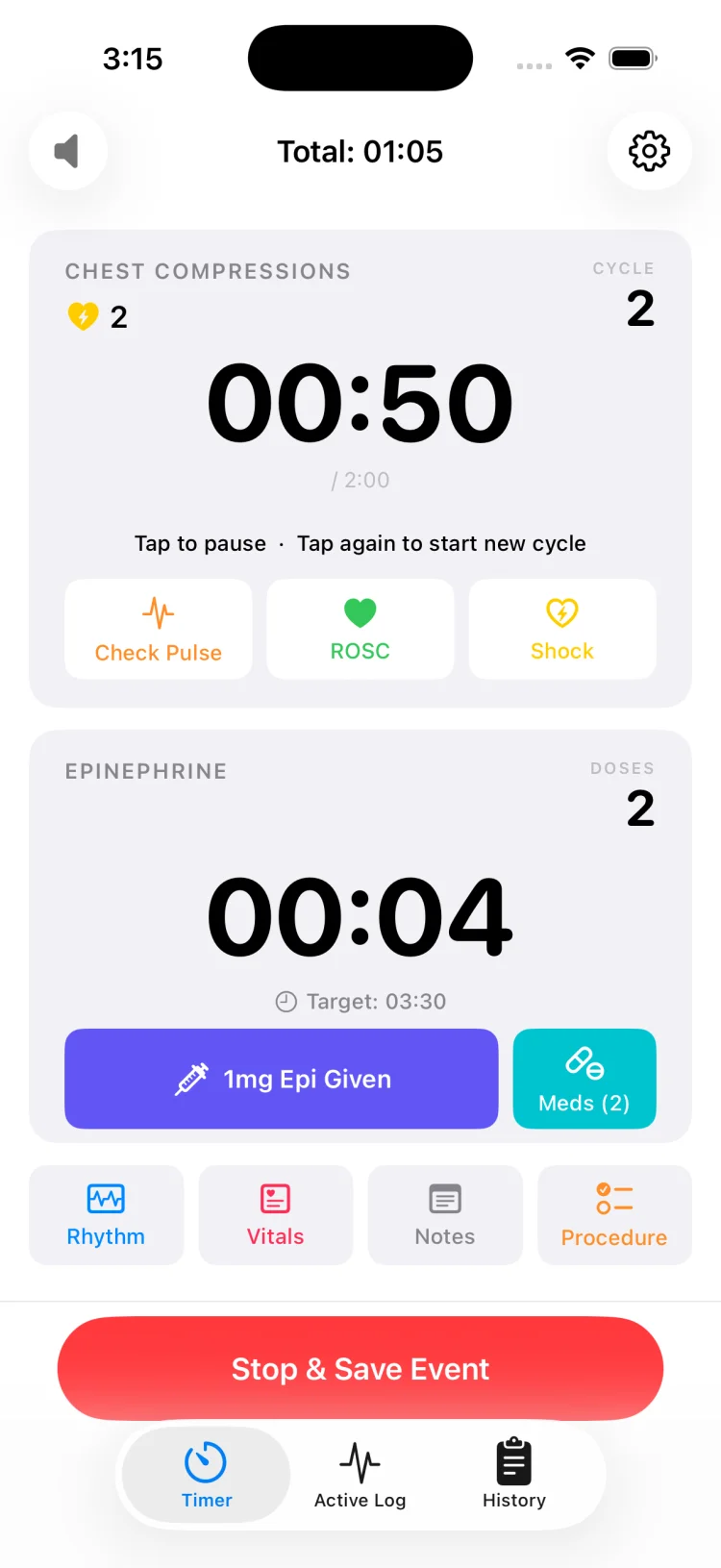
In MedCode, both timers are visible on the same screen. The compression cycle timer counts up to 2:00 and alerts when the cycle ends. The metronome ticks continuously at the configured BPM. The compressor can glance at the screen and see both the elapsed time in the current cycle and the beat they should be pacing to.
Why this pairing matters for chest compression fraction
Chest compression fraction (CCF) is the proportion of the total session time during which compressions are recorded as active. Training programmes commonly use a rehearsal target of 80 percent or higher. Achieving a high CCF in a practice session requires minimizing pauses.
The metronome paces the compressions during the active phase of the cycle, but it does not reduce pauses. Pauses happen during rhythm checks, airway management, vascular access and shock delivery. The two-minute cycle timer cues the team when the rhythm check is due, which helps minimize the pause duration because everyone knows the check is coming and can prepare for it.
Using both timers together — the metronome for rate and the cycle timer for the rhythm check — supports both rate consistency and CCF review in practice sessions. See the chest compression fraction guide for more on reviewing pauses and calculating CCF from a session timeline.
Using the metronome in MedCode
Configure the metronome to the rate specified in your training or protocol, then pair it with the two-minute compression cycle timer:
- Open MedCode and tap Start Event to begin the session clock.
- The compression cycle timer and the epinephrine interval timer both start automatically.
- The metronome ticks at the configured BPM (default 110, adjustable 100-120 in settings).
- The compressor can pace their compressions to the beat. The cycle timer alerts at 2:00 for the rhythm check.
- After the rhythm check, reset the compression cycle timer and the metronome continues at the same rate.
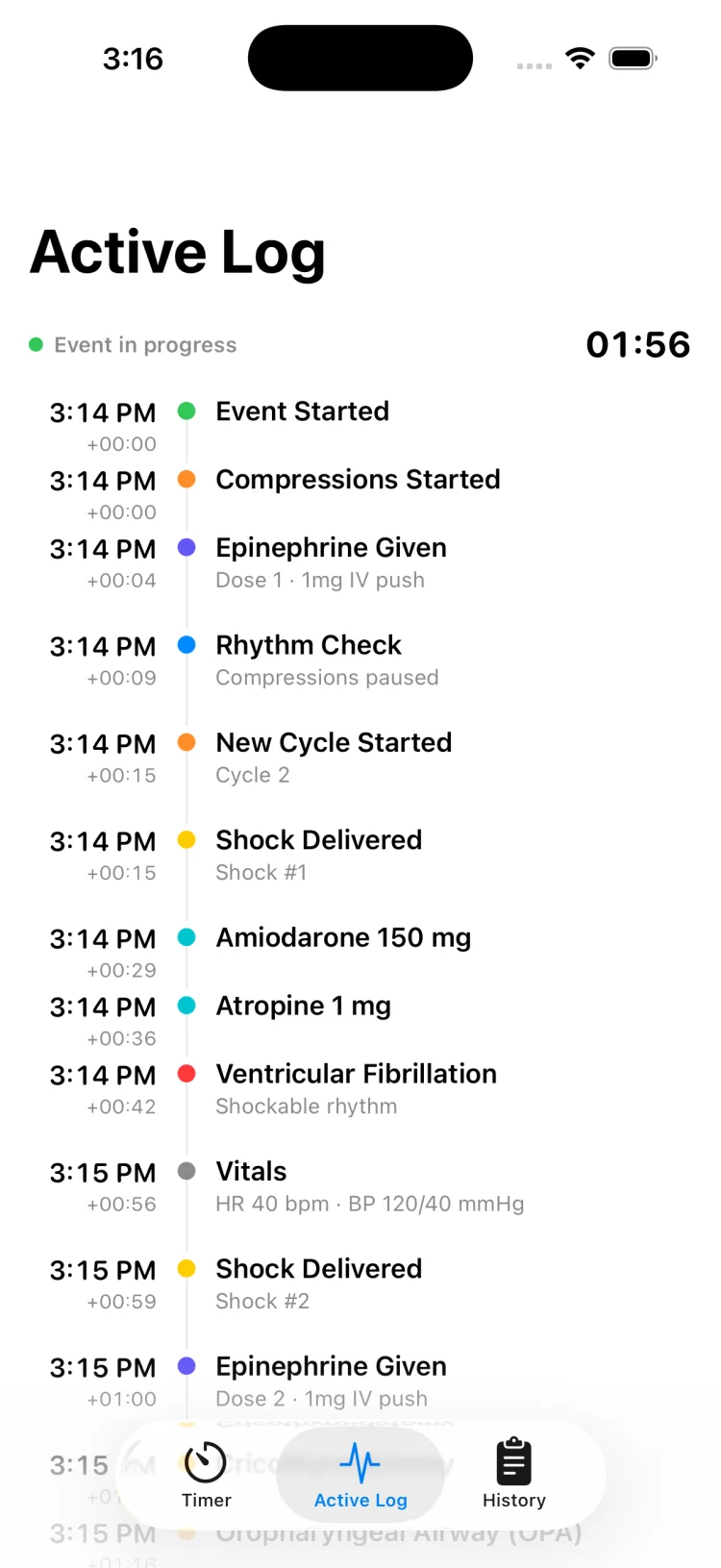
- Every logged event — medications, rhythms, shocks, procedures — is timestamped with clock time and elapsed offset.
Using the metronome during training and mock codes
A metronome is most effective when the compressor is already familiar with what the pacing cue feels like. That familiarity comes from training. Here is how teams integrate the metronome into mock codes and simulation sessions to build familiarity with the audible beat.
Running the metronome during mock codes
If a team intends to use a metronome, running it during mock codes builds familiarity with pacing to the beat, so the compressor is not hearing the metronome for the first time in a high-pressure environment. The mock code can replicate the conditions of the intended use as closely as feasible, and that includes the auditory environment.
Reviewing the exported timeline after the session
MedCode's exported PDF timeline shows the exact intervals between logged events during the mock code. If the team logged each compression cycle, the timeline shows how long each cycle lasted. This turns a subjective debrief — "I think I was going too fast" — into a data-driven one: "The first cycle was 1:50 and the second was 2:10, so the pacing drifted across the session."
See the mock code simulation guide for a full walkthrough of setting up an in-situ simulation, running it with timestamped logging, and using the data to drive a debrief.
Practising pacing to the beat in low-stakes settings
Outside of a full mock code, individual compressors can practice pacing to the metronome on a manikin. Configure the metronome to the specified rate, start the beat, and compress in time with it for two minutes. This low-stakes practice builds familiarity with the pacing cue so that when the compressor is in a high-pressure simulation, the pacing feels more automatic.
Debriefing the audibility of the metronome
After a mock code, ask the compressor whether they could hear the metronome clearly throughout the cycle, or whether it was lost in the noise of the room. If the beat was inaudible, adjust the device volume, reposition the phone closer to the compressor, or switch to haptic alerts. The mock code is the time to discover those configuration issues.
Important: MedCode is a timer and documentation tool
MedCode is not clinical decision support and is not a medical device. The metronome provides an audible pacing cue at a user-configurable rate; it does not measure actual compression depth, actual delivered rate, or provide real-time feedback on compression quality from an accelerometer or sensor. The app does not recommend a specific compression rate. The rate you configure should match the rate taught in your current training and specified in your institutional protocol. Real-event use of any tool, including a metronome, is the individual clinician's professional judgment based on their training and the clinical context.
MedCode is a practice and training tool. It is not a medical device, not clinical decision support, and not a substitute for your institution's required documentation or protocol. Any use during a real event is the individual clinician's own professional judgement.
Frequently asked questions
What compression rate range do resuscitation guidelines describe?
Resuscitation guidelines commonly describe a compression rate range for adult CPR that is taught in BLS and ACLS training programmes. The specific rate range is defined by the guidelines and training protocol your institution follows. MedCode's metronome is user-adjustable from 100 to 120 BPM to accommodate the rate specified in your training programme or institutional protocol. The app does not recommend a specific rate; it provides a configurable pacing cue at whatever rate you set.
Why do people use a metronome during practice sessions?
Rate drift is commonly observed in practice sessions. Adrenaline and the urgency of a scenario tend to push the compression rate higher than intended early in the session, while fatigue over a two-minute cycle can slow the rate as the compressor tires. Most people cannot accurately perceive their own tempo without an external reference, and a crowded, noisy room provides no audible cue to correct for drift. A metronome provides an external, audible beat at a fixed tempo. The compressor hears the beat and times their compressions to match it, which externalizes the timekeeping and removes the need to estimate the correct cadence from memory.
Can a music playlist be used instead of a metronome?
Songs with a specific tempo are often taught as a mnemonic device during CPR training, and they work well as a memory aid for learning a cadence. However, a song is a memory aid, not a real-time pacer. The person has to remember the song, recall the rhythm accurately, and maintain the beat in their head while managing the scenario. A real metronome provides an external, audible beat that plays continuously, requires no recall, and does not depend on memory. For training and practice, songs are useful as teaching tools. For rehearsing with a reliable external cue, a metronome provides a consistent reference.
Will a CPR metronome app work if the phone is on silent?
It depends on how the app is configured. MedCode's metronome is configured to play audio over the iPhone silent switch, which means the beat remains audible even when the ringer switch is flipped to silent. Device volume still applies, so the volume setting on the phone determines how loud the metronome is, but the silent switch itself does not mute it. Haptic alerts are also available as an alternative in MedCode, with four strength settings from off to strong. If you are using a different app, check its documentation or test it ahead of time to confirm the metronome will be audible when needed. Generic metronome apps not designed for resuscitation may respect the silent switch and become inaudible.