The code blue record is the clinical document least likely to be written at the time it describes. Someone is watching a wall clock, someone else is counting epinephrine doses on their fingers, and the recorder is trying to write on a paper form while listening for what just happened. Then, twenty minutes after the event ends, the record gets reconstructed from memory — and the timestamps become best estimates rounded to the nearest five minutes. Here is how to document a resuscitation in a way that survives the conditions of the room.
The short version
A complete code record captures start time, rhythms at each check, compressions, shocks with energy, medications with dose and time, airway and access procedures, vitals, and outcome. Assign one recorder, use one clock for the room, call times out loud, and log entries as they happen rather than afterwards. Export the timeline when the code ends.
Why the code record matters after the code
The resuscitation record is not written for the resuscitation. It is written for everything that happens afterwards. The uses of a code blue record extend far beyond the immediate event, and each one depends on the accuracy and completeness of the documentation.
Quality review and performance improvement
Institutions track resuscitation quality metrics: chest compression fraction, time-to-first-epinephrine, time-to-first-shock, pause durations, and rhythm-specific outcomes. These numbers come from the code record. If the timestamps are rounded to five-minute intervals or the rhythm at each check is missing, the data cannot be used for meaningful quality improvement.
Debriefing and team learning
A hot debrief immediately after the code, or a cold debrief days later, relies on an objective timeline to ground the conversation. Without it, the discussion becomes four people remembering four different sequences. A complete record helps show what happened, in what order, and at what intervals. See the full process in the code blue debriefing guide.
Registry reporting and research
Hospitals that participate in resuscitation registries report standardized metrics for every in-hospital cardiac arrest. The data submitted comes directly from the code record. Missing fields, estimated times, and incomplete event logs degrade the quality of the aggregate data and reduce the value of the registry for benchmarking and research.
Continuity of care
The next provider who receives the patient needs to know what happened: total downtime, shocks delivered, medications given with doses and times, airway secured, access obtained, and whether spontaneous circulation returned. A complete code record communicates this information without requiring the team to reconstruct the event from memory an hour later.
Legal record
The resuscitation record is a legal document. It may be reviewed months or years after the event in the context of a complaint, an inquiry, or litigation. The record should reflect what was done, when it was done, and who did it, documented contemporaneously rather than retrospectively. Gaps, inconsistencies, and obviously rounded timestamps undermine the credibility of the record.
What belongs on a resuscitation record
A complete code blue record captures every intervention, every rhythm check, and every timestamp from recognition to outcome. The categories of information that belong on the record are consistent across institutions, even if the forms themselves vary.
| Category | What to document | Why it matters |
|---|---|---|
| Event start & recognition | Time of arrest recognition, time compressions started, location | Establishes time zero for all subsequent intervals and elapsed times |
| Rhythm at each check | Rhythm observed at each two-minute pause, classified as VF, pulseless VT, PEA, asystole, or organized | Drives algorithm choice and determines shockable versus non-shockable treatment path |
| Compressions start & stop | When CPR started, when pauses occurred, when CPR resumed, total duration | Used to calculate chest compression fraction, a primary quality metric |
| Defibrillation attempts | Time of shock, energy delivered in joules, outcome of rhythm check after shock | Tracks defibrillation sequence and energy escalation for shockable rhythms |
| Medications | Drug name, dose, route, time administered | Critical for next provider, tracks epinephrine timing and antiarrhythmic use |
| Airway & access procedures | BVM, intubation, cricothyroidotomy, OPA, NPA, peripheral IV, central line, arterial line, IO | Documents definitive airway, vascular access, and any procedural complications |
| Vitals | Heart rate, blood pressure, SpO2, EtCO2, temperature when available | EtCO2 indicates ventilation and perfusion quality, used to guide CPR quality |
| ROSC or termination | Time of return of spontaneous circulation, or time resuscitation was terminated | Defines total event duration and outcome for registry reporting |
| Personnel | Names and roles of team members present, including team leader, compressor, airway, recorder | Identifies who performed which interventions, required for some institutional policies |
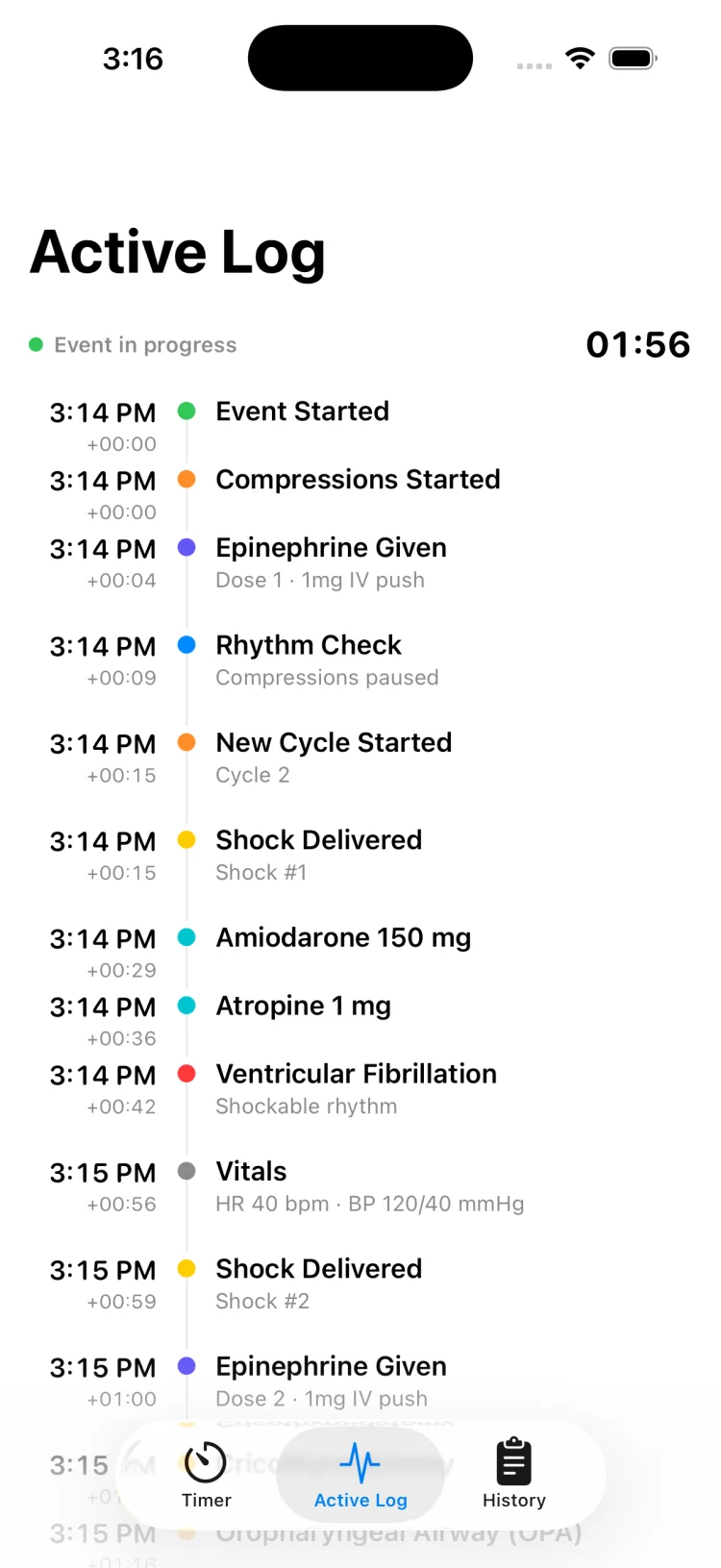
Every entry on the record should carry two timestamps: the clock time when it occurred, and the elapsed time from the start of the event. This dual timestamping allows the record to stand alone and also fit into the overall timeline of the patient's care.
Why timestamps drift when reconstructed after the event
Ask three people in the room when the second dose of epinephrine was given and you will get three different answers. This happens because the conditions of a resuscitation actively work against accurate time capture. Understanding why timestamps drift is the first step toward preventing it.
Recall bias and memory compression
Human memory for event timing degrades rapidly under stress. Research on eyewitness recall consistently shows that people overestimate short durations and underestimate long ones, especially when cognitive load is high. A pause that felt like thirty seconds may have been ninety. An interval that seemed like five minutes may have been three. When the record is written up after the event, these distortions compound.
Rounding to five-minute intervals
Many paper code sheets have timestamp fields at five-minute intervals: 0, 5, 10, 15, 20. Recorders round to the nearest available box. An epinephrine dose given at 12 minutes gets logged at 10 or 15, and the error propagates. Over a twenty-minute code, the cumulative rounding error can misrepresent the entire sequence.
Clock discrepancies across devices
The wall clock says one time. The monitor says another. Someone's phone says a third. If different people are referencing different clocks, the timestamps on the record reflect whichever clock the recorder happened to see at that moment. When the times are compiled later, the inconsistencies are obvious.
Writing up the record after the fact
In many resuscitations, the recorder captures fragments during the event — a drug name here, a rhythm there — and fills in the timestamps afterwards. This retrospective documentation introduces systematic error because the recorder is estimating times based on their memory of the sequence, not the actual moments when events occurred.
Incomplete handoff between roles
If the timekeeper role and the recorder role are split, and the timekeeper does not communicate every timestamp to the recorder in real time, the recorder has to reconstruct the times later. The information exists in someone's head but never makes it onto the record in a usable form. Understanding the code blue team roles helps clarify these handoffs.
Contemporaneous versus reconstructed documentation
The difference between a contemporaneous record and a reconstructed one is not just accuracy. It is the difference between a document that can be trusted and one that cannot. Contemporaneous documentation means logging events as they happen, not writing them up later from memory.
What contemporaneous means in practice
Contemporaneous documentation does not mean the recorder writes a full sentence for every event. It means the timestamp and the event are captured at the moment they occur, even if the full description is added afterwards. A one-tap log entry with an automatic timestamp is contemporaneous. A list of drug names written during the code and timestamped twenty minutes later is not.
Why it matters for legal and regulatory review
Reviewers can tell the difference. A record with timestamps at 3, 7, 11, 14, 18, and 22 minutes looks contemporaneous. A record with timestamps at 0, 5, 10, 15, 20, and 25 minutes looks reconstructed. The first is credible. The second raises questions about what else might have been estimated or filled in later.
How to make documentation contemporaneous without slowing the team
The recorder should not have to choose between keeping up with the event and keeping the record accurate. The solution is tools and habits that reduce the work required to log an entry. One-tap medication logging, automatic timestamping, and a single clock visible to the entire room all make contemporaneous documentation feasible under the conditions of a real code.
Doing this in MedCode
Keep the clock and the record in the same place so every entry is timestamped as it happens:
- Start the session when compressions begin. The session clock starts and every entry from this point carries an elapsed offset from time zero.
- Log medications, rhythms, shocks, procedures and vitals with one tap from the main screen. Each entry is automatically stamped with both clock time and elapsed time.
- Scroll the live timeline mid-code to answer questions like "how long since the last epi?" without interrupting the flow of the event.
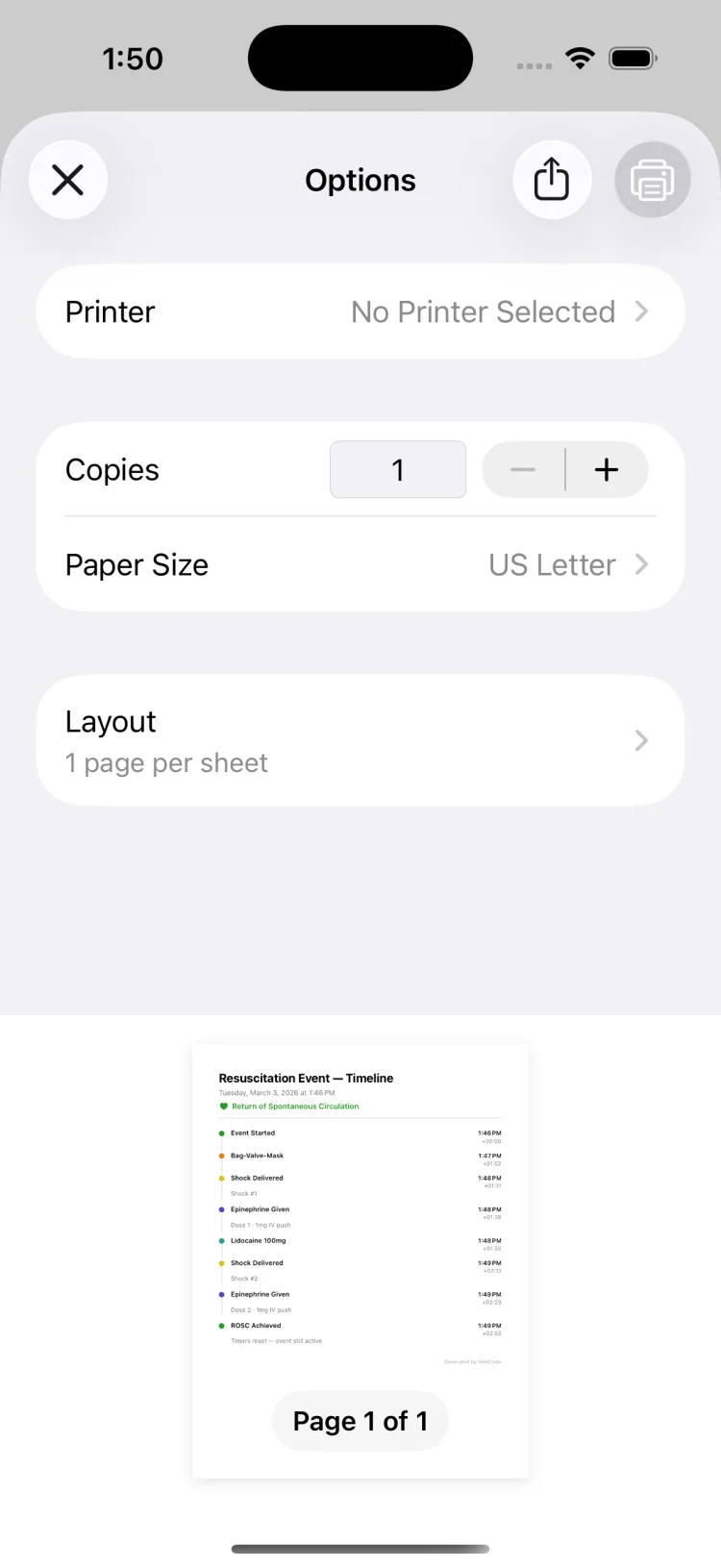
- End the session and export a PDF in two formats: a full chronological timeline, or a grouped summary showing medication totals, shocks and rhythms.
- Share the PDF through the iOS share sheet to print, email or file it per institutional policy.
Practical habits that make the record better
Accuracy in code blue documentation is not about working harder. It is about establishing team habits that make the right things happen by default. These habits are simple, but they require intentional practice and team buy-in.
Use one clock for the entire room
Designate a single time source for the event and make it visible to everyone. This could be a wall clock, a monitor clock, or a phone held by the timekeeper. Every timestamp on the record references the same clock, eliminating discrepancies from multiple time sources. Call out the clock at the start of the code so everyone knows where to look.
Assign one dedicated recorder
The recorder should have no other clinical responsibility during the event. Their job is to capture what happens, when it happens, and who does it. If the recorder is also managing medications, drawing up syringes, or assisting with procedures, the record will have gaps. A dedicated recorder improves both the quality of the documentation and the ability to debrief afterwards.
Call times out loud when they matter
The team leader should call out key timestamps as they occur: "First epi in at 14:32," "Intubated at 14:35," "ROSC at 14:41." This verbal timestamping gives the recorder accurate information in real time without requiring them to look at the clock for every entry. It also reinforces situational awareness for the entire team. This practice ties directly to the epinephrine timing discipline that high-performing teams use.
Log at the moment, not at the end of the cycle
Do not batch entries and log them at the next pause. Log each event when it happens. If the medication is administered now, log it now. If the rhythm changes, log it immediately. Batching introduces recall bias and rounding errors that accumulate over the course of the event.
Standardize the logging interface
Use the same documentation method for every code. Whether it is a paper form, an electronic flowsheet, or a phone app, the interface should be familiar and rehearsed. The recorder should not have to think about how to document — only what to document. Practice this during mock codes so it becomes automatic under pressure. See the mock code simulation guide for how to structure this training.
Common gaps in code blue records
Certain pieces of information are consistently missing from resuscitation records, and they are the same pieces that appear as questions in debriefs and quality reviews. Knowing where the gaps occur allows teams to address them proactively.
Missing pause durations
The record shows when CPR started and when it stopped, but it does not show the individual pause durations for rhythm checks, intubation attempts, and pulse checks. These pauses are the denominator in chest compression fraction, a primary quality metric. Without them, CCF cannot be calculated. The solution is to log when compressions stop and when they resume for each pause, not just at the start and end of the event. Learn more in the chest compression fraction guide.
Missing time-to-first-epinephrine
Guidelines commonly describe early epinephrine administration in cardiac arrest, but many code records do not capture the exact time of the first dose. The entry shows an epinephrine entry with no timestamp, or the timestamp is rounded. Time-to-first-epinephrine is a reportable metric in most resuscitation registries, and it cannot be calculated from incomplete data.
Missing rhythm at each check
The record may show "VF" at the start of the code and "asystole" at the end, but it does not document the rhythm observed at each two-minute pause. This information is essential for understanding rhythm evolution, determining whether the rhythm was persistently shockable or converted to a non-shockable rhythm, and deciding whether to continue or terminate resuscitation.
Missing personnel and role assignments
Some records list who was present but not who performed which role. This matters when reviewing performance, identifying training needs, and documenting procedures for credentialing. The record should show who led the code, who managed the airway, who obtained access, who administered medications, and who performed compressions for each cycle.
After the code: turning the record into something useful
The code record does not end when the event ends. The documentation becomes the foundation for debriefing, quality improvement, and continuity of care. How the record is used after the code determines whether the effort spent creating it was worthwhile.
Use the record for a hot debrief
A hot debrief occurs immediately after the code, while the team is still in the room. The timeline serves as a shared reference point: what happened first, what happened next, what the intervals were. Instead of arguing about timing, the team can focus on decisions and performance. A hot debrief should take five to ten minutes and address what went well, what could improve, and what the team will do differently next time.
Submit it for quality improvement review
Institutions track resuscitation outcomes and process metrics as part of ongoing quality improvement. The code record provides the raw data for these metrics: chest compression fraction, time-to-first-epinephrine, number of shocks delivered, rhythm-specific survival, and more. Incomplete or inaccurate records weaken the institution's ability to identify trends, benchmark performance, and target improvement efforts.
Store it according to institutional policy
The resuscitation record is a legal medical document and must be stored in accordance with hospital policy and regulatory requirements. This may mean attaching the PDF to the electronic medical record, filing a paper copy in the patient chart, or both. The record should be retrievable years after the event if needed for review or inquiry.
Use it to inform the next handoff
If the patient is transferred to intensive care, the next provider needs to know what happened: total downtime, number and timing of shocks, medications given with doses and times, airway management, access obtained, and current rhythm. The code record should contain all this information in a format that can be communicated clearly during the handoff. A well-documented timeline reduces the need for verbal recall and helps support continuity of care.
MedCode is a documentation tool, not clinical decision support
MedCode is a timer and documentation tool for resuscitation events. It is not clinical decision support and is not a medical device. It does not recommend a medication, a dose, an interval, a rhythm interpretation or a next step. Medication entries exist so that administrations your team has already decided on can be recorded in one tap, with automatic timestamping.
All clinical decisions remain with the team and should follow your local protocol and current resuscitation guidelines. MedCode is not intended for diagnosis or treatment. The exported record is a documentation artifact and should be reviewed, edited and filed in accordance with your institution's policy.
MedCode is a practice and training tool. It is not a medical device, not clinical decision support, and not a substitute for your institution's required documentation or protocol. Any use during a real event is the individual clinician's own professional judgement.
Frequently asked questions
What information should be documented during a code blue?
A complete code blue record captures event start and recognition time, rhythm observed at each two-minute check, when compressions started and stopped, defibrillation attempts with joule settings, all medications with dose, route and time of administration, airway management and vascular access procedures, vital signs when available, return of spontaneous circulation or termination time, and personnel present in each role. Each entry should carry both clock time and elapsed time from the start of the event for continuity of care and quality review.
Who is responsible for documenting a code blue?
The designated recorder or scribe holds responsibility for documenting the resuscitation. This person is assigned at the start of the code and focuses on capturing events, timestamps, and interventions as they occur. The recorder should not have competing clinical responsibilities during the event so they can maintain a complete and contemporaneous record. In smaller teams, the timekeeper role may overlap with the recorder, but documentation quality improves when one person is dedicated to this task.
How accurate do code blue timestamps need to be?
Code blue timestamps should be accurate to the minute when possible, not rounded to five-minute intervals. Precision matters for calculating chest compression fraction, time-to-first-epinephrine, and pause durations, all of which are quality metrics tracked in resuscitation registries. The timestamps also inform clinical decision-making for the next provider who receives the patient. Recording times as they happen, rather than reconstructing them from memory afterwards, is the most reliable way to maintain accuracy under the conditions of a resuscitation.
Can I use a phone app to document a code blue?
Yes, and it is one of the most effective ways to keep the clock and the record in the same place. A purpose-built code blue timer like MedCode runs the compression cycle and epinephrine interval on one screen, logs medications, rhythms, vitals and procedures in one tap, and timestamps every entry with both clock time and elapsed time automatically. The record is already written when the event ends, and it can be exported as a PDF for printing, filing or attaching to the patient chart. Nothing leaves the device unless you choose to share the export.