The practice session ends. Participants disperse. Someone says the team should debrief later, and later never comes. Or the debrief happens in the hallway, turns into general discussion, and nobody captures the learning points. Effective training debriefs are short, structured, focused on coordination patterns rather than individual critique, and built on recorded data rather than recollection.
The short version
Hot debrief: three to five minutes, immediately after the practice session. Review what went well, what could improve, and identify one learning point. Use a timestamped timeline so the conversation is built on recorded timing data, not what participants think happened. Frame the review as an educational activity, not performance evaluation.
Why training debriefs get skipped
Training debriefs require intentional structure, time and a learning-focused environment. The reasons they get skipped are predictable, and addressing them helps make post-session review routine.
Time pressure and competing demands
The practice session ends and participants have other commitments. The facilitator has another session scheduled. The five minutes required for a hot debrief feel impossible to find, so the review gets deferred and then forgotten. The solution is to treat the debrief as part of the training session, not an optional add-on. If the practice happened, the debrief happens. Three minutes now is better than a canceled meeting later.
Discomfort after a challenging scenario
If the practice scenario revealed significant coordination issues, participants may want to move on rather than revisit them. Debriefs after challenging training sessions are valuable learning opportunities. The goal is to identify patterns and learning points, not to assign blame.
Concern that it will become performance critique
If training debriefs have historically been used to critique individuals, participants will avoid them. The person facilitating the debrief sets the tone in the first thirty seconds. Frame the conversation as a learning review, not performance evaluation. Focus on role clarity, equipment readiness, communication patterns and coordination issues rather than individual mistakes.
No shared reference for what happened
Without a recorded timeline, the debrief can devolve into disagreements about timing. One person remembers an interval as three minutes. Another remembers seven. The conversation stalls. A timestamped record provides a shared reference, and the discussion can move to reviewing patterns and identifying learning points.
Hot debrief versus cold debrief for training
A hot debrief and a cold debrief serve different educational purposes and require different structures. Both are valuable for training, but they are not interchangeable.
| Hot debrief | Cold debrief | |
|---|---|---|
| When | Immediately after the practice session, within minutes | Days or weeks later, in a scheduled meeting |
| Duration | 3-5 minutes | 30-60 minutes |
| Who attends | Everyone who participated in the training scenario | Participants plus educators, facilitators, or quality reviewers |
| What it captures | Immediate observations, obvious coordination patterns | Detailed timing analysis, recorded data review, broader learning patterns |
| Primary goal | Identify one or two immediate learning points | Deep analysis, educational objectives, pattern identification across multiple sessions |
When to do a hot debrief
Every practice session benefits from a brief hot debrief. The hot debrief captures observations while they are fresh and provides immediate learning feedback. It does not need to be comprehensive. It just needs to happen.
When to do a cold debrief
When the practice session revealed significant coordination issues, when the scenario will be used for broader education, or when it is part of ongoing training assessment. Cold debriefs allow for reflection, detailed timeline review, and involvement of educators who may not have been present during the scenario.
The memory problem in training debriefs
Memory is unreliable after high-pressure practice scenarios. Stress, cognitive load, time compression and divided attention all affect recall accuracy. Within an hour of a training session, participants will confidently describe different sequences, different timings and different events.
Memory compression during training
A 22-minute practice scenario feels like eight minutes to one participant and forty minutes to another. Pauses that lasted ninety seconds are remembered as thirty seconds. Intervals that were four minutes feel like two. This is how memory works under high cognitive load. The brain compresses duration, especially when attention is divided across multiple tasks.
Event reordering and sequence errors
Participants remember that three things happened during the scenario, but they disagree about the order. Did the simulated shock come before or after the airway was placed? Memory reconstructs sequence based on plausibility rather than actual chronology. Without a timeline, these disagreements cannot be resolved during the debrief.
Role-based attention and selective recall
The assigned compressor remembers compressions and when they were told to stop. The airway person remembers the intubation attempt. The medication person remembers what was drawn up. The recorder sees the whole scenario but may not recall specifics outside the timeline. Each participant has partial visibility, and their recollection reflects what they were focused on during the scenario. Understanding how roles are assigned during practice clarifies why these gaps exist.
Why a recorded timeline changes the training debrief
A timestamped timeline provides a shared reference for the review. Instead of debating whether a pause was long, participants can see the recorded interval was 47 seconds. Instead of guessing when a simulated medication was given, the timeline shows it was at 03:22 elapsed. The conversation can shift to reviewing patterns and identifying learning points. For more on documentation during training, see the code blue documentation guide.
The structure of a short hot debrief
A hot debrief does not need a conference room. It happens at the bedside or just outside it, immediately after the event ends. The structure is simple and should take no more than five minutes.
Step one: Gather the team before they disperse
The team leader or charge nurse calls the debrief immediately. Everyone who participated stays for three to five minutes. If someone has to leave for an urgent call, they leave, but the debrief still happens with whoever is present. Waiting until everyone is free means the debrief never occurs.
Step two: Set the tone in the first sentence
The person leading the debrief frames it as systems review, not performance critique. Example opening: "We are going to take three minutes to talk about what went well and what we can improve for next time. This is about the process, not about anyone's performance." This framing establishes psychological safety and signals that the goal is learning, not blame.
Step three: Ask what went well
Start with positive observations. What worked? What should the team keep doing? This is not false praise. Real things went well, and naming them reinforces good practice. Examples: "Compressions started immediately," "The airway team had backup equipment ready," "Communication was clear and the team leader called out times."
Step four: Ask what could improve
Identify one or two specific improvement opportunities. Do not try to fix everything. Focus on the gap that had the biggest impact or the one the team has direct control over. Examples: "Pauses were long during rhythm checks," "Epinephrine timing drifted in the second half," "We did not have IO access ready when the second IV failed."
Step five: Assign one action to someone with a date
A debrief without an action is just a conversation. Before the team disperses, assign one concrete change to one person with a follow-up date. Examples: "Charge nurse will add IO kit to the top of the crash cart by end of shift," "We will review pause discipline at next staff meeting," "Recorder will share the timeline with the quality team by Friday." The action must be specific, owned, and time-bound.
Step six: Close and thank the team
Acknowledge the work, close the debrief, and let the team move on. Three minutes is enough. If deeper review is needed, schedule a cold debrief later.
What to talk about in a code blue debrief
The topics that matter in a debrief are the ones that show up repeatedly in quality metrics and registry data. These are the areas where small changes have measurable impact.
Pauses and chest compression fraction
How long were the pauses for rhythm checks, pulse checks, and procedures? Could they have been shorter? Was the team ready to resume compressions immediately, or did the compressor step away? Pause discipline is one of the most modifiable factors in resuscitation quality. See the chest compression fraction guide for why pauses cost more than teams realize.
Role clarity and communication
Did everyone know their role? Were there conflicts or gaps in role assignment? Did the team leader communicate clearly and was the team able to hear them? Role ambiguity slows every intervention and increases cognitive load for everyone in the room.
Equipment availability and readiness
Was the crash cart stocked and accessible? Was backup airway equipment immediately available? Were medications drawn up and labeled? Equipment delays are system failures, not individual failures, and they are fixable with process changes.
Epinephrine timing and medication intervals
When was the first dose of epinephrine given? Were subsequent doses on time or did the interval drift? Medication timing is one of the easiest things to lose track of in a code, and it is also one of the most measured quality metrics.
Rhythm recognition and defibrillation delays
How quickly was a shockable rhythm identified? Was the defibrillator ready and charged? Were there delays between rhythm recognition and shock delivery? Time to first shock is a primary outcome predictor in ventricular fibrillation arrests.
Handoff and communication gaps
Were there moments when information did not reach the person who needed it? Did the recorder miss an entry because no one called it out? Did the next provider receive a complete handoff, or did they have to ask for details that should have been documented? Handoffs are high-risk transitions, and debriefs often reveal where the gaps occurred.
The one rule that makes debriefs safe: describe the system, not the person
The language used in a debrief determines whether the team will engage or shut down. The rule is simple: describe what happened and why the system allowed it to happen, not who did it wrong.
System-focused language versus person-focused language
Person-focused: "You did not check the rhythm on time." System-focused: "The rhythm check happened at three minutes instead of two. What made it hard to stay on the two-minute cycle?" The first shuts down conversation. The second opens it. The difference is describing the gap and asking why it existed, rather than attributing it to individual failure.
Why individual performance review does not belong in a group debrief
If someone made a significant error or demonstrated a skill deficit that needs remediation, that conversation happens one-on-one, not in front of the team. A group debrief is for identifying system-level improvements, not for evaluating individual competence. Mixing the two destroys psychological safety and ensures the team will avoid future debriefs.
How to redirect when the conversation becomes personal
If someone in the debrief starts naming individuals or assigning blame, the leader redirects: "Let's focus on the process rather than the person. What was it about the situation that made this outcome likely?" This redirection must be immediate and consistent, or the culture will not shift.
Using a timeline as the shared factual base
An objective timeline turns a debrief from a debate into a review. Instead of six people arguing about when something happened, the timeline shows it, and the conversation moves to why and what changes.
What the timeline shows that memory does not
Elapsed time from event start to each intervention. Intervals between compressions, shocks, and medications. Pause durations for rhythm checks and procedures. Event spacing and clustering that reveals workflow bottlenecks. All of this is measurable in a timestamped record and estimated poorly from recall.
Pulling up session history for review
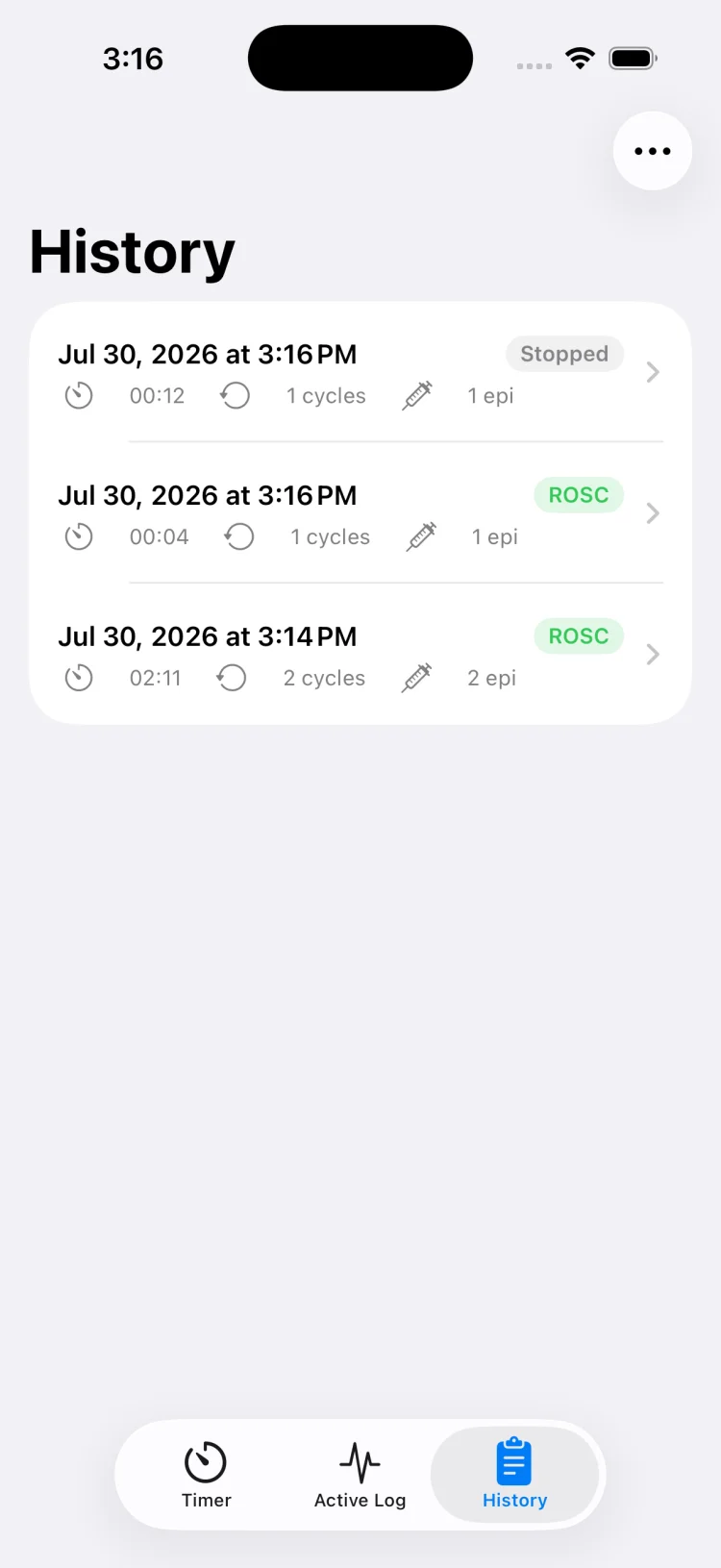
If the code was logged in a timer app like MedCode, the session is saved with a full timeline. The team can pull it up during the hot debrief or export it for the cold debrief. The timeline shows every medication, rhythm, shock, procedure, and vital sign entry with both clock time and elapsed offset. This becomes the artifact the debrief is built around.
Using the PDF export as a debrief handout
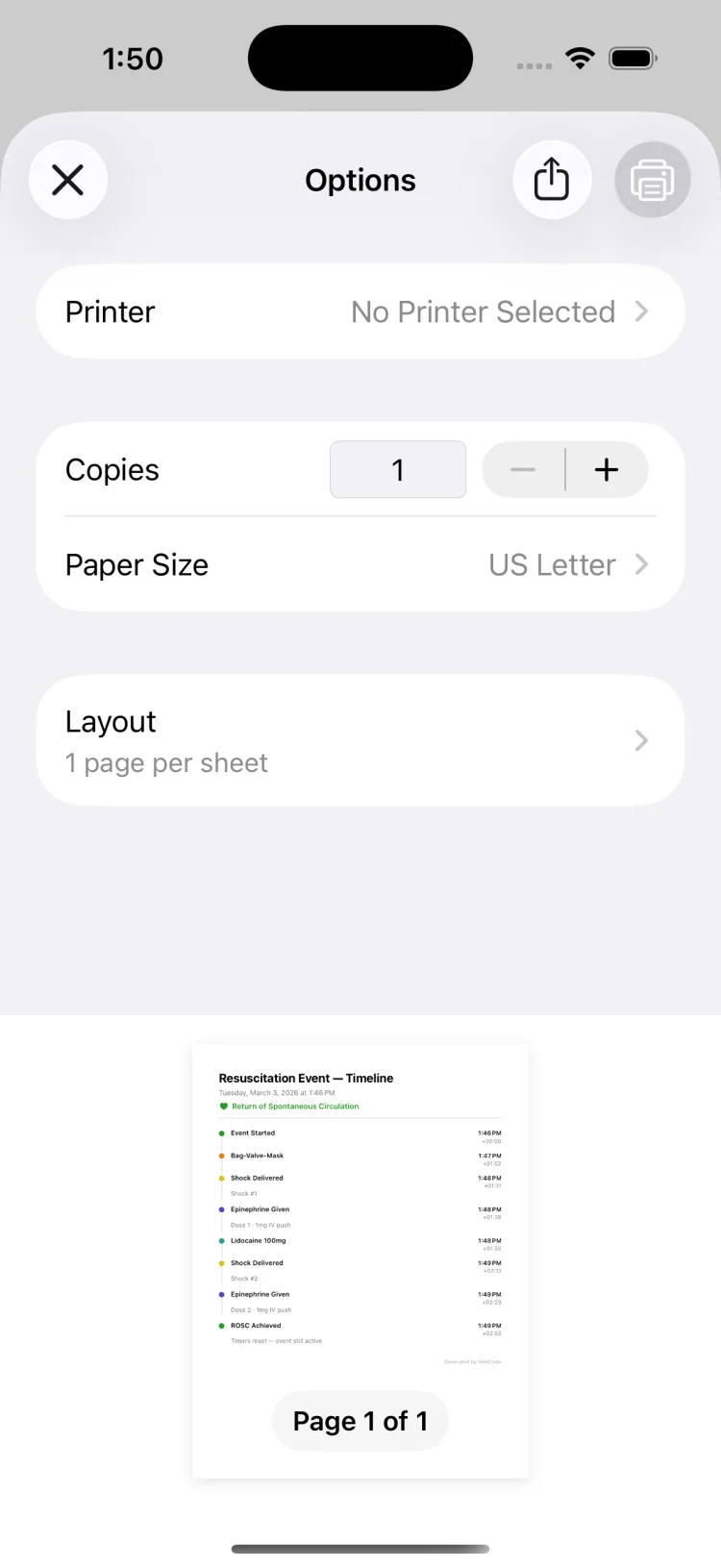
Export the timeline as a PDF and put it on the table. Everyone sees the same data. The discussion becomes: "The pause at 08:15 was 52 seconds. What happened during that pause and how do we make it shorter?" instead of "I think the pause was long," "No, it was not that long," "How long was it?" "I do not know, but it felt long."
Using MedCode for training debriefs
Pull up the session timeline after a practice session to review recorded data with participants:
- Open the saved session from session history. The full timeline is preserved with every logged event from the training scenario.
- Review elapsed times, pause intervals and event spacing with participants. Use the timeline to answer questions like "How long was the pause?" and "When was the first simulated medication logged?"
- Export the timeline as a PDF in full chronological format or grouped summary format.
- Share the PDF with participants or educators for discussion during the training debrief.
- Use the timeline to identify coordination patterns, timing intervals and learning points from the practice session.
Turning a debrief into an actual change
A debrief is only useful if it produces a change. The change does not need to be large. It needs to be specific, assigned, and followed through.
One thing, not five things
Do not try to fix everything at once. Identify the one gap that had the biggest impact or the one the team has the most control over. Assign it to someone. Set a deadline. Follow up. If the team tries to fix five things, none of them will get done.
Assign it to a person with a date
"We should improve pause discipline" is not an action. "Charge nurse will review pause technique at the next staff meeting on Tuesday" is an action. The action must be owned by a named person and have a specific completion date, or it will not happen.
Close the loop: did the change happen?
Two weeks later, check whether the assigned action was completed. If it was not, ask why and reassign it. If it was, acknowledge it and measure whether it had an effect. Closing the loop signals that debriefs lead to real change, which increases buy-in for future debriefs.
Measure whether it made a difference
If the change was about pause discipline, check whether pauses got shorter in subsequent codes. If it was about epinephrine timing, check whether the interval tightened. If it was about equipment readiness, check whether the crash cart checklist is now completed daily. Measurement reinforces accountability and demonstrates improvement.
What to do when the debrief surfaces something serious
Not every gap is fixable in a three-minute hallway conversation. Some findings require escalation to quality review, morbidity and mortality conference, or formal incident reporting. Knowing when to escalate and how to do it is part of the debrief leader's responsibility.
When a gap is a system failure, not a process tweak
If the debrief reveals that the crash cart was missing essential medication, that the defibrillator was not charged, that nobody knew how to access the blood bank after hours, or that a critical role was unfilled because staffing was inadequate, these are not problems the bedside team can fix. They require institutional response.
When an individual performance issue needs formal review
If the debrief reveals that someone performed a procedure they were not credentialed for, made a decision outside their scope, or demonstrated a competency gap that put the patient at risk, that issue must be escalated. It does not get resolved in the debrief. The debrief leader documents the observation and refers it to the appropriate supervisor, educator, or quality leader for follow-up.
How to escalate without derailing the debrief
Acknowledge the issue, note that it will be escalated, and move on. Do not attempt to resolve it in the moment. Example: "That is a significant finding and I will escalate it to the quality team today. For this debrief, let us focus on what we can control at the team level." This keeps the debrief on track and ensures the issue gets the attention it requires.
Institutional policy on training debrief material
Some institutions have policies governing training debrief content and how it may be used. Know your institution's policy regarding training materials. In many cases, training activities conducted for educational purposes are treated differently from quality review or incident reporting. Do not assume training debrief material has the same protections or requirements as clinical quality review. Verify the rules that apply to educational activities and follow them.
MedCode is a documentation tool, not clinical decision support
MedCode is a timer and documentation tool for resuscitation events. It is not clinical decision support and is not a medical device. It does not evaluate team performance, score resuscitation quality, or provide clinical recommendations. The session timeline is a personal working record, not the legal medical record, and should be reviewed, edited, and filed per institutional policy before being used in a debrief or quality review.
Institutional policy governs what can be used in a debrief, how debrief material is protected under quality improvement privilege, and when findings must be escalated or reported. MedCode does not provide legal or regulatory guidance. Follow your institution's protocol for documentation, debriefing, and quality review.
MedCode is a practice and training tool. It is not a medical device, not clinical decision support, and not a substitute for your institution's required documentation or protocol. Any use during a real event is the individual clinician's own professional judgement.
Frequently asked questions
What is the difference between a hot debrief and a cold debrief in training?
A hot debrief happens immediately after the practice session, usually within minutes, while participants are still present. It lasts three to five minutes and captures immediate observations about what went well and what could improve. A cold debrief happens days or weeks later, lasts 30 to 60 minutes, and allows for detailed review with educators or quality reviewers. Cold debriefs benefit from having a complete timeline and the ability to review the session with less immediate pressure.
How long should a practice session debrief take?
A hot debrief after a training scenario should take three to five minutes. Any longer and participants start to disperse or the conversation drifts. A cold debrief can last 30 to 60 minutes because it occurs in a scheduled meeting with protected time. The length matters less than the structure: identify what went well, discuss one or two learning opportunities, and establish a follow-up plan.
What should be discussed in a training debrief?
Discuss pauses and timing patterns, role clarity and team communication, equipment readiness, coordination during handoffs, and any communication gaps observed during the scenario. Focus on coordination patterns and processes, not individual performance critique. The goal is to identify learning points and coordination issues revealed during practice, treating the debrief as an educational activity.
How does a recorded timeline improve a training debrief?
A recorded timeline provides an objective reference for reviewing the practice session. Participants in a high-pressure scenario will remember different sequences and compressed timing. A timestamped record shows the actual intervals between simulated events, making timing patterns measurable rather than estimated. The conversation can focus on observed coordination patterns and communication effectiveness rather than debating what happened when.