Important: This page is about recording, not dosing
This guide describes recording medication administration, not prescribing it. You will find no specific doses, concentrations, rates or intervals on this page. All clinical decisions come from current AHA or ERC resuscitation guidelines, your institution's protocol, and your pharmacy. MedCode is a documentation tool intended for practice, training, and skills rehearsal. It includes a medication pick-list for recording, but it performs no weight-based calculation, no dose checking, no interaction checking, and no allergy checking. This page is about what a log entry needs to capture, not what a patient needs to receive.
What this page is and is not
This page does not tell you how much of a drug to give, by what route, or at what interval. Those decisions come from current resuscitation guidelines and your institution's protocol. MedCode's medication list is a pick-list for recording an administration your team has already decided on: you choose the drug and set the amount that was actually given, and the app timestamps it. It does not calculate a dose, check a dose, check interactions or allergies, or recommend anything. If you are looking for dosing information, consult the most recent ACLS or ERC guidelines, your hospital's code cart reference card, or your clinical pharmacist.
This is a guide about recording medication administration during a code or mock code. It describes what fields a medication entry needs to be useful later, why the timing of each one matters to the record, and why medication logs are the most-reconstructed and least-accurate part of a code note. The goal is to help the person holding the clipboard or the phone understand what they need to capture, and when.
Why medication timing is the most-reconstructed part of a code note
After a code, someone sits down to write the formal documentation for the medical record. They have a paper form with some timestamps, some verbal recollections from the team, and a lot of blank spaces where the exact times should be. The medication list is the blankest section. The team gave six drugs over twenty minutes, but only three of them have timestamps, and those timestamps are estimates rounded to the nearest five minutes.
This happens for a predictable set of reasons. The person giving the medication is focused on the IV line, the flush, and making sure the drug actually goes in. They do not announce it because the room is loud. The recorder is watching the airway or listening to the team leader and does not see the administration happen. Nobody writes down the exact time because nobody was explicitly assigned to capture it. Twenty minutes later, the documentation is a reconstruction based on who remembers what, and the timestamps become guesses.
The result is that medication timing, which is one of the most important parts of a resuscitation record for quality review and outcome analysis, is also the least accurate. Time to first epinephrine, repeat-dose intervals, cumulative antiarrhythmic doses, and the sequence of drugs relative to shocks and rhythm changes are all auditable metrics, but they are only meaningful if the timestamps were captured as events happened rather than estimated afterwards. See the code blue documentation guide for the broader context of what a resuscitation record needs.
What medications appear during a code
Resuscitation protocols describe several categories of medication that may be used during cardiac arrest. The recorder does not need to be a pharmacist, but understanding the categories helps anticipate what might be logged and why the timing of each one matters. Each category has different tracking requirements.
Repeat-dose medications
Some medications are given repeatedly at defined intervals throughout the resuscitation. The interval is set by your protocol, and tracking each administration with a timestamp is critical for maintaining consistent dosing and for auditing time to first administration. See the epinephrine timing guide for why the interval is one of the easiest things to lose track of.
Cumulative-dose medications
Some agents have cumulative dose limits described in resuscitation guidelines, which means the record needs to track not just whether the drug was given, but how much has been given in total. Missing a dose from the record can lead to overdosing; incorrectly logging a dose that was not actually administered can lead to underdosing.
One-time or limited-repeat medications
Some medications are given once or only a few times, often for specific causes. The timing relative to the suspected cause and the patient's response is important for the record. If a reversal agent is given and the patient responds, documenting the exact timing helps establish causality during the debrief.
Short-acting medications
Some drugs have short durations of action and are often redosed during or after resuscitation. The record needs to track each administration separately to avoid confusion about whether the patient is still under the effect of the drug or needs another dose.
Five things a medication entry needs to be useful later
A medication entry on a resuscitation record is only useful if it captures enough information to answer the questions that will be asked during the debrief, the quality review, or the chart audit. Here are the five fields that make a medication entry complete.
| Field | What it is for | How it commonly gets lost |
|---|---|---|
| Drug name | Identifies which medication was given, distinguishing between agents with similar roles or routes. | Verbal abbreviations misheard or misrecorded; generic versus trade name confusion. |
| Time administered | Establishes when the drug went in, relative to the event start, other drugs, shocks, and rhythm changes. Needed for interval tracking and quality metrics. | Not captured in real time; estimated afterwards; rounded to nearest five minutes; attributed to the wrong cycle. |
| Dose given | Documents what amount was actually administered, as recorded by the person who gave it. Needed for cumulative dose tracking and to verify against protocol. | Assumed to be the standard dose but actually was a reduced or repeated dose; syringe only partially administered; multiple syringes given as one entry. |
| Route | Specifies how the drug was given: IV push, IO, infusion, endotracheal (if still taught). Needed for complete documentation. | Assumed to be IV when it was IO; multiple lines in use and unclear which one was used; route changed mid-code and not updated. |
| Who administered it | Identifies the clinician who gave the drug. Useful for closed-loop communication verification, teaching debriefs, and medicolegal documentation. | Handoffs mid-code; multiple people at the IV; assumed to be the medication nurse but was actually someone else stepping in. |
If any of these fields is missing, the entry is incomplete and the record's usefulness for quality review is compromised. The time field is the one most commonly missing or inaccurate, because it requires someone to be watching the clock at the exact moment the drug goes in.
The repeat-dose interval problem
Some medications in a resuscitation are given once; others are given repeatedly at defined intervals. Vasopressors are the most common repeat-dose drugs, with guidelines describing administration at regular intervals throughout the arrest. The interval is set by your protocol, but tracking it in real time is harder than it sounds.
Why "about every few minutes" is not a record
After the code, the documentation might say "vasopressor given approximately every three to five minutes." This is not a record. It is an admission that nobody was tracking the actual intervals and the timestamps are guesses. A real record shows exactly when each dose went in, which allows the debrief team to measure whether the intervals were consistent, whether any doses were missed, and whether delays correlated with other events such as prolonged pauses or handoffs.
Tracking the interval in real time
Tracking a repeat-dose interval requires someone to own the clock for that specific drug. This is usually the recorder or the timekeeper, who sets a repeating alert for the interval and announces when it elapses. The team leader decides whether to give the dose now or wait; the recorder logs the decision and resets the timer. Without an explicit alert, the interval drifts, doses are delayed or bunched, and the record becomes unreliable. The epinephrine timing guide covers this workflow in detail.
Closed-loop communication and the medication nurse's readback
Closed-loop communication is the practice of confirming that an order was received, understood and executed correctly. During a resuscitation, closed-loop communication around medication administration prevents wrong-drug, wrong-dose and wrong-route errors, and it also creates a verbal timestamp that the recorder can capture.
The standard sequence
The team leader gives an order. The medication nurse repeats it back, confirming the drug, dose and route. The nurse administers the drug, then confirms completion. The recorder hears the confirmation and logs it with a timestamp. This sequence takes five seconds and prevents the majority of medication errors and documentation gaps.
When the loop is not closed
In a chaotic code, the verbal confirmation often gets skipped. The leader gives an order, the medication nurse administers the drug without confirming, and nobody announces that it was given. The recorder does not know to log it. Five minutes later, the leader asks "did we give that epi?" and nobody is sure. The loop was not closed, so the drug may or may not have been administered, and the record has a gap.
Teaching the loop
Closed-loop communication is taught in ACLS and team training courses, but it requires practice to become automatic under pressure. The debrief is the place to reinforce it. If a medication was given without a readback, point it out during the review and explain why the loop matters. If a readback happened and it prevented an error, highlight that as an example of good team performance. See the code blue debriefing guide for how to structure these conversations.
Where the record breaks: common failure modes
Medication documentation fails in predictable ways. Recognizing the failure modes helps the team put safeguards in place before the next code.
Verbal orders never written
The team leader says "let's give an antiarrhythmic." Someone draws it up. Someone gives it. Nobody writes it down because the order was verbal and the confirmation was assumed. Later, the record has no entry for the drug, and the only evidence it was given is that the vial is empty.
Drugs drawn but not given
A syringe is prepared in anticipation of an order. The order never comes, or the patient converts to a rhythm that makes the drug unnecessary. The syringe sits on the crash cart. Later, someone assumes it was given because it was drawn, and it gets logged incorrectly. Or the opposite: the syringe is assumed to be unused, discarded at the end, and a dose that was actually given never makes it to the record.
Drugs given during a pause and attributed to the wrong minute
Compressions pause for a pulse check. During the pause, a medication is administered. The recorder is focused on the rhythm and the pulse check and does not notice the drug going in. When they write up the documentation later, they attribute the drug to the next compression cycle or to the timestamp of the pulse check, which might be off by a full two minutes.
Handoffs without state transfer
The initial recorder hands off to the official scribe mid-code. The outgoing recorder has been tracking medication intervals in their head. The incoming scribe does not know what intervals are being tracked or when the last dose of anything was given. The interval tracking stops, and subsequent doses are given based on guesses rather than measured time.
How MedCode fits into the medication logging workflow
MedCode is intended for practice, training, mock codes and skills rehearsal. It is a timer and documentation tool. It does not decide what medication to give, at what dose, or at what interval. It performs no weight-based calculation, no dose checking, no interaction checking, and no allergy checking. It does not connect to monitors, pumps, or the EHR. What it does is run the clocks and help the recorder capture timestamps for the entries they decide to make.
The medication logging screen
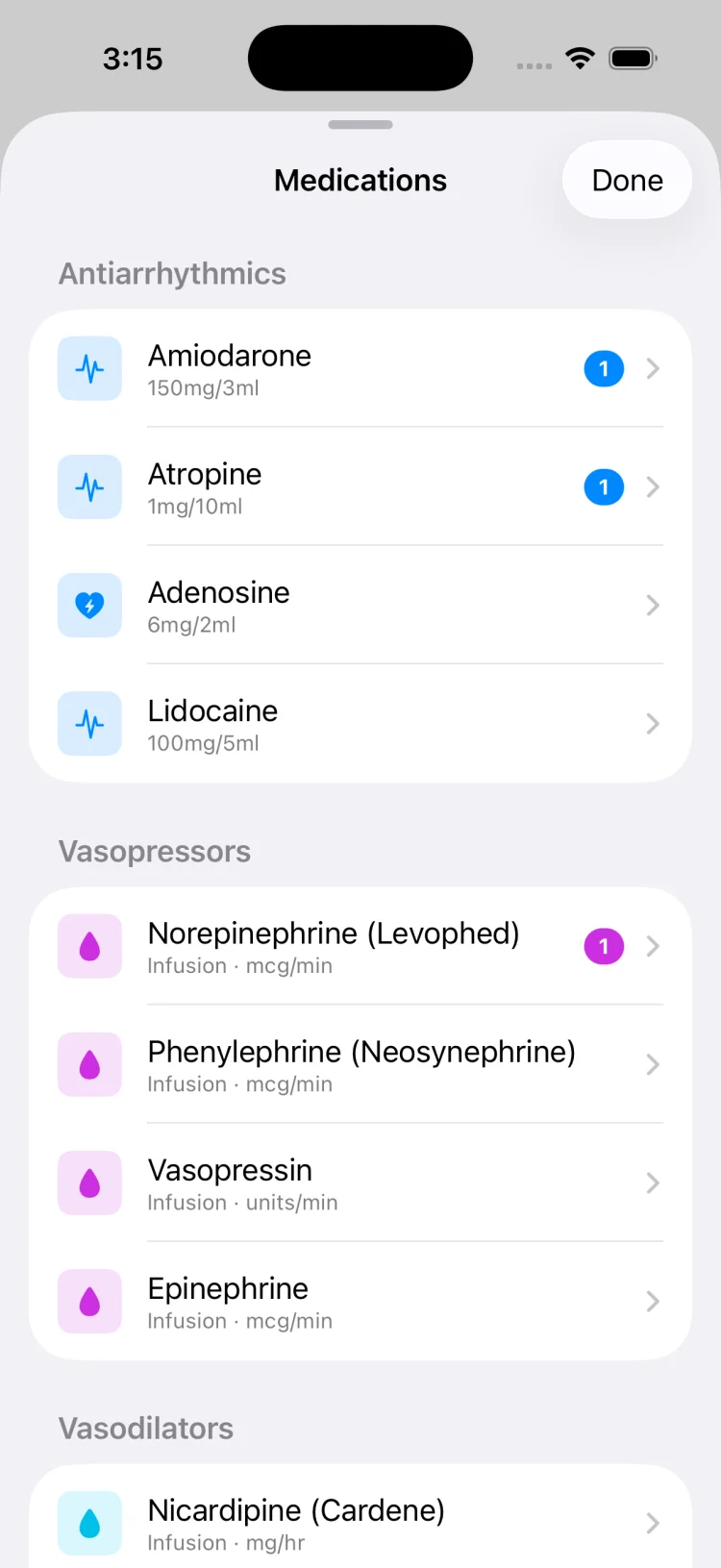
The medication list in MedCode uses a built-in pick-list of 30 critical-care medications organized into 8 categories. Each entry displays a reference concentration label and an adjustable stepper with a selectable range. The user selects the amount that was actually given. The app performs no weight-based calculation and makes no recommendation about what to give or when. Tapping an entry logs it immediately with the current clock time and elapsed time from the session start. The entry lands on the timeline, and the recorder's attention returns to the room. This design is intentional: logging must be fast enough that it does not pull focus away from the practice scenario.
The epinephrine timer as a separate visible clock
The epinephrine interval timer runs on the main screen alongside the compression cycle timer. Both are visible at once. When the epinephrine interval elapses, an alert fires and repeats until acknowledged. The recorder announces it to the team leader. The leader decides whether to give a dose. If yes, the recorder taps the entry, logs it, and resets the timer. This keeps the interval tracking and the documentation in the same place, managed by the same person. See the epinephrine timing guide for why this matters.
The session timeline
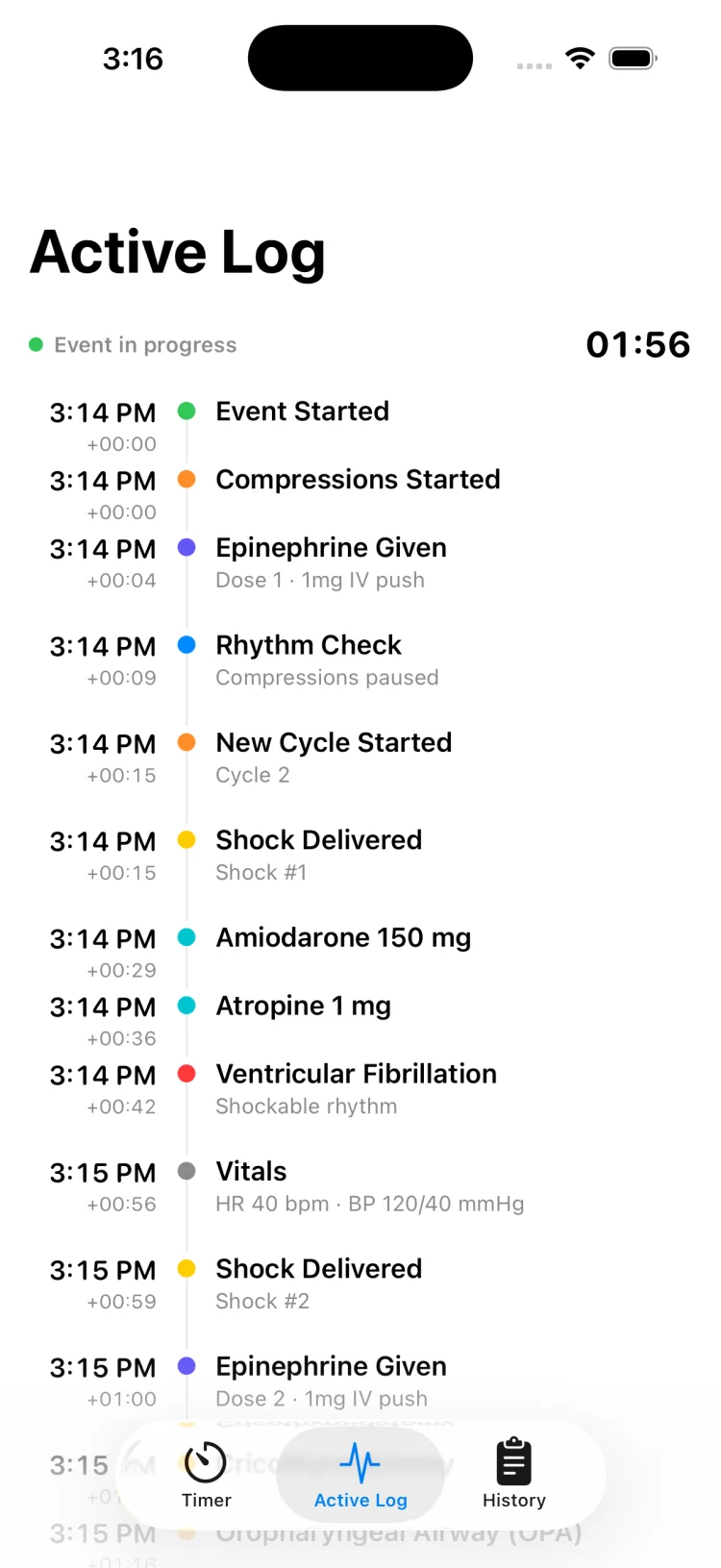
Every logged medication appears on the session timeline in chronological order, with both clock time and elapsed time displayed. During the practice scenario, the recorder can scroll back through the timeline to answer "when was the last dose of X?" without stopping to calculate intervals. After the session, the timeline is already written and can be exported as a PDF for review during the debrief.
PDF export for review
At the end of the session, the recorder can export a PDF of the timeline. The PDF shows every medication entry with timestamps, along with shocks, rhythm changes, procedures, and vitals. The export is a snapshot of what was captured during the practice session. MedCode does not replace the documentation your institution requires; if used during a real clinical event, the timeline would be transcribed into the system of record afterwards.
Logging medications in MedCode
Record medication administration during practice with a pick-list and automatic timestamping:
- From the main timer screen during an active session, tap the Medications button to open the pick-list.
- Find the medication in the list. Each entry shows a reference concentration label and an adjustable stepper.
- Select the amount that was actually given using the stepper, then tap to log. The entry is recorded immediately with the current clock time and elapsed time.
- The entry appears on the live session timeline. You can scroll back mid-scenario to check when the last dose was logged.
- For repeat-dose medications, reset the interval timer after logging the dose so the alert fires at the correct time for the next dose.
- At the end of the session, export the timeline as a PDF. The medication log is included with timestamps for every entry.
Transcribing to the chart afterwards without changing the record's meaning
The medication log from the code, whether it is a handwritten form or an exported PDF, is a source document. It gets transcribed into the formal medical record, but transcription is not interpretation. The goal is to transfer the information accurately without adding assumptions or rounding timestamps in ways that change the record's meaning.
Do not round timestamps unless the source is already rounded
If the source document says a drug was given at 14:43:18, write 14:43 or 14:43:18 in the chart. Do not round it to 14:45 because it is close to a five-minute mark. If the source document says "approximately 14:45," then write approximately 14:45. The level of precision in the transcribed record should match the level of precision in the source.
Do not fill in gaps with assumptions
If the medication log has a gap where a dose should have been recorded but was not, do not invent a timestamp and fill it in. Note the gap in the record. If the team remembers that a dose was given but the exact time was not captured, document it as "given at unknown time during the code" rather than guessing.
Include both clock time and elapsed time if both were captured
If the source document includes both clock time and elapsed time from event start, transcribe both. Elapsed time is useful for calculating intervals and for quality metrics such as time to first epinephrine. Clock time is useful for correlating the resuscitation record with other clinical events such as lab draws, imaging, or consultant arrival.
What a good medication log looks like at the debrief
A good medication log is one that can answer the questions the team will ask during the debrief without requiring anyone to guess or reconstruct. Here is what that looks like in practice.
Every medication has a timestamp
Not an approximate timestamp, not a range, not "around the fourth cycle." An actual time, captured when the drug went in. If the log has this, the team can measure intervals, audit repeat-dose timing, and calculate time-to-first-administration metrics accurately.
Repeat-dose intervals are consistent or the variations are explained
If your protocol describes a vasopressor every four minutes and the log shows doses at 1:00, 5:00, 9:00, 13:00 and 17:00, the intervals are consistent. If the log shows doses at 1:00, 4:00, 9:30, 11:00 and 16:00, the intervals are all over the place, and the debrief needs to ask why. A good log makes the pattern visible so the conversation can happen.
Cumulative doses are calculable
For drugs with cumulative dose limits, the log should show each individual administration so the total can be calculated. If the log just says "multiple doses of antiarrhythmic given," the total is unknown and the team cannot verify whether the limit was approached or exceeded.
The sequence of drugs relative to other events is clear
A good medication log sits within a larger timeline that also shows shocks, rhythm changes, procedures and vitals. This allows the debrief to ask questions like "did we give the antiarrhythmic before or after the third shock?" and "what was the rhythm when we gave the reversal agent?" The medication log alone is useful; the medication log in context is powerful.
This article is not medical advice
MedCode is a timer and documentation tool. It includes a medication pick-list for recording, but it provides no clinical decision support. This guide describes how to track medication administration during a resuscitation event, not how to choose or administer medications. All dosing decisions come from current AHA or ERC resuscitation guidelines and your institution's protocol and pharmacy.
MedCode includes a built-in pick-list of critical-care medications to make logging faster, but it performs no weight-based calculation, no dose checking, no interaction checking, and no allergy checking. It does not recommend or verify anything about a medication. It does not connect to monitors, pumps, or the EHR. It records what your team tells it, with a timestamp. Every clinical decision stays with the team, following your local protocol and current resuscitation guidelines. This article is educational content about documentation practices, not clinical instruction. Always consult your institution's protocol and current resuscitation guidelines. MedCode is not a medical device and is not intended for diagnosis or treatment.
MedCode is a practice and training tool. It is not a medical device, not clinical decision support, and not a substitute for your institution's required documentation or protocol. Any use during a real event is the individual clinician's own professional judgement.
Frequently asked questions
Does MedCode include drug doses or a dosing calculator?
MedCode includes a built-in pick-list of 30 critical-care medications to make logging faster, but it performs no weight-based calculation, no dose checking, no interaction checking, and no allergy checking. The pick-list displays reference concentration labels and an adjustable stepper; the user selects the amount that was actually given. MedCode does not recommend or verify anything about a medication. All dosing decisions come from current resuscitation guidelines and your institution's protocol.
What categories of medication show up during a code?
Resuscitation guidelines describe several categories: vasopressors to support circulation, antiarrhythmics to treat shockable rhythms, reversal agents for specific causes such as opioid overdose or toxin exposure, sedatives and paralytics for airway management, and adjunctive therapies for electrolyte abnormalities or other reversible causes. Each category serves a different role in the algorithm, and the timing of administration varies by protocol and clinical context.
Why is medication timing the least-accurate part of a code note?
Because the timestamps are usually reconstructed afterwards from memory rather than captured as events happen. The person giving the medication is focused on the line and the flush, the recorder is watching something else, and nobody writes down the exact time. Twenty minutes later, the record gets filled in with best estimates rounded to the nearest five minutes. Verbal orders never written, drugs drawn but not given, and doses given during a pause and attributed to the wrong minute all contribute to the problem.
What does a medication entry need to be useful later?
Five things: the drug name, the time it was given with both clock time and elapsed offset, the dose that was administered as recorded by the person who gave it, the route such as IV or IO, and who administered it. Without these fields, the entry is incomplete and the record cannot be used to reconstruct what actually happened or to audit quality metrics such as time to first epinephrine.