The question everyone asks is "how many miles a day should I plan?", and the answer everyone gives is a number pulled from a different trip, different terrain, and a different pack weight. A useful answer is a model — a way to estimate your own pace based on the route you actually have, the weight you will actually carry, and the people you are actually bringing.
The short version
Use 2 mph loaded plus 30 minutes per 1,000 feet of gain. Make day one shortest. Cut 15–25% for groups, heavy packs or rough terrain. Build the schedule backwards from sunset, and leave a margin.
Naismith's rule and its corrections
The oldest and most widely cited pace model is Naismith's rule, published in 1892 by a Scottish mountaineer. It says: allow 1 hour for every 3 miles (5 km) of horizontal distance, plus 1 hour for every 2,000 feet (600 m) of ascent.
For a 12-mile hike with 3,000 feet of gain, Naismith gives 4 hours for distance plus 1.5 hours for gain — 5.5 hours total. That is faster than most backpackers with overnight packs actually move, because Naismith was estimating day-hike pace for fit hillwalkers.
Tranter's corrections for fitness and fatigue
In 1964, Philip Tranter published corrections to Naismith's rule that adjust for fitness level. Tranter's table assumes your fitness corresponds to how long it takes you to climb 1,000 feet over half a mile — very fit hikers do it in 15 minutes; unfit or heavily loaded hikers need 50 minutes or more. The table then multiplies Naismith's time by a correction factor ranging from 0.8 (very fit) to 2.5 (slow or heavily loaded).
Most backpackers with packs over 25 pounds fall into the middle or slow categories, meaning Naismith's times need to be multiplied by 1.3 to 1.8 to be realistic.
Langmuir correction for descent
Naismith ignored descent, which is fine for gentle slopes but wrong on steep or technical downhills. The Langmuir correction adds time for steep descents: add 10 minutes for every 1,000 feet of descent beyond the first 1,000 feet, if the descent is steeper than about 12 degrees. On scree, talus or snow, add more.
For most North American backpacking routes with moderate descent, Langmuir is a minor correction. For alpine scrambles or knee-destroying downhills like the Grand Canyon, it matters.
A practical simplified model for loaded backpacking
Naismith plus corrections gives you precision, but it is arithmetic you will not do on the trail. A simpler, calibrated model that works for most overnight trips:
- Base loaded pace: 2 mph on moderate trail with a full pack.
- Elevation penalty: add 30 minutes for every 1,000 feet of gain.
- Descent penalty: add 15 minutes for every 1,000 feet of steep or technical descent.
So a 10-mile day with 2,500 feet of gain becomes 5 hours walking (10 miles ÷ 2) plus 1 hour 15 minutes for elevation — 6 hours 15 minutes of moving time. Add rest stops, water stops and lunch, and you are at 7.5 to 8 hours trailhead to camp.
This model is conservative by design. It is better to arrive early and read a book than to set up a tent in the dark.
Daily mileage benchmarks by experience level
Pace models give you time; what you actually need is how far to plan each day. Here are realistic daily distances and elevation for different experience levels, assuming moderate trail, stable weather, and a pack between 20 and 30 pounds base weight.
| Experience level | Daily distance | Daily elevation gain | Moving time |
|---|---|---|---|
| First overnight | 4–6 miles | 500–1,000 ft | 3–4 hours |
| Beginner (2–5 trips) | 6–8 miles | 1,000–1,500 ft | 4–5 hours |
| Intermediate (regular backpacker) | 10–14 miles | 2,000–3,000 ft | 6–7 hours |
| Experienced, fit | 15–20 miles | 3,500–5,000 ft | 8–10 hours |
| Ultralight long-distance hiker | 20–30+ miles | Variable | 10–14 hours |
These are comfortable distances — what you can sustain for multiple days without injury or burnout. You can push harder for a single day, but a multi-day itinerary built at your maximum pace is a plan to hurt yourself.
Day one is always shortest
Make your first day 60–70% of your normal daily mileage. You will start later than you planned, your pack is heaviest before you eat anything, and you need time to find your rhythm. Trailhead at 10 a.m., camp by 3 p.m. is a good target.
Factors that slash your pace
The models above assume moderate, maintained trail in decent conditions with a reasonable pack. Real trips include variables that cut your speed by 15% to 50%. Account for these before you commit to a mileage plan.
Pack weight over 20–25% of body weight
Carrying more than about a quarter of your body weight slows you measurably and increases injury risk. A 150-pound hiker with a 40-pound total pack weight (gear, food, water) is carrying 27% of body weight and will move 15–20% slower than the same hiker with a 25-pound pack. If your base weight is above 20 pounds and you are carrying five days of food, subtract speed.
Group size
Solo hikers move at their own pace. Groups wait for the slowest member, take more breaks, and lose time to navigation discussions and photo stops. A group of two or three is roughly 10% slower than solo. A group of five or more is 20–30% slower, and the penalty increases with group size and skill variance.
Off-trail, scrambly or unmaintained terrain
Pace models assume trail. Off-trail cross-country, talus fields, river boulder-hopping, or unmaintained trails with blowdowns can cut your speed in half. If more than 20% of your route is off-trail or class 2–3 scrambling, subtract 25–40% from your estimated pace.
Snow, ice and stream crossings
Snow slows you unless it is frozen firm. Postholing through soft snow or navigating around cornices can drop pace to 1 mph or slower. Early-season snow bridges and swollen stream crossings add both time and risk. If you expect snow coverage above 30%, cut your planned daily mileage by at least a quarter and build in a weather buffer day.
Altitude
Above about 8,000 feet, most people slow down. Above 10,000 feet, unacclimatised hikers can lose 20–30% of their pace, and above 12,000 feet the penalty is steeper. If your route camps above 10,000 feet and you live at sea level, plan shorter days and build in acclimatisation time.
Heat, humidity and weather
Hiking in 35°C heat or 90% humidity drains energy and forces slower pace and longer breaks. Rain does not slow most people much, but sustained heavy rain, lightning risk, or high winds can pin you in camp for hours or force an early stop.
Hard constraints: water, camps and daylight
Your daily mileage is not a free variable. It is constrained by three hard limits: where you can legally camp, where the water is, and when the sun sets. These are not negotiable on the trail, so plan around them from the start.
Camp spacing and legal sites
Many wilderness areas restrict camping to designated sites or require camps to be a minimum distance from water, trails and other groups. Your daily segments must end at a legal, suitable site with tent space for your group. If there are only three viable camps on a 25-mile loop, your daily mileage is decided for you.
Water availability
You cannot camp without water unless you are willing to carry two to three litres extra. Mark every reliable water source on your route, and check recent trip reports for seasonal sources that may be dry. Your camps must be within reasonable distance of water — ideally within a quarter mile, and never more than half a mile each way if you are cooking.
Building the plan backwards from sunset
Your arrive-at-camp time must leave enough daylight to set up, filter water, cook and eat before dark. In summer at temperate latitudes, sunset is around 8–9 p.m.; plan to stop hiking by 6 p.m. In shoulder season or at higher latitudes, sunset can be 5 p.m. or earlier. Check actual sunset time for your dates and location, then subtract 90 minutes minimum. That is your latest arrival time, and it sets the maximum you can hike that day.
Splitting the route into daily segments
Now you have a pace model, mileage benchmarks and hard constraints. Turn them into a day-by-day plan.
Start from the hardest day
Identify the most difficult segment — usually the one with the most gain, the least water, or a mandatory high pass. Plan that day first to make sure it is possible, then build the rest of the trip around it. If the hardest day does not fit your pace model, you need a different route or an extra night.
Make day one shortest
Already mentioned, but worth repeating: the first day should be 60–70% of your normal distance. A 4–6 mile first day puts you in camp early, gives you time to adjust your pack, and sets a relaxed tone. A 12-mile first day with a late start guarantees you will arrive stressed and tired.
Build in a buffer day
On any trip longer than three nights, plan a shorter day, a rest day, or an optional layover camp. Buffer days absorb weather, injury, fatigue, or the discovery that the spring you were counting on is dry. They also give you a bail-out option: if someone cannot continue, you can cut the buffer day and exit early without ruining the whole trip.
Identify bail-out points
For every night, know the closest exit to a trailhead or road. If someone twists an ankle, gets sick, or the weather turns dangerous, you need a way out that does not require finishing the whole loop. Mark these on your map and communicate them to the group before you start.
Doing this in GoVenture
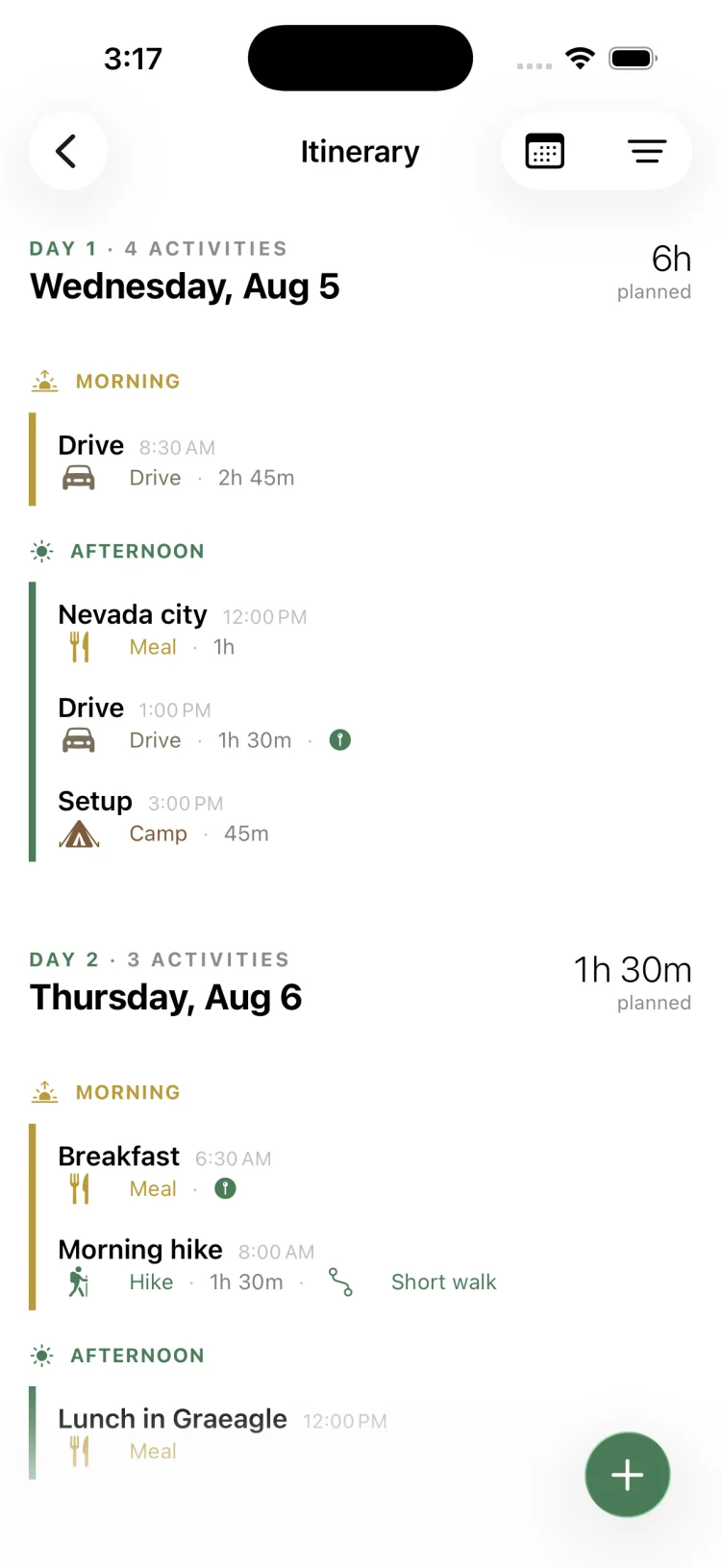
Turn mileage into a real day-by-day plan:
- Create a trip and attach your route with total distance and elevation.
- Open the Itinerary tab and add each day as a separate section.
- For each day, list activities with start times and durations: wake, break camp, hike segments, water stops, lunch, arrive at camp.
- Drop waypoints on the route for each camp, water source and junction so your schedule ties to the map.
- Check the running total time against sunset and adjust the plan before you pack.
Converting mileage into an hour-by-hour itinerary
A mileage plan tells you how far. A schedule tells you when. Build a full hour-by-hour itinerary for each day so you can see the whole shape of the trip and catch problems early.
What to include in the daily schedule
- Wake time — usually 6–7 a.m. for an 8 a.m. start.
- Break camp and start hiking — allow 60–90 minutes from wake to trailhead on day one, 45–60 minutes on subsequent days.
- Hiking segments — break the day into 2–3 hour blocks with mileage and elevation for each.
- Water stops — 10–15 minutes each time you filter or refill.
- Rest breaks — 10 minutes per hour, or one 20-minute break mid-morning and mid-afternoon.
- Lunch — 30–45 minutes, ideally at a scenic spot or water source.
- Arrive at camp — your target arrival time, ideally 90+ minutes before dark.
- Set up, cook, eat — allow 90 minutes from arrival to in-tent if you are cooking a hot meal.
Add it all up. If the schedule says you are hiking from 8 a.m. to 6:30 p.m. with only 30 minutes of breaks, you have built a forced march, not a backpacking trip. Adjust the mileage or add a day.
Check against the weather forecast
Once you have a schedule, overlay the weather. If afternoon thunderstorms are forecast, plan to be off exposed ridges by 2 p.m. If it will be 35°C, plan an early start and a long midday break in shade. Weather is a hard constraint as much as water or daylight.
Doing this in GoVenture
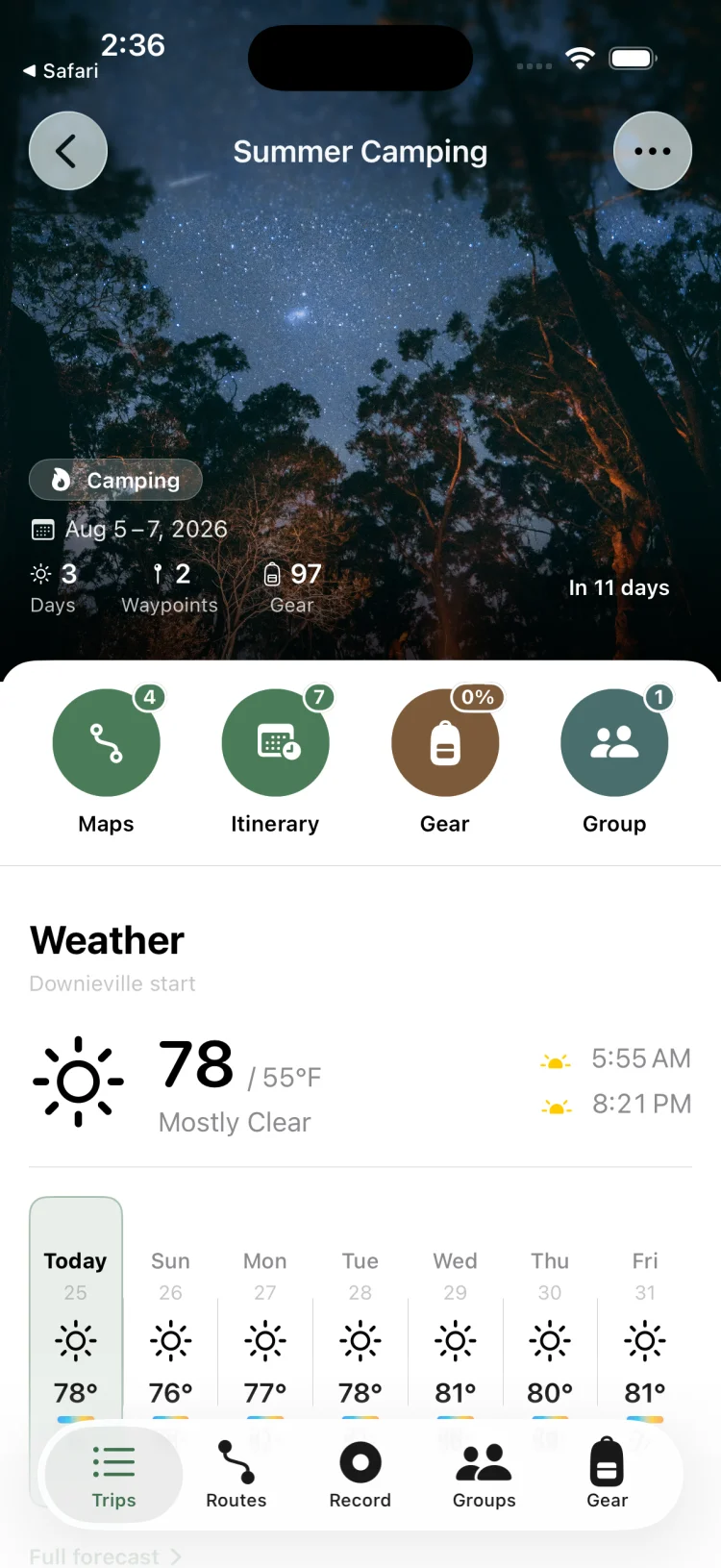
See the weather forecast alongside your itinerary:
- Set your trip dates in the trip details.
- GoVenture fetches the forecast for those dates and displays it in the trip view.
- Cross-check your planned hiking times against forecast conditions — heat, rain, wind, lightning risk.
- Adjust start times, break times or daily mileage to avoid hiking in dangerous or miserable conditions.
Worked example: A 3-day, 30-mile loop
Here is how to turn a route into a full itinerary. The route: a 30-mile loop with 6,500 feet of total gain, three legal camps with water, moderate maintained trail. Group: two intermediate backpackers, base weight around 18 pounds each, comfortable with 10–12 miles per day.
Step 1: Measure the segments
- Day 1 (shortest): Trailhead to Camp 1 — 7 miles, 1,200 ft gain.
- Day 2 (hardest): Camp 1 to Camp 2 — 12 miles, 3,500 ft gain (includes a pass).
- Day 3: Camp 2 to trailhead — 11 miles, 1,800 ft gain, 2,000 ft descent.
Step 2: Estimate times using the simplified model
Base pace 2 mph, plus 30 min per 1,000 ft gain, plus 15 min per 1,000 ft steep descent.
- Day 1: 7 miles ÷ 2 = 3.5 hours + 36 min (1,200 ft) = 4 hours 6 min moving. Add breaks and lunch = 5 hours total.
- Day 2: 12 miles ÷ 2 = 6 hours + 1 hour 45 min (3,500 ft) = 7 hours 45 min moving. Add breaks = 9 hours total.
- Day 3: 11 miles ÷ 2 = 5.5 hours + 54 min (1,800 ft gain) + 30 min (2,000 ft descent) = 7 hours moving. Add breaks = 8 hours total.
Step 3: Build the hour-by-hour schedule
Day 1 schedule
| 7:00 a.m. | Wake, breakfast, break camp |
| 8:30 a.m. | Drive to trailhead (45 min) |
| 9:15 a.m. | Start hiking |
| 10:45 a.m. | Water stop, 3 miles in (15 min) |
| 12:00 p.m. | Lunch at 5 miles (30 min) |
| 2:00 p.m. | Arrive Camp 1 (7 miles total) |
| 2:00–4:00 p.m. | Set up, filter water, relax |
| 5:30 p.m. | Cook dinner |
| 8:30 p.m. | Sunset, in tent |
Day 2 schedule (the long day)
| 6:00 a.m. | Wake |
| 6:30 a.m. | Breakfast, pack up |
| 7:30 a.m. | Start hiking |
| 9:30 a.m. | Break (10 min) |
| 11:00 a.m. | Water stop at creek, 5 miles in (15 min) |
| 12:30 p.m. | Lunch below the pass (45 min) |
| 2:30 p.m. | Summit the pass, 9 miles in |
| 3:00 p.m. | Descend, break (10 min) |
| 4:30 p.m. | Arrive Camp 2 (12 miles total) |
| 6:00 p.m. | Dinner |
| 8:30 p.m. | Sunset |
Day 3 schedule (exit day)
| 6:30 a.m. | Wake |
| 7:00 a.m. | Breakfast, break camp |
| 8:00 a.m. | Start hiking |
| 10:00 a.m. | Break, 4 miles in (10 min) |
| 11:30 a.m. | Water stop (15 min) |
| 1:00 p.m. | Lunch, 8 miles in (30 min) |
| 3:30 p.m. | Arrive trailhead (11 miles total) |
| 4:00 p.m. | Drive home |
Step 4: Check and adjust
Day 2 is long but doable for intermediate hikers in good conditions. The schedule has them in camp by 4:30 p.m. with plenty of daylight. If the forecast shows afternoon storms, move the pass crossing to the morning by starting at 6:30 a.m. instead of 7:30 a.m., or split day 2 into two shorter days by adding a fourth night.
This is the value of an hour-by-hour schedule: you see the problem before you are standing under the pass in a thunderstorm.
Frequently asked questions
How many miles a day should you hike when backpacking?
Most beginner backpackers should plan 5 to 8 miles per day with elevation gain under 1,500 feet. Experienced hikers can comfortably manage 12 to 18 miles with 3,000 to 4,500 feet of gain on good trail. Always make day one the shortest and subtract speed for groups, heavy packs or off-trail terrain.
What is Naismith's rule for hiking?
Naismith's rule estimates hiking time as 1 hour per 3 miles (5 km) of horizontal distance, plus 1 hour for every 2,000 feet (600 m) of ascent. Corrections exist for fitness (Tranter's), descent (Langmuir), and real-world factors like pack weight, terrain and fatigue.
How do you calculate how long a hike will take?
Use a pace model: 2 mph on moderate trail with a loaded pack, plus 30 minutes per 1,000 feet of elevation gain. Subtract 15–25% for groups over four people, off-trail terrain, packs over 25% body weight, snow or heat. Then add rest stops, water stops and lunch.
Should you plan a buffer day on a multi-day hike?
Yes. A buffer or rest day every three to four days absorbs weather delays, injury, fatigue or a short resupply. It also gives you a bail-out option if someone cannot continue, and prevents you from being forced to hike in dangerous conditions just to make the schedule.