Most backpackers pack from memory or from whatever was in the pack last time, which means they carry things they never use and forget things they need. A proper gear list is built from categories, not guesswork. This is the full checklist for a two- to three-night trip in mild to moderate conditions — temperate season, established trails, legal camps. Use it as a starting point, then subtract for your specific route, season and skill.
The short version
Weigh every item. Total your base weight (everything except food, water and fuel). If you are over 20 pounds, cut from the big three first: pack, shelter, sleep system. Then eliminate duplicates, ditch cotton, and leave anything you packed "just in case" but have never once used.
Shelter and sleep system
This is where half your base weight sits. A heavy tent, a winter-rated bag in summer, and a thick foam pad will put you at 8–10 pounds before you have added anything else.
| Item | Typical weight | Notes |
|---|---|---|
| Tent (2-person) | 3–5 lb (1400–2300 g) | Split weight with a partner; ultralight models sit at 2–3 lb |
| Sleeping bag (20–30°F) | 2–3 lb (900–1400 g) | Down is lighter, synthetic works wet |
| Sleeping pad | 12–20 oz (340–570 g) | Inflatable pads pack smaller than foam |
| Pillow (optional) | 2–4 oz (60–115 g) | Use a stuff sack with spare clothes if cutting weight |
| Tent footprint (optional) | 4–8 oz (115–230 g) | A sheet of Tyvek cut to size weighs less and costs nothing |
If you are sharing a tent, split the weight: one person carries the body, the other carries poles and stakes. Never have one person hauling the whole shelter while their partner carries a day pack worth of gear.
Backpack and pack accessories
Your pack should weigh less than your shelter. If it does not, you have bought too much pack. A 60–70 litre volume handles a 2–3 night trip comfortably for most people; going bigger just means you fill it with things you do not need.
| Item | Typical weight | Notes |
|---|---|---|
| Backpack (60–70 L) | 3–5 lb (1400–2300 g) | Lighter models sacrifice some comfort features |
| Pack liner or cover | 2–6 oz (60–170 g) | A compactor bag works as well as a branded liner |
| Dry bags / stuff sacks | 1–3 oz each (30–85 g) | Use for sleep system, clothes; skip the rest |
If your base weight is under about 15 pounds, you can drop to a frameless ultralight pack around 1–2 pounds. Anything heavier needs the frame.
Kitchen and cooking
The kitchen is where group trips save the most weight. One stove, one pot, one lighter for four people. If you are solo, this category should weigh under 2 pounds including fuel for three days.
| Item | Typical weight | Notes |
|---|---|---|
| Stove (canister or alcohol) | 2–4 oz (60–115 g) | Canister stoves are faster; alcohol stoves are lighter and simpler |
| Fuel (3 days, solo) | 6–12 oz (170–340 g) | One 110g canister is usually enough for 2–3 nights solo |
| Pot (0.9–1.2 L) | 4–8 oz (115–230 g) | Titanium is light; aluminium is cheap |
| Spork or spoon | 0.5–1 oz (15–30 g) | Leave the full cutlery set at home |
| Lighter + backup matches | 0.5 oz (15 g) | Two lighters weigh less than one and redundancy matters |
| Bear canister or hang kit | 2–3 lb (900–1400 g) or 2 oz (60 g) | Required in some areas; check regulations before the trip |
For a group, assign one person the stove and pot, another the fuel and lighter. Never have everyone carrying a full kitchen. See the group trip planning guide for how to divide shared gear fairly.
Doing this in GoVenture
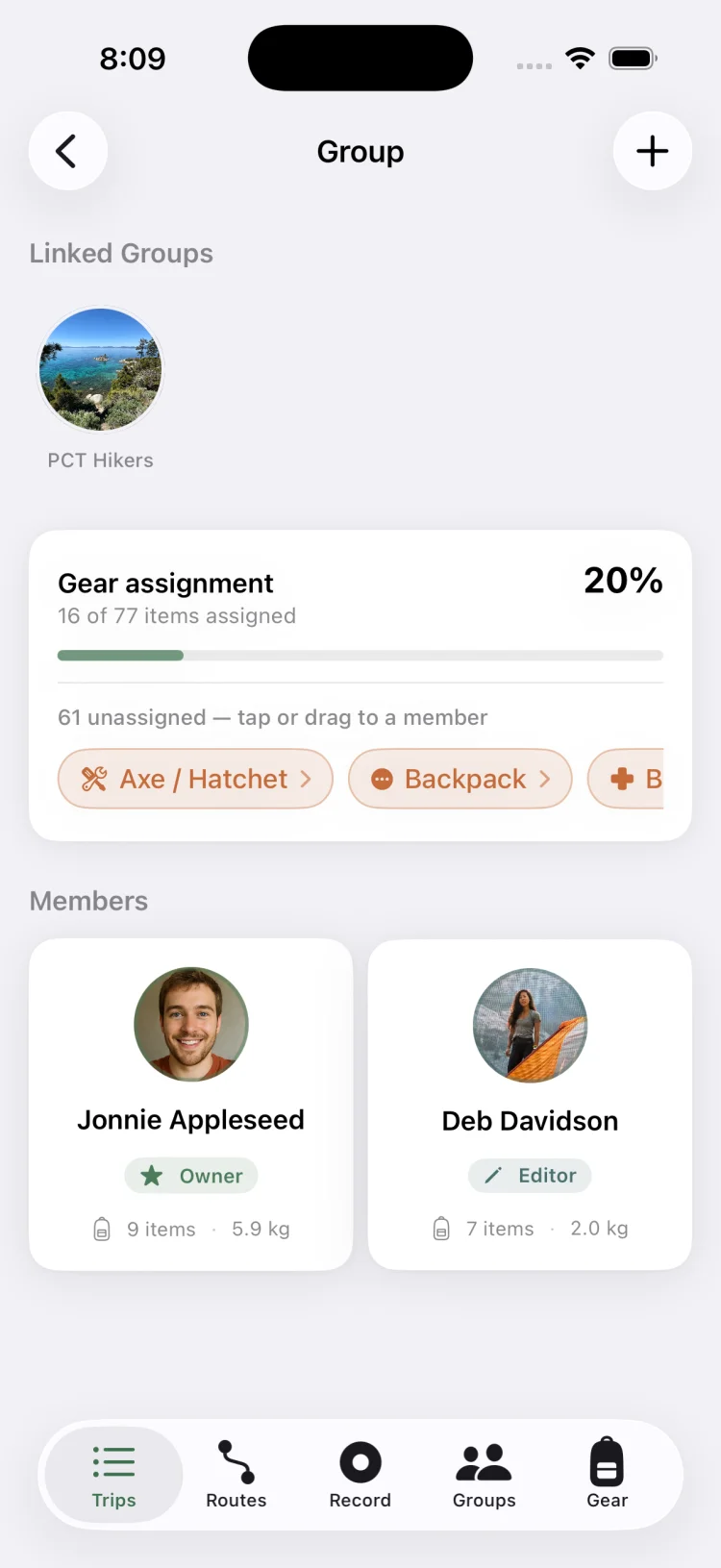
Assign shared gear to specific people so nothing is packed twice:
- Create a trip and invite your group members.
- Open Gear and add the full group list, marking items as "Group gear".
- Assign each group item to one person — tent body to one, poles to another, stove to a third.
- Everyone sees the full list; only their assigned items show in their personal pack weight.
Water treatment and carry
Carry capacity should match the longest stretch between reliable sources, plus a margin. For most routes with water every 5–8 miles, 2–3 litres total is enough. Desert routes need 4–6 litres minimum.
| Item | Typical weight (empty) | Notes |
|---|---|---|
| Water filter or purifier | 3–8 oz (85–230 g) | Squeeze filters are light; gravity filters are fast for groups |
| Water bottles (2 × 1 L) | 2–3 oz each (60–85 g) | Disposable bottles work and weigh almost nothing |
| Hydration bladder (2–3 L) | 4–6 oz (115–170 g) | Convenient but harder to monitor intake; can freeze in cold |
One filter per group of 3–4 people is usually enough. Carry backup treatment tablets in case the filter fails — they weigh half an ounce and can save a trip.
Clothing and layers
This is the category where beginners over-pack the most. You do not need a full wardrobe. Plan in layers: base layer, insulation, shell. Wear one set, carry one spare top and bottom, sleep in dedicated dry clothes. That is it.
| Item | Typical weight | Notes |
|---|---|---|
| Insulated jacket | 8–16 oz (230–450 g) | Down for dry cold, synthetic for wet |
| Rain jacket | 6–12 oz (170–340 g) | Waterproof-breathable; skip the "water-resistant" softshells |
| Rain trousers (optional) | 4–8 oz (115–230 g) | Useful in prolonged rain or cold; skip in summer |
| Spare base layer top | 4–6 oz (115–170 g) | Merino or synthetic; never cotton |
| Spare hiking trousers/shorts | 6–10 oz (170–285 g) | One spare is enough; they dry overnight if hung |
| Spare socks (2 pairs) | 2–3 oz per pair (60–85 g) | Wear one, carry two spares, sleep in dedicated dry pair |
| Spare underwear (1–2) | 1–2 oz each (30–60 g) | Synthetic or merino; skip cotton entirely |
| Warm hat | 1–2 oz (30–60 g) | You lose significant heat through your head; always carry one |
| Sun hat (optional) | 2–4 oz (60–115 g) | Essential in desert or alpine; skip in forest |
| Gloves (light or insulated) | 1–4 oz (30–115 g) | Liner gloves for moderate cold; insulated for shoulder season |
The clothing you are wearing when you start does not count toward base weight. Everything in the pack does. Most people can get their clothing category under 3 pounds by ruthlessly cutting spares.
Navigation and electronics
Your phone is your primary navigation tool if you have downloaded offline maps before leaving signal. Carry a paper map and compass as backup, and carry enough battery capacity to last the trip plus one extra day.
| Item | Typical weight | Notes |
|---|---|---|
| Phone | 5–7 oz (140–200 g) | GPS works without signal; download maps beforehand |
| Battery bank (10,000 mAh) | 6–8 oz (170–230 g) | Enough for 2–3 full phone charges |
| Charging cable | 1 oz (30 g) | Bring one short cable; leave the brick at home |
| Headlamp | 2–4 oz (60–115 g) | 200+ lumens; carry spare batteries or a rechargeable model |
| Paper map | 1–2 oz (30–60 g) | Waterproof or in a zip-lock; mark your route beforehand |
| Compass | 1–2 oz (30–60 g) | Baseplate type; know how to use it before you need it |
| Watch (optional) | 1–2 oz (30–60 g) | Your phone tells time; only carry if you prefer a watch |
Put the phone in airplane mode and low power mode on the trail. A phone searching for signal drains in hours; in airplane mode with occasional GPS use, it lasts two to three days.
Safety, repair and first aid
This is the category people skip and then regret. A first aid kit does not need to handle surgery — it needs to cover blisters, cuts, sprains and common pills. Repair kit is duct tape, safety pins, and a sewing needle. The knife is a small folder, not a machete.
| Item | Typical weight | Notes |
|---|---|---|
| First aid kit | 4–8 oz (115–230 g) | Blister treatment, bandages, tape, pain relief, antihistamine, personal meds |
| Knife or multi-tool | 2–6 oz (60–170 g) | One blade, scissors and tweezers is enough |
| Repair tape (duct tape) | 1 oz (30 g) | Wrap 10 feet around a trekking pole or water bottle |
| Emergency shelter (bivy or tarp) | 2–4 oz (60–115 g) | For if the tent fails or someone gets injured and cannot move |
| Whistle | 0.5 oz (15 g) | Three blasts is the universal distress signal |
| Trekking poles (pair, optional) | 12–18 oz (340–500 g) | Reduce knee strain and improve stability; double as tent poles for some shelters |
For a group, one comprehensive first aid kit is enough. Have one person carry it and make sure everyone knows who has it. Add a satellite communicator or PLB if you are going somewhere without any cell coverage and no traffic.
Hygiene and personal care
You do not need to carry toiletries for a hotel. A toothbrush, a small tube of paste, biodegradable soap, and a trowel. That is the whole list for most trips under a week.
| Item | Typical weight | Notes |
|---|---|---|
| Toothbrush and paste | 1 oz (30 g) | Cut the toothbrush handle in half if you are serious about weight |
| Biodegradable soap (small bottle) | 1–2 oz (30–60 g) | Use 200 feet from water sources; bury or pack out grey water |
| Toilet paper and trowel | 2–3 oz (60–85 g) | Pack out used TP in a zip-lock; it does not decompose quickly |
| Hand sanitiser (small bottle) | 1 oz (30 g) | Use after toilet and before eating; saves water |
| Sunscreen (travel size) | 2–3 oz (60–85 g) | Reapply every two hours in full sun; mineral formulas are reef-safe |
| Lip balm with SPF | 0.5 oz (15 g) | Your lips burn faster than you think at altitude |
| Insect repellent (seasonal) | 1–2 oz (30–60 g) | DEET or picaridin; skip it in desert or above tree line |
Leave the towel at home. A bandana or a small microfibre cloth weighs an ounce and dries in twenty minutes. A full-size towel weighs half a pound and stays damp for two days.
Personal items and documents
Keep this category light. The permit, your ID, a small amount of cash for an emergency, and a car key. Everything else is optional.
| Item | Typical weight | Notes |
|---|---|---|
| Permit and ID | 1 oz (30 g) | Keep in a waterproof bag or phone case |
| Car key | 1 oz (30 g) | Leave the full keyring in the car; bring only the one key |
| Cash (small amount) | Negligible | For roadside emergencies or an unplanned resupply |
| Notebook and pencil (optional) | 2–4 oz (60–115 g) | A small notebook; most people use their phone instead |
| Camera (optional) | 8–16 oz (230–450 g) | Only if phone quality is not enough; adds significant weight |
Do not carry your full wallet, your house keys, or anything you would be upset to lose in a river crossing. Leave it locked in the car.
Doing this in GoVenture
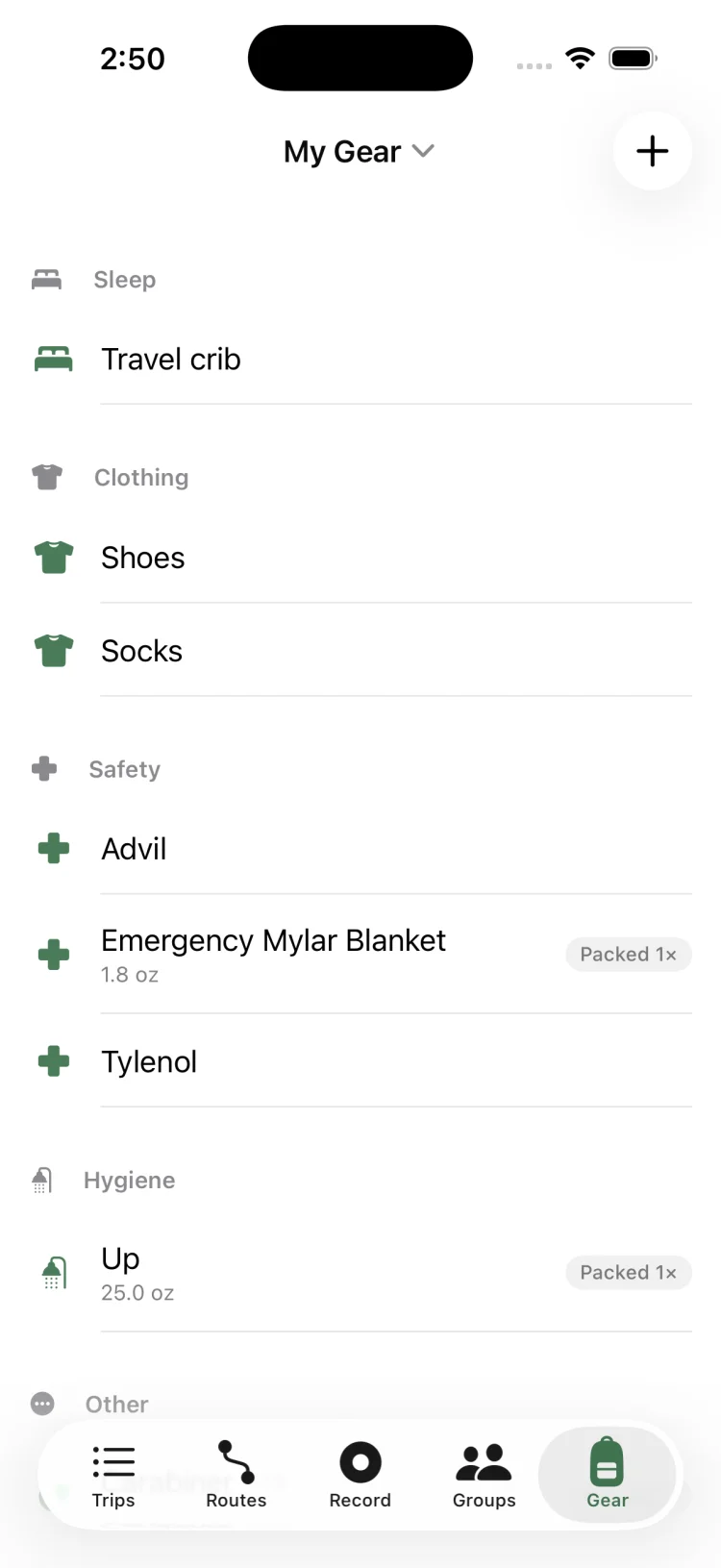
Build your master gear inventory once, reuse it forever:
- Open Gear and create categories: Shelter, Sleep, Pack, Kitchen, Water, Clothing, Navigation, Safety, Hygiene, Personal.
- Add every item you own with its actual weight (use a kitchen scale).
- Create Quick Kits for items you always take together: sleep system (bag + pad + pillow), kitchen (stove + pot + spork + lighter), first aid.
- When planning a trip, add the relevant Quick Kits in one tap, then add trip-specific extras (ice axe, bear canister, extra warm layer).
The Ten Essentials
The Ten Essentials are not a gear list — they are a survival checklist. Every item above maps to one of these ten categories. Carry all ten, even on a day hike, even in good weather. Conditions change, people get lost, and rescue is not instant.
- Navigation — map, compass, GPS or phone with offline maps.
- Sun protection — sunglasses, sunscreen, hat, protective clothing.
- Insulation — extra clothing beyond what you need for the expected conditions.
- Illumination — headlamp or torch with spare batteries.
- First aid — kit with supplies for cuts, blisters, sprains, and personal medications.
- Fire — lighter, matches, firestarter; even if fires are banned, you may need one in an emergency.
- Repair kit and tools — knife, duct tape, cordage, safety pins.
- Nutrition — extra food beyond your planned meals; enough for one unplanned night.
- Hydration — extra water or reliable treatment method.
- Emergency shelter — bivy, tarp, or space blanket for if your main shelter fails or you cannot reach camp.
Notice that these are categories, not specific items. You satisfy "fire" with a lighter and a few matches in a waterproof bag. You satisfy "emergency shelter" with a 2-ounce bivy sack. The Essentials do not add much weight if you choose the right version of each.
What to leave home
Most backpackers carry 3–5 pounds of things they never use. Here is what to cut first.
Items commonly over-packed
- Camp shoes or sandals. Your trail runners dry overnight if you hang them. A second pair of footwear is 12–16 ounces you will use for twenty minutes.
- Cotton clothing. It does not dry, it does not insulate when wet, and it is heavy. No cotton t-shirts, no jeans, no hoodies. Synthetic or merino only.
- Too many spare clothes. One spare top, one spare bottom, two spare socks. That is it. You do not need a full outfit for every day.
- Full-size towel. A bandana works. A small microfibre cloth weighs one ounce. A towel weighs eight and never dries.
- Books, journals, heavy electronics. Your phone can hold a book, a journal app, and a camera. A paperback and a notebook add half a pound.
- Camp chair. Sit on your foam pad, a log, or the ground. A chair is 2 pounds of comfort you do not need.
- Redundant group gear. Four people do not need four stoves, four water filters, and four first aid kits. Split it.
- Too much food. Most people pack 20–30% more food than they eat. Weigh your meals and pack by the day, not by guesswork.
- "Just in case" items. If you have carried it on three trips and never used it, leave it home. The only exception is safety gear.
After you have done a few trips, go through your pack and physically separate everything you used from everything you did not touch. The "did not touch" pile is what you cut next time. See the base weight calculator guide for the full method of tracking and cutting pack weight over time.
Seasonal adjustments for shoulder season, desert and alpine
The list above assumes mild conditions — summer or early autumn, temperate forests, moderate elevation. Adjust for season and terrain.
Shoulder season (spring, late autumn) or alpine
Add:
- Heavier insulation layer (down or synthetic puffy)
- Insulated gloves and warm hat (not just a liner cap)
- Warmer sleeping bag (15–20°F instead of 30°F rating)
- Four-season tent if severe weather or wind is forecast
- Microspikes or an ice axe if snow or ice is expected on the route
- Extra fuel — a canister lasts half as long in freezing temperatures
Cut:
- Sun hat (unless above tree line)
- Insect repellent (bugs are gone by shoulder season)
Desert or high desert
Add:
- Extra water capacity — 4 to 6 litres minimum, sometimes more depending on source spacing
- Sun protection: wide-brimmed hat, sun umbrella (sounds silly, works brilliantly), long sleeves
- Electrolyte mix or salt tablets for heat
- Higher SPF sunscreen and more of it
Cut:
- Heavy insulation (desert nights are cold but not alpine-cold; a light puffy is enough)
- Rain gear (many desert trips see zero precipitation; check forecast and cut accordingly)
Winter (snow camping)
Winter camping is a different discipline and needs a different list entirely: four-season tent or snow shelter, 0°F or colder sleeping bag, insulated pad with R-value above 5, winter boots, expedition gloves, goggles, avalanche safety gear if in avalanche terrain, and a stove that works in freezing temperatures. Do not attempt winter trips without specific training and experience.
How to reuse this list across trips
The mistake most people make is building a new list from scratch every time. Build the list once, weigh everything once, then reuse it. Your core gear — sleep system, kitchen, water treatment, clothing, first aid — does not change trip to trip. Only the extras change: bear canister for Yosemite, ice axe for alpine, extra water capacity for desert.
Keep a master inventory of everything you own with weights. When you plan a trip, start from the base template for that trip type (backpacking, car camping, alpine, desert), then add the trip-specific items and subtract anything you do not need. This approach is faster, more accurate, and ensures you do not forget something because it was not on last trip's list.
GoVenture is built around this model: you maintain one permanent gear inventory, create reusable Quick Kits for the bundles you always take (sleep system, kitchen, first aid), and add them to each trip in one tap. Then you add the extras, check the total weight, and adjust. The full process is in the backpacking trip planning guide.
Frequently asked questions
What are the Ten Essentials for backpacking?
The Ten Essentials are a survival checklist for wilderness travel: navigation (map and compass or GPS), sun protection, insulation (extra clothing), illumination (headlamp), first aid, fire (lighter and matches), repair kit (knife and tape), nutrition (extra food), hydration (extra water or treatment), and emergency shelter (bivy or tarp). Carry them even on day hikes.
How heavy should a backpacking pack be?
Your total pack weight when loaded with food, water and fuel should stay below 20% of your body weight for comfortable multi-day hiking. A 150-pound person should carry under 30 pounds total; a 200-pound person under 40 pounds. Base weight — the pack without consumables — should sit around 15–20 pounds for most backpackers, under 10 pounds if you have gone ultralight.
What items are commonly over-packed on backpacking trips?
The most commonly over-packed items are: camp shoes (trail runners dry overnight), cotton clothing (it does not dry and adds dead weight), too many spare clothes (one set is usually enough), a full-size towel (a bandana works), extra electronics, books or heavy journals, bulky camp chairs, redundant group gear like multiple stoves and water filters, and too much food — most people pack 25% more than they eat.
How do I adjust my gear list for different seasons?
For shoulder season or alpine trips, add insulated jacket and gloves, swap to a warmer sleeping bag (15–20°F instead of 30°F), carry microspikes or an ice axe if snow is expected, and pack a four-season shelter if severe weather is forecast. For desert trips, increase water capacity to 4–6 litres, add a sun umbrella or wide-brimmed hat, pack sunscreen and electrolyte mix, switch to lighter insulation, and carry your filter even if sources are scarce — you cannot afford to skip one when you find it.