Base weight is the most important number in backpacking, and most people cannot tell you theirs within five pounds. It is not total pack weight, it is not including the water you are carrying, and it is definitely not what the manufacturer's website claimed the tent weighed. This guide defines it properly, shows you how to calculate it with a kitchen scale, and explains where to cut when the number is too high.
The short version
Base weight = everything in the pack minus food, water and fuel. Weigh every item. Total it. If you are over 20 pounds, cut from the big three (pack, shelter, sleep system) first. Track it after every trip.
Definitions: base weight vs consumables vs total weight
There are three weights that matter, and people conflate them constantly.
Base weight
Base weight is the weight of your loaded backpack excluding consumables — food, water and fuel. It includes your pack, shelter, sleep system, clothing, cook kit, first aid, navigation, everything that is not food, water or fuel. This is the number you compare across trips and across gear choices. It is the weight your back carries before you add the variables.
Total pack weight (or "full pack weight")
Total pack weight is base weight plus consumables. This is what you are actually carrying on the trail. It starts highest on day one when your food bag is full and your water is topped up, and it drops every day as you eat and drink. Total pack weight is what should stay under 20% of your body weight (see below).
Skin-out weight
Skin-out weight is total pack weight plus everything you are wearing and everything in your pockets — boots, trekking poles, the clothes on your back, the phone in your pocket, sunglasses, hat, watch. This is the true total weight you are moving. Most people do not track this number, but ultralight hikers do because they realise that a pound on your feet costs you more energy than a pound on your back.
For practical trip planning, focus on base weight and total pack weight. Skin-out weight is for spreadsheet enthusiasts.
Worked example: calculating base weight
Here is a worked example for a two-night summer backpacking trip.
| Category | Items | Weight |
|---|---|---|
| Shelter | 2-person tent (your half: body, stakes) | 2.5 lb (1135 g) |
| Sleep | Sleeping bag (30°F), pad, pillow | 3.2 lb (1450 g) |
| Pack | Backpack (65 L), liner, stuff sacks | 4.0 lb (1815 g) |
| Kitchen | Stove, pot, spork, lighter | 0.6 lb (270 g) |
| Water | Filter, two 1 L bottles (empty) | 0.5 lb (225 g) |
| Clothing | Insulated jacket, rain jacket, spare base layer, spare socks, gloves, hat | 2.8 lb (1270 g) |
| Navigation | Phone, battery bank, cable, headlamp, map, compass | 1.2 lb (545 g) |
| Safety | First aid kit, knife, repair tape, whistle, emergency bivy | 0.8 lb (360 g) |
| Hygiene | Toothbrush, paste, soap, trowel, TP, sunscreen, lip balm | 0.4 lb (180 g) |
| Personal | Permit, ID, car key | 0.1 lb (45 g) |
| Base weight | 16.1 lb (7295 g) |
Now add consumables:
| Consumables | Weight (day one) |
|---|---|
| Food (2.5 days at 1.8 lb/day) | 4.5 lb (2040 g) |
| Water (2 L carried at start) | 4.4 lb (2000 g) |
| Fuel (one 110 g canister) | 0.4 lb (180 g) |
| Total consumables | 9.3 lb (4220 g) |
| Total pack weight (day one) | 25.4 lb (11515 g) |
This backpacker has a base weight of 16.1 pounds and a total pack weight at the trailhead of 25.4 pounds. By the end of day two, they will have eaten most of the food and the total weight will drop to around 18–19 pounds.
Base weight benchmarks: traditional to ultralight
What is a "good" base weight? It depends on the season, the terrain, your experience, and your tolerance for discomfort. Here are the community-accepted benchmarks.
| Category | Base weight range | Notes |
|---|---|---|
| Traditional | 25–30 lb (11–14 kg) | Heavy tent, full-feature pack, comfort prioritised over weight |
| Lightweight | 15–20 lb (7–9 kg) | Lighter gear without major compromises; achievable with off-the-shelf equipment |
| Ultralight | Under 10 lb (under 4.5 kg) | Requires deliberate gear choices, often DIY or cottage-brand items |
| Super-ultralight | Under 5 lb (under 2.3 kg) | Extreme minimalism; not practical for most people or most conditions |
These are for three-season temperate hiking. Winter trips, alpine routes, and long resupply-free sections add weight. A 15-pound base weight in summer might become 22 pounds in shoulder season when you need a warmer bag, a four-season tent, insulated jacket, and extra fuel.
Most experienced backpackers should target the lightweight range (15–20 lb). It is comfortable, achievable without spending thousands, and does not require you to saw your toothbrush in half. Going ultralight is a choice, not a necessity.
The 20% body-weight rule for total pack weight
Your total pack weight when loaded with food and water should stay under about 20% of your body weight for comfortable multi-day hiking. This is not a hard physical limit — people carry more — but it is the point past which your pace drops measurably and your knees start complaining by day three.
| Your body weight | 20% (max comfortable total pack weight) |
|---|---|
| 120 lb (54 kg) | 24 lb (11 kg) |
| 150 lb (68 kg) | 30 lb (14 kg) |
| 180 lb (82 kg) | 36 lb (16 kg) |
| 200 lb (91 kg) | 40 lb (18 kg) |
If you weigh 150 pounds, your total pack weight on day one should be under 30 pounds. If your base weight is 18 pounds, you have 12 pounds left for food, water and fuel. That is tight for a week-long trip but fine for three days.
The 20% rule is a target, not a law. Fit, conditioned hikers carry more. Beginners, older hikers, or anyone recovering from injury should aim lower — 15% is more realistic. Use it as a check: if your pack is over 20% of your body weight and you are struggling, weight is likely the reason.
The big three: where half your base weight sits
The big three are your backpack, your shelter (tent or tarp), and your sleep system (sleeping bag or quilt plus pad). These three categories typically account for 50–60% of your base weight. If you want to cut weight, start here. Replacing a 5-pound tent with a 3-pound tent saves more than replacing thirty small items.
| Big three item | Traditional weight | Lightweight | Ultralight |
|---|---|---|---|
| Backpack (60–70 L) | 4–5 lb (1800–2300 g) | 2.5–3.5 lb (1100–1600 g) | 1–2 lb (450–900 g) |
| Shelter (tent, 2P, your half) | 3–4 lb (1400–1800 g) | 1.5–2.5 lb (700–1100 g) | 0.5–1.5 lb (225–700 g) |
| Sleep system (bag + pad) | 4–5 lb (1800–2300 g) | 2.5–3.5 lb (1100–1600 g) | 1.5–2.5 lb (700–1100 g) |
| Big three total | 11–14 lb | 6.5–9.5 lb | 3–6 lb |
A traditional big three weighs 12–15 pounds. A lightweight big three weighs 7–10 pounds. An ultralight big three weighs under 5 pounds. The difference between traditional and lightweight is 5–7 pounds, which is more than most people's entire clothing and kitchen category combined.
If your base weight is high, look at these three first. A $200 lighter tent will cut more weight than $500 spent replacing twenty other items. See the complete backpacking gear list for specific item weights and lighter alternatives in every category.
When the big three is actually the big four
If you are hiking in bear country and carrying a bear canister, add it to the big three. A full-size canister weighs 2.5–3 pounds empty and it is non-negotiable in many areas. Your effective big three becomes the big four, and your base weight goes up by that much. Plan for it.
The weigh-everything method using a kitchen scale
Do not guess. Do not use manufacturer specs. Do not estimate. Weigh every item with a kitchen scale that reads to 0.1 oz or 1 g precision. Manufacturer weights are often optimistic, and they rarely include the stuff sack, the stakes, the batteries in the headlamp, or the fuel in the canister.
How to do it
- Get a kitchen scale. Any cheap digital scale works; you do not need a specialist tool.
- Set it to ounces or grams. Grams give you finer resolution; ounces are easier to add in your head if you are American.
- Weigh each item as it goes into the pack. Include stuff sacks, include batteries, include the fuel if it is a liquid-fuel stove.
- Write it down immediately. Use a spreadsheet, a notes app, or GoVenture (see below). Do not trust your memory.
- Total the base weight (everything except food, water, fuel). Total the consumables separately. Add them for total pack weight.
Weigh your pack empty first, then weigh it again fully loaded. The difference should match your calculated total within a few ounces. If it does not, you have forgotten something or mis-recorded something.
Doing this in GoVenture
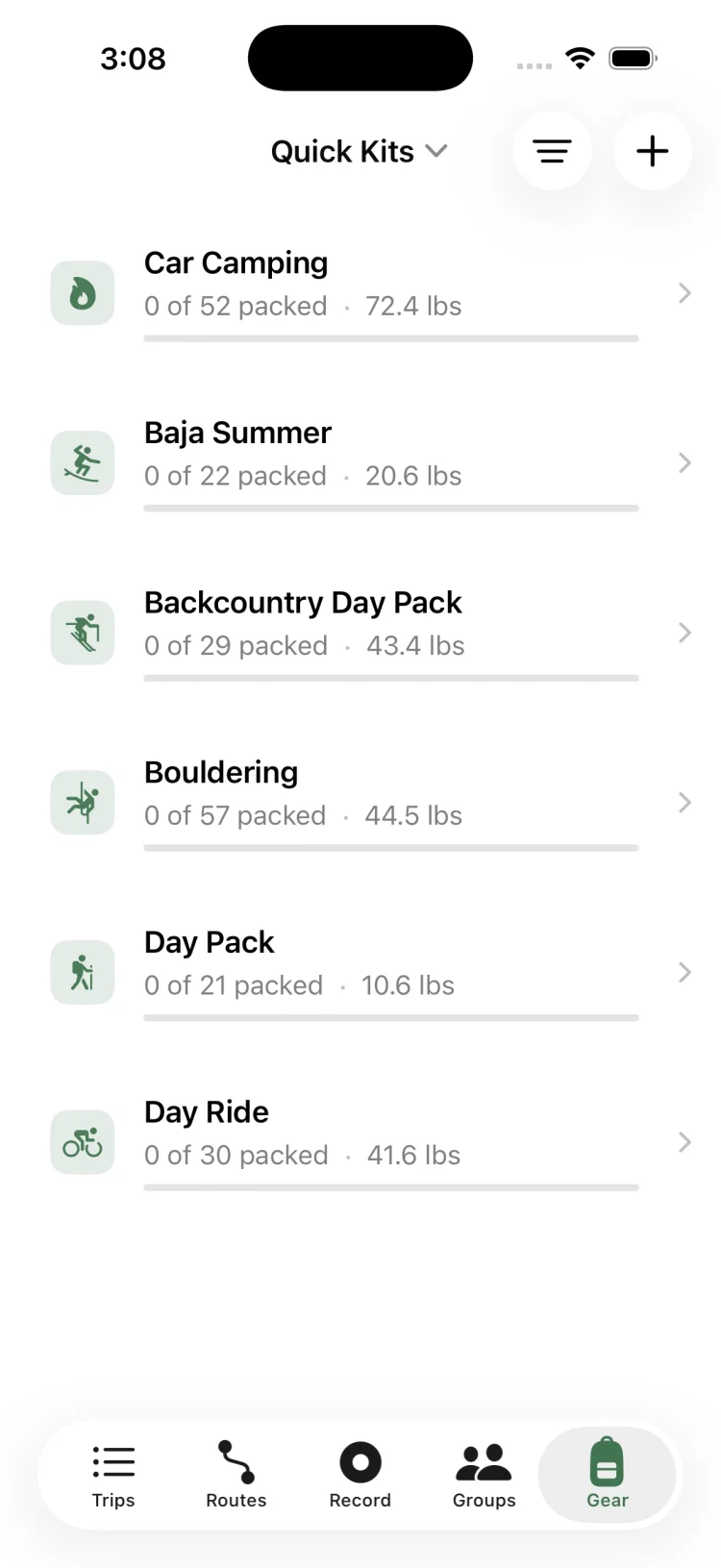
Track every item's weight and watch the total update automatically:
- Open Gear and add each item with its actual weighed mass.
- Create a trip and add your full gear list — GoVenture separates base weight (gear) from consumables (food, water, fuel).
- Check the running pack weight total as you add items. If you go over your target, remove the heaviest non-essential item first.
- Save the trip as a template and reuse it — every future trip starts from known weights, not guesses.
Typical item weights and lighter alternatives
Once you know your current weights, here is where to cut. This table shows common items, their typical weight, and a lighter alternative that does the same job.
| Item | Typical weight | Lighter alternative | Weight saved |
|---|---|---|---|
| Tent (2P, full weight) | 5 lb (2300 g) | Ultralight 2P tent (e.g. Big Agnes Fly Creek, Nemo Hornet) | 2 lb (900 g) |
| Sleeping bag (synthetic, 30°F) | 3.5 lb (1600 g) | Down quilt (30°F) | 1.5 lb (700 g) |
| Backpack (65 L, full-feature) | 5 lb (2300 g) | Lightweight framed pack (e.g. Osprey Exos, Granite Gear Crown) | 2 lb (900 g) |
| Camp shoes | 12 oz (340 g) | None — your trail runners dry overnight | 12 oz (340 g) |
| Full-size towel | 8 oz (230 g) | Bandana or small microfibre cloth | 7 oz (200 g) |
| Cotton spare clothes | 16 oz (450 g) | One merino or synthetic base layer set | 8 oz (230 g) |
| Multi-tool (full Leatherman) | 6 oz (170 g) | Small knife + small scissors (e.g. Swiss Army Classic) | 4 oz (115 g) |
| Branded stuff sacks (set of 5) | 5 oz (140 g) | Ultralight dry bags or nothing (pack liner only) | 3 oz (85 g) |
| Heavy water bottles (Nalgene) | 6 oz each (170 g) | Disposable bottles (SmartWater) or collapsible bladder | 8 oz for two (230 g) |
The quickest wins: ditch camp shoes (save 12 oz), swap the towel for a bandana (save 7 oz), replace cotton clothes with synthetics (save 8 oz), and stop using Nalgene bottles (save 8 oz). That is 35 ounces — over 2 pounds — without spending a penny.
Common mistakes that keep base weight high
People obsess about base weight and then make three mistakes that keep it high.
1. Buying light gear before weighing what they have
The first step is not buying a new tent. It is weighing your current tent and everything else. You might discover that your tent is fine but your pack, your sleeping bag, and your pile of "just in case" items are where the weight is. Weigh first, buy second.
2. Ignoring the "small stuff" pile
Twenty items at 2 ounces each is 2.5 pounds. People focus on the tent and ignore the fact that they are carrying a full toiletries bag, three stuff sacks they do not need, a heavy multi-tool, a Nalgene bottle, a notebook, a deck of cards, and a book. The small stuff adds up faster than you think.
3. Carrying duplicate group gear
The fastest way to cut weight on a group trip is to stop duplicating. One stove for four people, not four stoves. One first aid kit. One water filter. One repair kit. Split the tent. Split the cooking pot. See the group camping trip planning guide for the full method of assigning shared gear so nobody double-packs and the load is fair.
Track base weight over time
Your base weight should drop trip by trip as you learn what you use and what you carry for nothing. After every trip, go through your pack and separate everything into two piles: used and never touched. The "never touched" pile is what you cut next time, unless it is safety gear.
Keep a record. A spreadsheet, a notes file, or a trip-planning app like GoVenture. Record your base weight, the trip type, the season, and what you wish you had brought or wish you had left behind. After four or five trips you will see patterns: the things you always use, the things you always carry and never need, and the conditions that require extras.
Experienced backpackers have a stable base weight that varies by only 2–3 pounds across most trips. They know their core kit, they know what the conditions require, and they do not pack from guesswork. That is the goal.
Frequently asked questions
What is base weight in backpacking?
Base weight is the total weight of everything in your backpack excluding consumables — food, water and fuel. It is the weight of your pack, shelter, sleep system, clothing, navigation, safety and hygiene gear. Base weight is the number that predicts how your back and knees will feel on day three.
What is a good base weight for backpacking?
A good base weight for most backpackers is 15–20 pounds. Traditional backpackers sit around 25–30 pounds, lightweight hikers around 15–20 pounds, ultralight hikers under 10 pounds, and super-ultralight under 5 pounds. Your target depends on trip length, season, terrain and personal comfort tolerance — there is no single right number.
How do you calculate base weight?
Weigh every item in your pack using a kitchen scale. Add them all together. Subtract the weight of food, water and fuel. What remains is your base weight. Do not trust manufacturer specs or estimates — weigh the actual item as it goes into the pack, including stuff sacks, batteries in the headlamp, and fuel in the stove if it is a liquid-fuel model.
What are the big three in backpacking?
The big three are your backpack, shelter (tent or tarp), and sleep system (sleeping bag or quilt plus pad). These three categories typically hold 50–60% of your base weight. A traditional big three weighs 12–15 pounds; a lightweight big three weighs 7–10 pounds; an ultralight big three weighs under 5 pounds. Cut here first — swapping a 5 lb tent for a 3 lb tent saves more than replacing twenty small items.