Solo camping trips are simple: you make all the decisions, carry all the gear, and have nobody to blame if it goes wrong. Group camping trips are coordination problems. The typical failure modes are not navigational or meteorological — they are social and logistical. Someone assumed someone else was bringing the stove. Nobody knows who paid for the permit. The group chat has 147 unread messages and zero decisions. This guide is the system that prevents all of that.
The short version
Appoint a trip lead and a gear lead. Split shared vs personal gear. Assign shared items by weight, not count. Plan food by meal. Agree cost splits up front. Set three checkpoints: kickoff, T-2 weeks gear lock, T-2 days final check. Done.
Why group trips fail (and it is never the weather)
Group trips go wrong in four predictable ways, and all of them happen before you reach the trailhead.
Diffusion of responsibility
When everyone is responsible for the planning, nobody is responsible for the planning. Five people in a group chat all assume someone else has booked the campsite, checked the permit, or confirmed the route is open. The larger the group, the stronger the effect. Fix this by appointing a trip lead — one person whose job it is to make final decisions and hold the timeline.
The group chat as a planning tool
A group chat is a discussion venue, not a database. "Who's bringing the stove?" gets asked three times because the answer is buried under forty messages about what time everyone is leaving and whether dogs are allowed. A shared packing list solves this — one place where every item is assigned to a person and visible to everyone.
Duplicate gear and missing gear
Four people show up with four stoves and nobody brought a first aid kit. Or three people brought water filters and nobody brought a pot. This happens because "I'll bring a stove" is not the same as "I am the only person bringing a stove, and I am bringing it for the group." Again: a shared packing list where items are explicitly assigned.
Unclear money
Who paid for the permit? Who is covering the campsite fee? Is fuel a group cost or an individual cost? If you do not settle this before the trip, you will have an awkward conversation about it in the car park or, worse, after you get back. Agree the split up front and make it explicit.
Appoint a trip lead and a gear lead
The single most effective thing you can do is appoint two people before you start planning: a trip lead and a gear lead. They can be the same person for a small group, but separating the roles works better once you are past four people.
The trip lead
Owns the dates, the destination, the permits, the itinerary and the final call on any decision that is taking too long. This is not a dictator role — it is a "someone has to hold the timeline" role. The trip lead is the person who sends the reminders, books the permit, and says "we are leaving at 8am Saturday, that is locked" when the group chat is spiralling.
The gear lead
Owns the packing list, coordinates who brings what, and makes sure the shared gear is divided fairly and nothing is duplicated. The gear lead is the person who messages everyone two weeks out with "you are bringing the tent, Alex is bringing the stove, Sam is bringing the first aid kit, confirm you still have it." This is the role that stops the duplicate-stove problem.
If your group resists formal roles, frame it as "who is keeping track of the logistics?" rather than "who is in charge." Every successful group trip has these roles — most just do not name them.
Shared vs personal gear: the definitive split
Not everything is shareable, and assuming it is creates the "four sleeping bags, zero stoves" problem. Here is the actual split.
| Genuinely shareable (group gear) | Personal (each person carries) |
|---|---|
| Tent (one per 2–3 people) | Sleeping bag or quilt |
| Stove and fuel canister | Sleeping pad |
| Cookset (pot, pan) | Backpack |
| Water filter or purification system | Water bottles or bladder |
| First aid kit (one comprehensive kit) | Personal medications and blister kit |
| Coffee setup (press, grinder if applicable) | Mug, spork, bowl |
| Camp lantern or string lights | Headlamp |
| Cooler (car camping only) | Clothing and layers |
| Group food (shared meals) | Snacks and personal food preferences |
| Bear canister or food hang rope (if required) | Sunscreen, toiletries, personal hygiene |
The rule: if it serves the whole group at the same time, it is shareable. If each person uses their own copy simultaneously, it is personal. Tents are the grey area — some groups share, some people strongly prefer their own shelter. Settle this on day one.
Assign shared items by weight, not by item count
Once you know what is shared, you need to assign it. The instinct is to give everyone the same number of items: "You take the tent, I'll take the stove, you take the first aid kit." This is fair by count but not by weight, and the person who gets the tent is carrying three pounds while the person with the first aid kit is carrying twelve ounces.
Assign by total weight carried, not by item count. If one person is carrying a four-person tent at 5 pounds, they should not also be carrying the 2-pound cookset and the 1.5-pound stove. Someone else takes the stove and fuel; a third person takes the water filter and the first aid kit. The goal is roughly equal pack weight after shared items are distributed.
A worked example for a group of four
- Person A: 4-person tent (5 lb), bear canister (2.5 lb) = 7.5 lb shared
- Person B: Stove and fuel (1.5 lb), cookset (2 lb), water filter (0.5 lb) = 4 lb shared
- Person C: First aid kit (1 lb), group coffee setup (1.5 lb), lantern (0.5 lb) = 3 lb shared
- Person D: Group food for day one and two (4 lb) = 4 lb shared
Person A is carrying more shared weight, so they should have a lighter personal gear loadout or less personal food. Balance the whole pack, not just the shared column.
Doing this in GoVenture
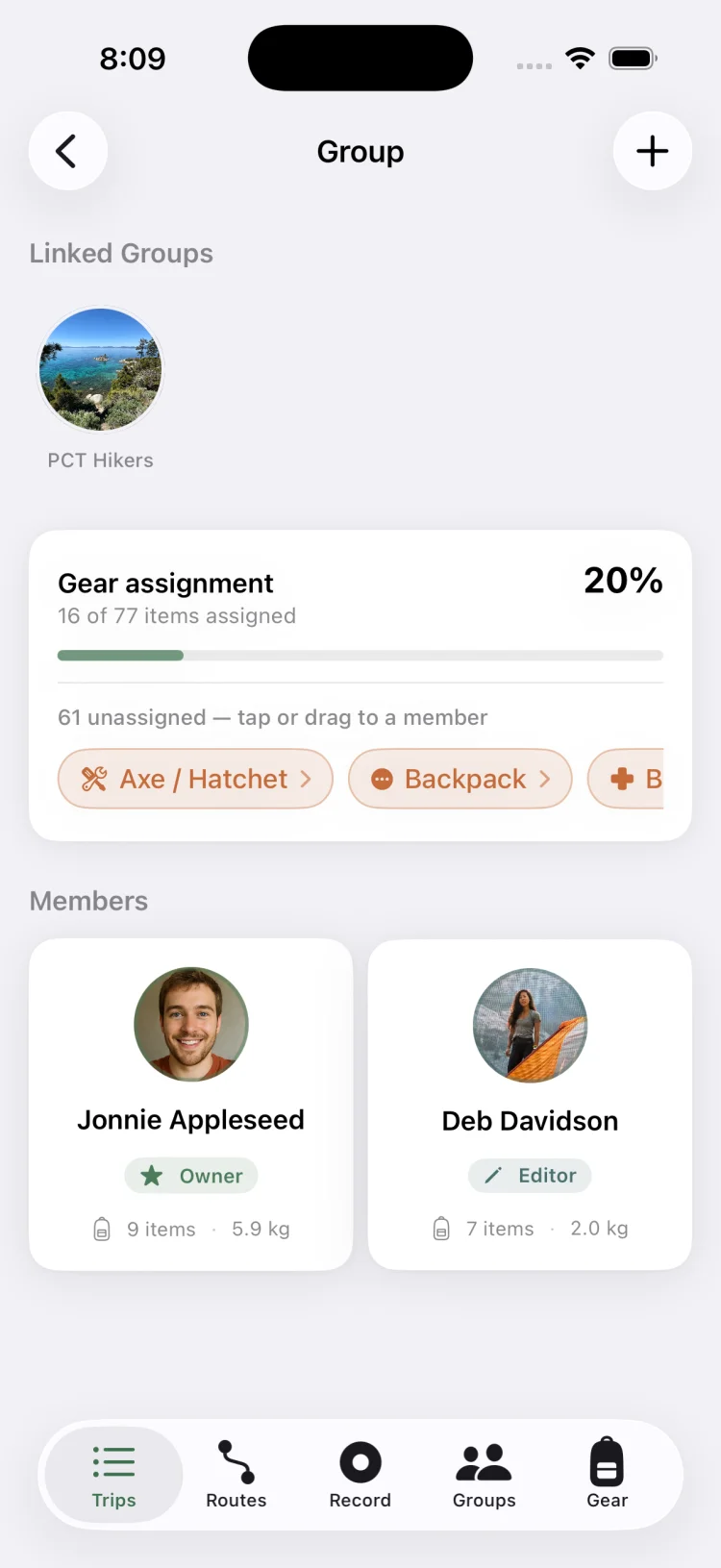
Assign gear to specific people so everyone knows who is bringing what:
- Create a trip and invite the other members from the trip screen.
- Open the Gear tab and add all the shared items (tent, stove, filter, first aid, cookset).
- Assign each item to a specific person by tapping the item and choosing who is responsible.
- Everyone in the group sees the shared packing list, knows what they are carrying, and can see the total weight assigned to them.
Food planning by meal with rotating cook duty
Food is the other major coordination problem. The failure mode is either everyone brings their own food and you never eat together, or everyone assumes someone else is planning meals and you arrive with seven bags of trail mix and no dinner.
Plan food by meal, and assign each meal to a person or a pair. For a two-night trip, that is two breakfasts, two lunches, two dinners and snacks. Each meal has a named owner who plans it, buys it, packs it and cooks it.
Sample meal assignment for a group of four, two nights
| Meal | Responsible | Notes |
|---|---|---|
| Day 1 dinner | Alex & Sam | Pasta for four, bring pot and stove |
| Day 2 breakfast | Jordan | Oatmeal and coffee, use group stove |
| Day 2 lunch | Everyone | Personal sandwiches and snacks |
| Day 2 dinner | Taylor & Jordan | Chili, pre-cooked and reheated |
| Day 3 breakfast | Alex | Breakfast burritos, bring tortillas |
Lunch is often personal — everyone packs their own sandwich, jerky, bars — but breakfast and dinner are group meals. Rotating cook duty means nobody is responsible for every meal, and everyone contributes. The person cooking is not also doing dishes; someone else handles clean-up.
If your group prefers to split food costs equally rather than assigning meals, one person buys all the group food and gets reimbursed before the trip. Do not wait until afterward — someone will forget, and it becomes awkward.
Splitting costs without awkwardness
Money is the thing nobody wants to talk about and everyone remembers poorly. Solve it by deciding the split before anyone pays for anything.
What is typically a group cost
- Permits and campsite reservations — usually one fee for the whole group or site. Split equally.
- Shared fuel — one canister serves the group stove. Split equally or the person carrying the stove covers it as their "gear tax."
- Group food — any meal cooked together. Either split the total equally or assign meals as above.
- Parking fees — if you carpool and there is a day-use or overnight trailhead fee. Driver pays, others split.
What is typically a personal cost
- Your own food for personal meals and snacks.
- Gear you are borrowing or renting individually.
- Transport if people are driving separately.
The cleanest model: one person fronts all group costs, totals them, and sends the split amount to everyone else before the trip. Use a payment app, not IOUs. If the permit was sixty dollars and the campsite was forty dollars and shared food was eighty dollars for a group of four, that is one hundred and eighty dollars total, forty-five dollars per person. Everyone pays their forty-five dollars before departure day. Done.
Note: GoVenture does not have expense splitting or payment features built in. You will need to handle cost splits manually or use a separate payment app. The trip lead or gear lead typically collects and tracks this.
Communication cadence: three checkpoints
The group chat will spiral if you let it. Instead, set three formal checkpoints and make it clear that decisions happen at these points, not in a continuous thread.
Checkpoint 1: Kickoff call (4–6 weeks out)
A thirty-minute video call where the trip lead covers dates, destination, permits, and the rough itinerary. The gear lead shares the packing list and asks who can bring what. Everyone commits to the trip or drops out here — no soft maybes. This is also when you agree on the cost split.
Checkpoint 2: Gear lock (T-2 weeks)
Two weeks before departure, the gear lead sends a final list of who is bringing what. Everyone confirms they still have their assigned items. If someone has dropped out or can no longer bring the tent, this is when you find out and reassign it. After this checkpoint, changes require active communication, not silence.
Checkpoint 3: Final check (T-2 days)
Two days out, the trip lead sends the final itinerary, the weather forecast, the meeting time and location, and any last-minute trail or road closures. The gear lead does a last confirmation that nothing has changed. If someone is dropping out, it happens here, not the morning of.
Between these checkpoints, the group chat can be as chaotic as it wants — but decisions only happen at the checkpoints. This prevents the endless "wait, did we decide on that?" problem.
Handling different fitness levels and drop-outs
Groups are only as fast as the slowest member, and someone will always be slower than the group expects. Do not plan the trip for the fittest person and assume everyone will keep up.
Plan for the slowest member
If one person in your group of five is on their first overnight, the trip is a beginner trip. Set mileage and elevation gain for that person, not for the experienced hikers. The alternative is a miserable experience for the slower person and a frustrating experience for everyone else. If the fitness gap is too wide, split into two separate trips.
Choose a route with bail-out points
Loops and point-to-point routes are efficient, but they trap you if someone gets injured, sick, or simply cannot continue. An out-and-back or a loop with multiple exit trails gives you options. Make sure everyone knows where the exits are before you start.
Have a drop-out contingency
Someone will cancel. Usually it is two days before, occasionally it is the morning of. If that person was carrying the tent or the stove, you have a problem. The fix: assign critical items to the people least likely to drop out, and have a backup assignment ready. The trip lead and gear lead should always be carrying something essential so they cannot drop without the trip collapsing.
For larger groups, keep a "reserve list" — people who would come if a spot opens. This is common for permit-limited trips where someone dropping creates an opening.
Trip type variants: bachelor party, family, friends weekend
The system above works for any group trip, but some trip types have specific quirks worth noting.
Bachelor party or celebration trips
Often a mix of experienced and completely inexperienced people. The inexperienced people will not read the packing list, will bring too much, and will show up in cotton. The fix: the trip lead sends a very explicit "what to bring, what not to bring" list with photos, and offers to review packs before departure. Also, plan for at least one person to forget something critical — bring a spare headlamp and extra batteries.
Family trips with kids
Kids change the pace dramatically. A five-year-old might manage two miles in three hours and think that is a huge adventure. Plan short days, build in long breaks, and choose a campsite with something interesting for kids (a lake, a stream, rocks to climb). Food becomes more important — hungry kids do not hike. Shared gear often includes more comfort items (camp chairs, extra lighting, games).
Friends weekend trips
Usually experienced people who have camped together before. The risk is overconfidence — everyone assumes someone else checked the permit, and nobody did. Use the same checklist and checkpoints; do not skip them just because the group is experienced. The other risk: too much ambition. A weekend trip does not need to be an epic — a short, easy route with good camp time is often better than a forced march.
Plan your next group trip in GoVenture
Invite your group, assign gear to specific people, share the itinerary and see who is bringing what — all in one place. Free, with unlimited trips and group planning included; Pro unlocks route drawing, unlimited gear lists, offline maps and extra map styles.
Download on the App Store →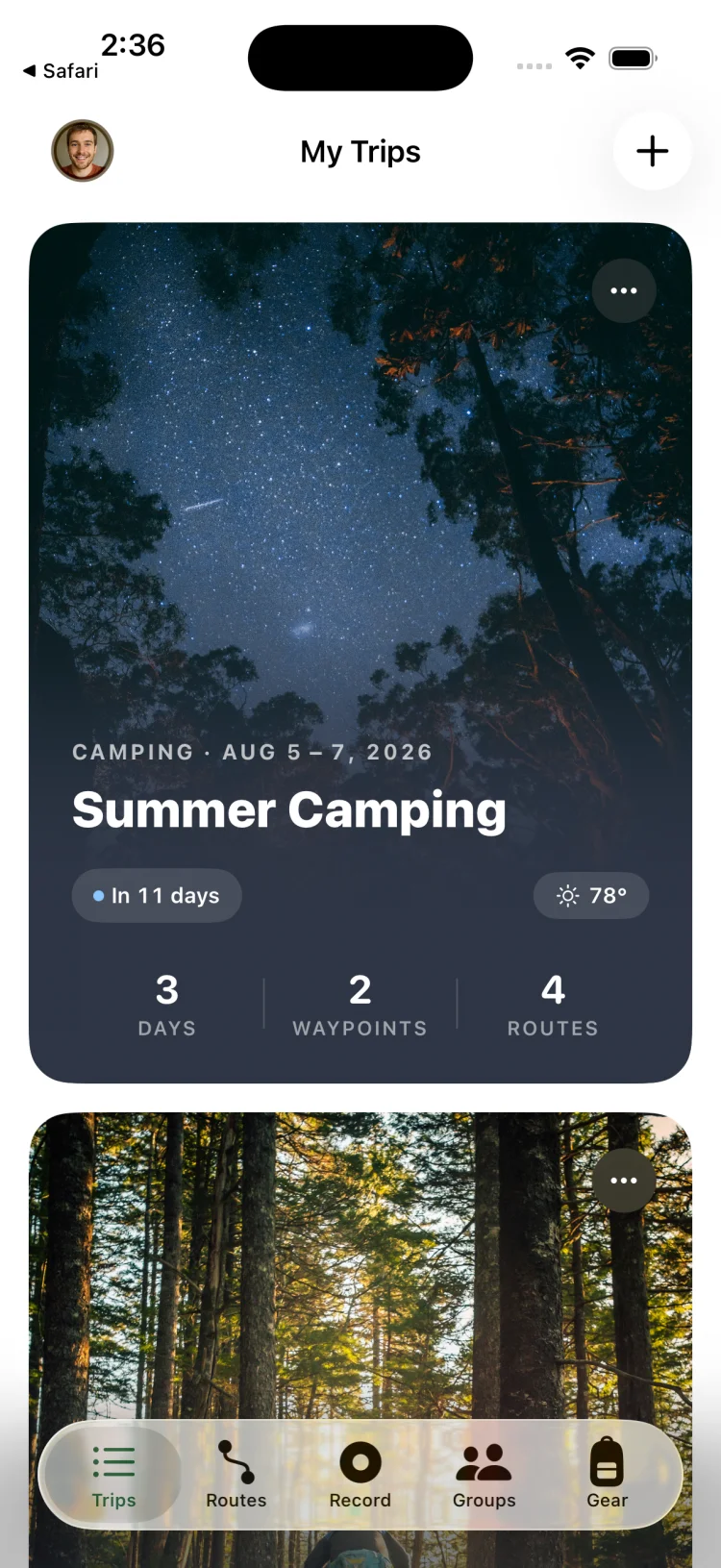
Frequently asked questions
How do you divide gear for a group camping trip?
Split gear into shared items (tent, stove, fuel, water filter, first aid, cookset) and personal items (sleeping bag, pad, clothes). Assign shared items to specific people by total weight carried, not item count, so the load is balanced. Use a shared packing list app so everyone sees who is bringing what and nothing gets packed twice.
What is the best way to split costs on a group trip?
Decide up front who pays for permits, campsite fees, shared fuel and group food. One person can front the group costs and get reimbursed before the trip, or everyone splits permits and fuel equally and handles their own personal food. Agree the method before anyone buys anything, and do not leave it to a trailhead conversation.
How far in advance should you plan a group camping trip?
Start at least four to six weeks ahead for a weekend trip, and three to six months ahead if the destination requires a permit lottery or campsite reservation. The bigger the group, the earlier you need to start — getting five people to commit to dates is harder than getting two people to commit.
Is there an app to coordinate group camping trips?
GoVenture is a free iPhone app with shared trip planning. Invite people to a trip, assign gear items to specific members, and everyone sees the shared packing list so nothing is packed twice and nothing is left behind. It keeps the gear list, itinerary, route and group assignments in one place instead of across group chats and spreadsheets. See how it compares to other trip planning apps.