A trip plan is the most effective piece of safety equipment you will never carry. It does not prevent accidents, but it turns a missing-person case with no leads into a targeted search with a defined area, a time window, and a list of people to look for. Search and rescue teams ask for them. Most hikers skip them. Do not.
The short version
Tell someone at home your route, camps, vehicle, group, expected return, and when to call the local sheriff or park dispatch. Set the call-for-help time late enough to avoid false alarms but early enough to matter. Check in when you exit.
What a trip plan is and why search and rescue teams ask for one
A trip plan — sometimes called a float plan, borrowed from boating — is a message you send to a trusted person before you leave, containing your route, expected return time, and instructions for what to do if you do not check in. It is not a legal document, and you are not obligated to file one. But SAR coordinators will tell you it is the single most useful piece of information they can have at the start of a search.
When someone is reported missing in the backcountry, the first question SAR asks is "where were they going?" If nobody knows, the search area is every trail within a day's drive. If someone knows the trailhead but not the route, the area is still dozens of square miles. If SAR has a trip plan with camps, waypoints and an intended route, the search area shrinks to a few square miles and response can start immediately instead of after hours of guesswork and phone calls to friends.
What a trip plan is not
A trip plan is not a permit, though some wilderness permits ask for similar information. It is not a replacement for carrying the Ten Essentials, knowing how to navigate, or having a satellite communicator. It is not a guarantee of rescue — SAR is not a taxi service, and response depends on available resources, weather and risk assessment. A trip plan is simply information that helps SAR start looking in the right place at the right time.
Exactly what to include in a trip plan
A useful trip plan contains enough detail to narrow the search but not so much that your contact cannot find the critical information. Here is what SAR teams actually use.
Route and nightly camps
Describe the route: trailhead, trail name or route description, and the camps or waypoints you intend to use each night. For established trails, a trail name and "the standard loop" is often enough. For cross-country or less-travelled routes, include GPS coordinates for camps or major waypoints. If you are doing a loop, specify the direction.
Example: "Trans-Catalina Trail, clockwise from Avalon, camping at Blackjack (night 1), Two Harbors (night 2), return to Avalon via coastal route."
Trailhead and vehicle description with plate
Give the exact trailhead name and location, not just the general area. Include the parking area if there are multiple options. Then describe your vehicle: make, model, colour, and license plate. If your vehicle is still at the trailhead after the deadline, that tells SAR you never exited — critical information.
Example: "Parked at Bear Lake Trailhead, Rocky Mountain NP, Colorado. Silver 2018 Honda CR-V, plate ABC 1234."
Group roster with medical notes and emergency contacts
List everyone in the group: full names, ages, and a brief physical description (height, build, hair colour). Include any medical conditions SAR should know about — diabetes, allergies, medications, previous injuries. Then provide an emergency contact for each person: name, relationship, phone number.
If you are solo, list yourself and your emergency contact. SAR needs to know who they are looking for and who to update during the search.
Gear that aids identification
Mention distinctive gear: tent colour and brand, pack colour, clothing colours. In a large-scale search, a bright orange tent or a red jacket visible from a helicopter can make the difference between being found in hours versus days.
Example: "Yellow Big Agnes tent, blue Osprey pack, red rain shell."
Expected return time and the call-for-help deadline
Give two times: your expected return (when you plan to exit and check in), and the call-for-help deadline (when your contact should escalate if they have not heard from you). The gap between these two times is the buffer that prevents false alarms when you are simply slow or stuck in traffic.
Example: "Expected return: Sunday 5 p.m. If you have not heard from me by Sunday 11 p.m., call for help."
Setting this threshold correctly is covered in detail below.
Who to call — local sheriff or park dispatch, not 911
Tell your contact exactly who to call when the deadline passes. In most of the United States, search and rescue is coordinated by the county sheriff's office. In national parks, it is park dispatch or the park's SAR coordinator. Provide the specific phone number, not just "call 911".
If your contact calls 911 from a different state, the call routes to their local emergency dispatch, who then has to transfer it to the correct county, which wastes time. Give them the direct number to the jurisdiction where the trailhead is located.
Example: "If I am overdue, call Larimer County Sheriff SAR at (970) 416-1985 (Rocky Mountain National Park area)." You can usually find the SAR contact number on the county sheriff's website or the park's emergency contact page.
A copy-paste trip plan template
Here is a template you can fill out and send to your contact. Copy it into an email, text, or save it in a shared note.
TRIP PLAN
Hiker(s): [Full name, age, height, physical description, medical conditions if any]
Emergency contact for hiker: [Name, relationship, phone]
Route: [Trail name or description, direction, waypoints]
Nightly camps:
Night 1: [Location or coordinates]
Night 2: [Location or coordinates]
[etc.]
Trailhead: [Exact trailhead name and location]
Vehicle: [Make, model, colour, plate]
Distinctive gear: [Tent colour, pack colour, jacket colour]
Dates: [Start date and time] to [End date and time]
Expected return: [Date and time I plan to exit and call you]
CALL FOR HELP if you have not heard from me by: [Date and time — typically 6–12 hours after expected return]
Who to call: [Local sheriff SAR or park dispatch, with phone number]
What to tell them: Give them this entire trip plan and say I am overdue and have not checked in.
I will check in by: [Text, call, or message when I exit, even if late]
How to set the overdue threshold
The call-for-help deadline is the most important number in the trip plan, and it is a balance. Set it too tight and you trigger a search because you stopped for dinner on the drive home. Set it too loose and SAR loses hours of daylight they could have used to search.
Expected return plus 6–12 hours is typical
A common guideline: if your expected return is Sunday 5 p.m., set the call-for-help deadline for Sunday 11 p.m. to Monday 5 a.m. That absorbs a slow exit, a flat tire, stopping for food, or losing cell signal for a few hours on the drive. It does not absorb "I forgot to call" — make it clear to your contact that you will check in, even if late.
Tighter thresholds in winter or technical terrain
In winter or shoulder season, daylight hours are short and hypothermia risk is high. A 6-hour buffer may be too long. Similarly, for technical routes, solo trips, or areas with known hazards (avalanche terrain, river crossings, exposed scrambles), a tighter threshold is appropriate — expected return plus 3–6 hours instead of 12.
The calculus is: would I want SAR to start looking after six hours, or after twelve? If the answer is six, set a tighter deadline and commit to checking in on time.
Avoiding false alarms
False alarms — SAR mobilising for someone who is fine but forgot to call — are a waste of resources and erode trust. Avoid them by:
- Setting a realistic buffer between expected return and the deadline.
- Choosing a contact who will not panic if you are a few hours late but will act when the deadline passes.
- Sending a check-in message as soon as you exit, even if it is midnight and you are tired.
- Updating your contact mid-trip if the plan changes and you have signal to do so.
Choosing the right home contact
Your trip plan is only as good as the person you send it to. The right contact is someone who:
- Will be reachable during your trip. Do not pick someone on holiday or in a different time zone who may not see the deadline until it is too late.
- Will follow through. Calling SAR is awkward and stressful. Pick someone who will make the call even if they feel uncertain.
- Understands the difference between late and missing. A good contact does not panic if you are two hours late but does act when the deadline passes.
- Is familiar with the outdoors, ideally. Not essential, but helpful — someone who understands that "a few hours late" is normal and "24 hours overdue" is not.
Family or a close friend is typical. Avoid coworkers unless you trust them completely, and avoid anyone who is likely to either dismiss the deadline or panic prematurely.
Check-in protocol and avoiding false alarms
The trip plan only works if you close the loop. When you exit the trail and get back to cell service, send a message or call your contact immediately, even if it is late and you are exhausted. A two-word text — "Out safe" — is enough.
If you are running late but still on track, send an update as soon as you get signal: "Late but fine, now expecting to exit by 8 p.m. instead of 5 p.m." That resets the deadline and prevents your contact from worrying unnecessarily.
If you have a satellite messenger or inReach device, you can send check-in messages from the trail. These complement the trip plan but do not replace it — if your device fails or you are incapacitated, the trip plan is still there.
Doing this in GoVenture
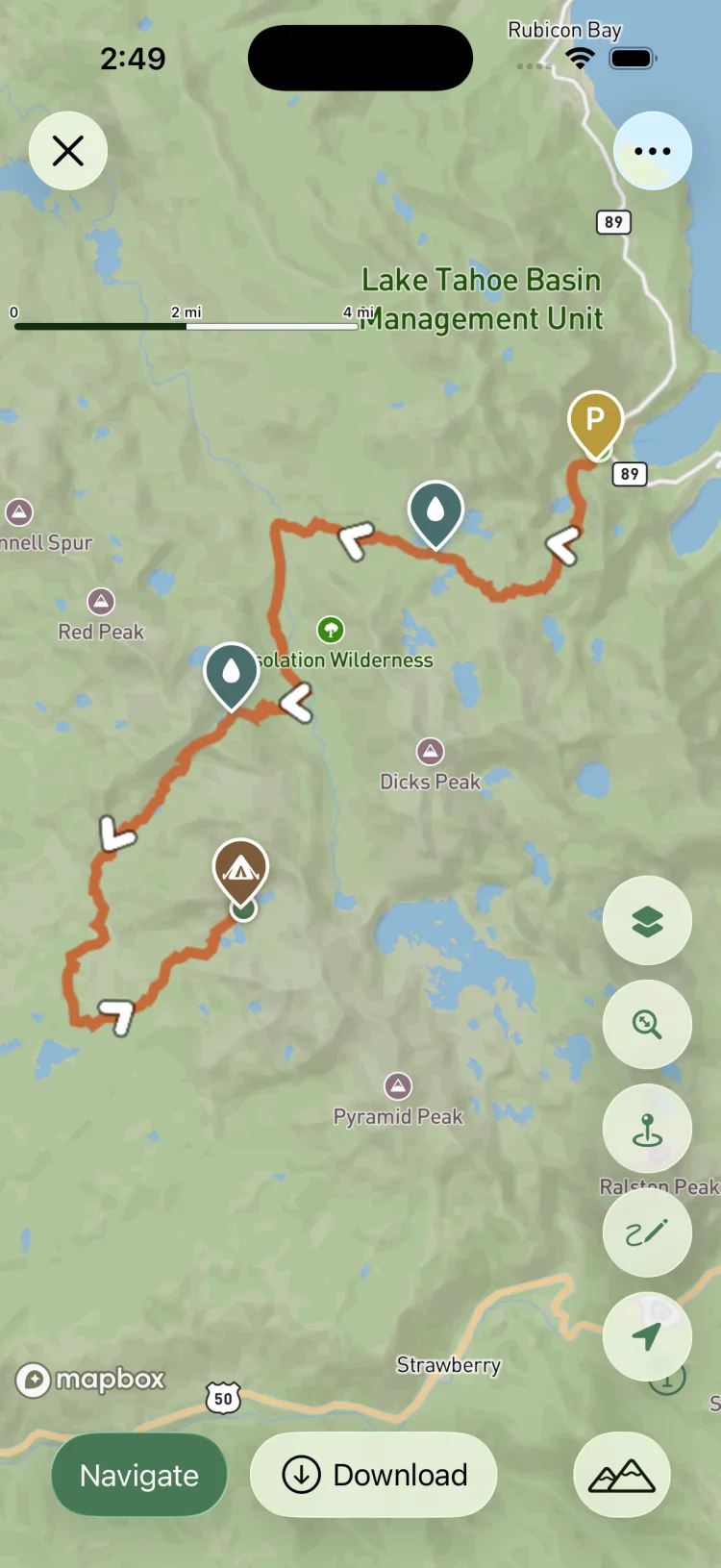
Keep your route, camps, itinerary and trip plan in one place:
- Create a trip in GoVenture with your route, nightly camps, and waypoints.
- Add your itinerary with start times, daily activities, and expected arrival at each camp.
- Include notes in the trip with vehicle description, emergency contacts, and distinctive gear.
- Export or share the trip details as a formatted trip plan and send it to your home contact.
- When you return, mark the trip complete and check in with your contact immediately.
What to do if the plan changes mid-trip
Plans change. Weather forces a bail-out, an injury shortens the trip, or you decide to take an extra rest day. If the plan changes and you have cell or satellite signal, update your contact immediately with the new expected return time and route if applicable.
If you bail out early and exit a day ahead of schedule, call your contact as soon as you reach the trailhead so they do not spend the next day wondering if you are overdue. If you extend the trip by a day, send a message before the original deadline passes.
If you have no way to communicate the change (no signal, no satellite device), stick to the original plan as closely as possible or exit early rather than late. Never extend the trip beyond the original deadline without communication — your contact will call SAR, and rightly so.
Satellite messengers and PLBs as complement, not replacement
Satellite messengers (inReach, SPOT, Zoleo) and personal locator beacons (PLBs) let you call for help from anywhere. They are excellent safety tools, but they do not replace a trip plan.
Here is why: a satellite SOS tells SAR "someone is in trouble at this location, right now." A trip plan tells SAR "this person has not returned, here is where they said they would be, and here is when to start looking." The first handles active emergencies — injury, illness, immobilised. The second handles the case where you cannot call for help at all — lost, incapacitated, dead, or device failed.
Use both. Carry a satellite device and file a trip plan. They cover different failure modes.
The Ten Essentials and self-rescue
A trip plan assumes SAR will come looking. But SAR is not instant, and in some conditions — weather, darkness, lack of resources — response may be delayed by hours or even days. Your first line of safety is the ability to self-rescue: stay warm, stay found, signal for help, and survive until SAR arrives.
That means carrying the Ten Essentials on every trip: navigation, sun protection, insulation, illumination, first aid, fire, repair kit, nutrition, hydration, emergency shelter. The trip plan does not replace these. It is what happens when the Ten Essentials were not enough.
Solo hiker considerations
Solo hikers should always file a trip plan. When you are alone, nobody knows you are missing until you fail to return, and the search area is the entire wilderness unless you left a plan. Solo also means tighter deadlines — your margin for error is smaller, and SAR response matters more.
For solo trips:
- Set a tighter overdue threshold — expected return plus 4–8 hours instead of 12.
- Consider carrying a satellite communicator, especially on remote or technical routes.
- Leave more detail in the trip plan — exact camps, waypoints with coordinates, bail-out routes.
- Check in religiously — your contact cannot see that you are fine, so they rely entirely on your check-in.
What search and rescue actually does with the trip plan
When your contact calls SAR and provides the trip plan, here is what happens. The SAR coordinator uses the route and camps to define the initial search area — typically starting with the intended camps and the trail segments between them. They check the trailhead for your vehicle, which tells them whether you exited without checking in (vehicle gone) or never exited (vehicle still there).
They use the group roster to know who they are looking for and how many people. They use medical information to prioritise response — a diabetic hiker overdue by 12 hours is a higher priority than a healthy hiker overdue by 6 hours. They use the distinctive gear description to brief search teams and helicopter crews: "look for a yellow tent and a red jacket."
They also use the timeline. If your expected return was Sunday 5 p.m. and it is now Monday 8 a.m., SAR knows you have been overdue for 15 hours, which sets the urgency and the scale of response. All of this happens faster and more effectively with a trip plan than without one.
Doing this in GoVenture
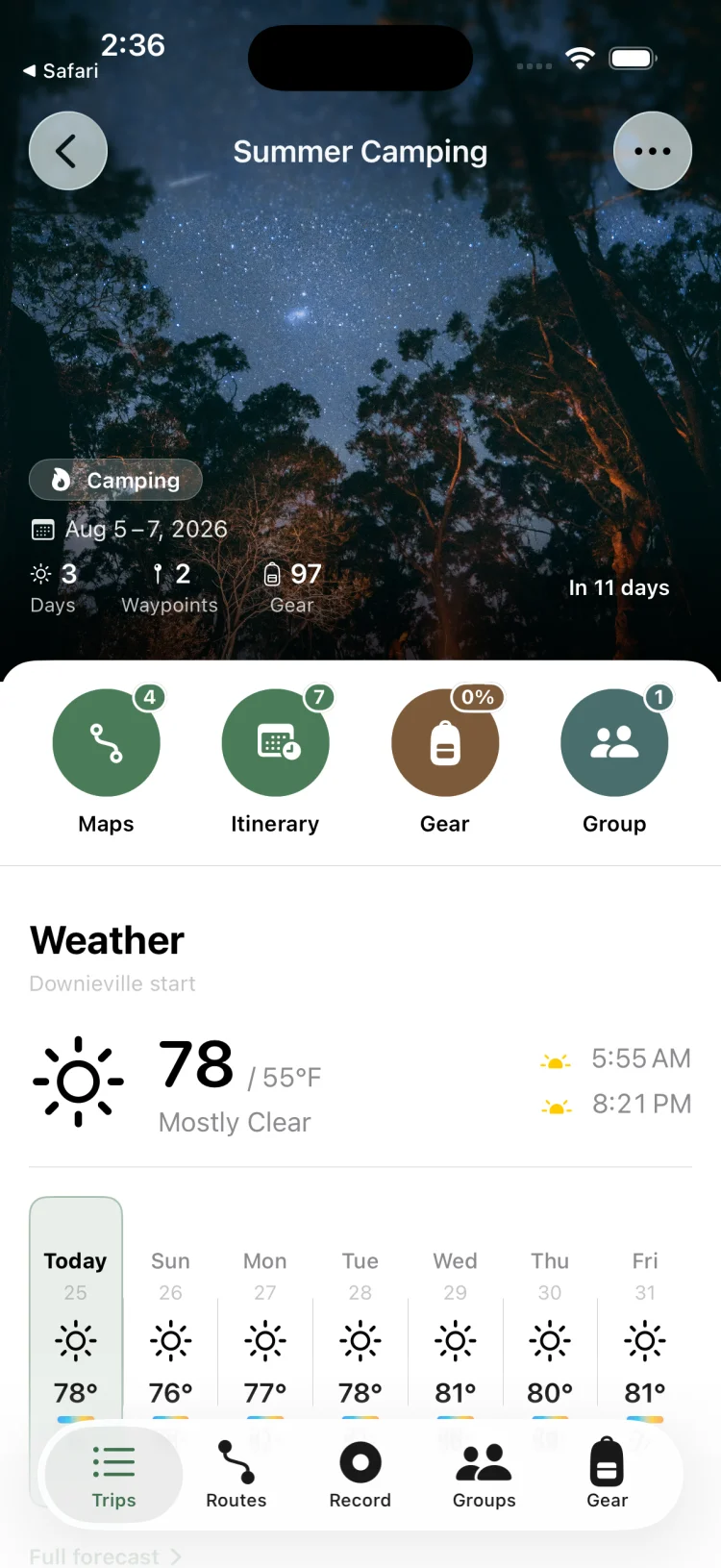
Build a complete trip plan with all the information SAR needs:
- Add your route with waypoints for camps, water sources and bail-out trails.
- Build a day-by-day itinerary with expected arrival times at each camp.
- Add weather forecast for the trip dates so you know conditions.
- Include trip notes with vehicle info, emergency contacts, and gear descriptions.
- Share or export the trip as a formatted plan and send it to your contact before you leave.
Frequently asked questions
What should be in a hiking trip plan?
Your route and nightly camps, trailhead location and vehicle description with plate, group roster with emergency contacts and medical information, expected return time, the deadline after which your contact should call for help, and the correct number to call — usually the local sheriff's office or park dispatch, not 911 from another state.
Who should you leave a trip plan with?
A reliable person who will be reachable during your trip, will follow through on the call-for-help deadline, and understands the difference between "a few hours late" and "actually missing". Family or a close friend is typical; avoid someone prone to panic or who will not be contactable.
Who do you call if a hiker is overdue?
Call the local sheriff's office for the county where the trailhead is located, or the park or forest service dispatch if the area has dedicated SAR. Do not call 911 from a different state unless there is no other option — emergency dispatch routes to your location, not the hiker's.
Do satellite messengers replace trip plans?
No. Satellite messengers and PLBs are for emergencies — injury, lost, immobilised. A trip plan is for when you do not return at all and cannot call for help. They are complementary, not alternatives.