Home baking is having a long moment. Sourdough culture never really receded after 2020; it professionalized in thousands of home kitchens instead. Meanwhile the price of a decent bakery loaf keeps climbing, and in plenty of neighborhoods there is no decent bakery at all. The result is durable, local demand for exactly what a skilled home baker produces — and a legal framework, cottage food law, built specifically to let them sell it.
The short version
Shelf-stable baked goods are the heart of what cottage food laws allow — confirm your state's list, do any required registration, and copy its label template. Then sell like a professional at small scale: a menu of two or three items baked identically every week, priced against bakeries rather than supermarkets, offered for pre-order with a single pickup window. Reliability, not variety, is what builds the list of regulars that makes a home bakery worth running.
Get the rules squared away first
Baked goods are the founding case for cottage food laws — when legislators picture a home food seller, they picture a baker. That means the legal lane is usually clear, but it has edges worth knowing before you plan a menu.
Shelf-stable bakes are broadly allowed: breads, rolls, cookies, brownies, muffins, scones, fruit pies with high-sugar fillings, and cakes with shelf-stable frostings. The recurring exclusions are anything that needs a fridge — cheesecake, custard and cream pies, meringue toppings, cream cheese frostings in many states, and anything with meat. If your signature item sits in that excluded band, check your state carefully; a few have expanded tiers that permit refrigerated items with extra requirements, and sometimes a recipe tweak (a buttercream instead of a cream-cheese frosting) moves a product into the allowed list.
Beyond the food list, your state's page will tell you whether you need to register or take a food-handler course, whether your kitchen needs inspection, what the label must say, and whether sales must be in person. Fifteen minutes on a .gov page settles all of it — and the cottage food guide walks through exactly what to look for.
Choose a menu you can repeat
The instinct is to offer everything you can bake. Resist it. A home bakery is a production operation run by one person in a domestic kitchen, and its scarcest resource is your time on bake day. The bakers who make this work almost all converge on the same shape: a very short menu, executed identically, on a schedule.
| Item | Demand | Production fit | Notes |
|---|---|---|---|
| Sourdough & artisan loaves | Very high | Excellent — batches scale in one oven | The flagship home-bakery product; regulars order weekly |
| Cinnamon rolls | High | Good — one pan, high perceived value | Weekend-morning pickup timing sells itself |
| Cookies | Steady | Excellent — batch-friendly, forgiving | Sell by the half-dozen; consistent size matters |
| Banana bread & quick breads | Steady | Excellent — mixes fast, freezes well | Reliable filler alongside a hero product |
| Fruit pies (shelf-stable fillings) | Seasonal spikes | Moderate — time-intensive | Holiday pre-orders can fund a whole quarter |
| Custom celebration cakes | By order | Poor for batching — price accordingly | Check frosting rules; many states exclude cream cheese |
Pick one hero product and one or two supporting items. The hero is what people remember you for; the supports raise the average order. You can always expand once the rhythm holds.
Price it like the product it is
Home bakers systematically underprice, for an understandable reason: the reference point in their head is the supermarket shelf. That is the wrong comparison. A supermarket loaf is an industrial product optimized for cost; your loaf is a bakery product, and local bakery prices are the honest anchor. In most areas that means several times the supermarket price — which buyers of homemade bread already expect to pay.
Build the price from the bottom and check it against that anchor: ingredients per batch (weigh the flour, count the butter — real numbers), plus packaging and labels, divided by units, then your time at a rate you would accept from an employer. If the anchored price cannot cover that, the product or the batch size needs to change, not your hourly rate. The pricing guide covers the psychology in more depth, but the one-line version: underpricing does not read as generous, it reads as amateur, and it fills your order list with the wrong customers.
Labeling and packaging
Two different jobs, often conflated. The label is a legal requirement; the packaging is a customer experience.
The label
Nearly every state requires cottage food labels: product name, your name and address or registration number, ingredients in descending order by weight, allergens declared explicitly, and the home-kitchen disclosure in the state's prescribed wording. Wheat, milk, eggs and nuts appear in almost everything a baker makes, so allergen lines do real work here. Print from your state's template, run them on ordinary sticker sheets, and the whole obligation costs a few minutes per batch.
The packaging
Package for the trip home, not for a shelf. Bread breathes in paper and suffocates in plastic; cookies want a flat box or a cellophane sleeve that keeps them from arriving as pieces; rolls travel in the pan-shaped foil tray they were baked in. Clean, simple, honest packaging with the label neatly applied reads as exactly what it is — care. Skip the branding exercise until the regulars ask for a name to search for.
Selling: pre-orders beat guesswork
The structural problem of a home bakery is matching production to demand with zero inventory tolerance — day-old stock is your family's breakfast, not a sale. Pre-orders solve it. Post the listing early in the week: what you are baking, the price, and a pickup window on bake day. Collect firm orders in chat, bake to the order list, and hand everything over within hours of the oven.
The listing itself follows the universal rules of local food selling: photograph your actual product in daylight (a cut loaf sells the crumb; a whole one only sells the crust), name it precisely, state the price plainly, and say when pickup happens. "Sourdough country loaf, 800g, baked Thursday morning, pickup Thursday 4–6pm" answers every question before it is asked.
From bake sales to a bake day
The difference between occasionally selling bread and running a tiny home bakery is a standing bake day. Same day every week, same menu, orders due the night before. Buyers organize around it with startling speed — a weekly loaf becomes part of a household's routine, and your order list starts to look like a small subscription business.
Guard the reliability more than anything else. A missed bake day costs more goodwill than a mediocre loaf ever will. Cap orders at what your oven and your patience genuinely handle, sell out politely, and let scarcity do its quiet work. When the list outgrows the kitchen, that is the signal to look at your state's sales cap and what graduating to a commercial kitchen would mean — a good problem, arrived at profitably.
How JustRype fits
A home bakery's hardest problem is not baking — it is being findable by the few hundred households within walking distance who would buy from it. That is the exact problem JustRype exists to solve.
Your bake day, on the neighborhood map
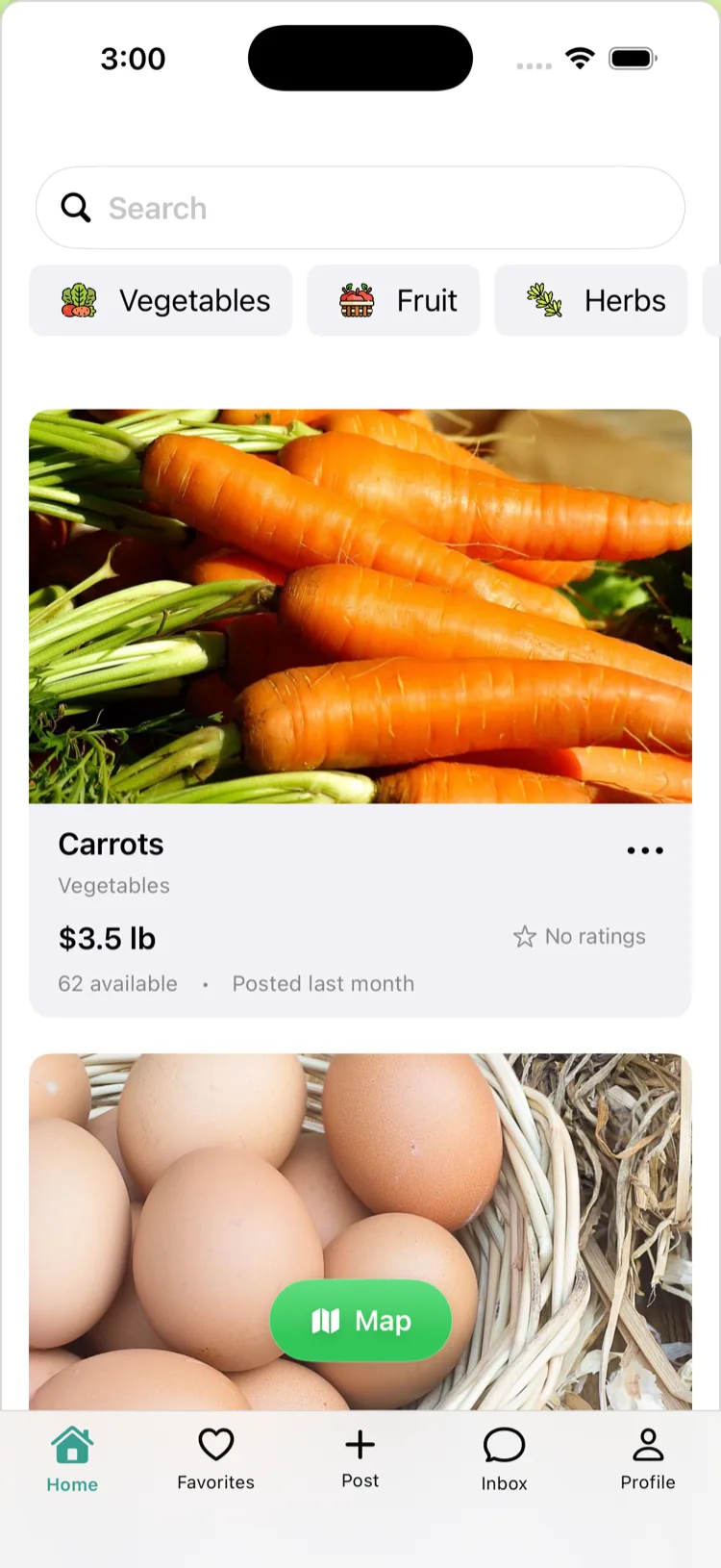
Listings appear in a feed and on a map of what is available nearby, so the neighbor searching for fresh bread finds your Thursday bake instead of a supermarket. Photos, price and pickup details travel with the listing, and buyers message you directly — no fees on the exchange, no algorithm between you and the neighborhood.
Pre-orders in chat, reputation over time
The order conversation stays attached to the listing, which makes collecting a week's pre-orders tidy rather than a scroll through scattered comments. Ratings build with every handoff, and in a business where all your customers live nearby, a visible track record compounds faster than any advertising.
A business page for the standing menu
Once the bake day is an institution, a business page gives it a permanent home — your menu, your schedule, your story — findable on the map even between listings.
Launching your home bakery on JustRype
One honest week, start to finish:
- Read your state's cottage food page; register or take the course if required.
- Pick a hero product and one or two supports; print labels from the state template.
- Post a bake-day listing with photos, prices and a pickup window.
- Collect pre-orders in chat and close the list the night before.
- Bake, label, and hand over within hours of the oven.
- Repeat on the same day next week — the regulars take it from there.
General information, not legal advice
Cottage food rules — approved foods, permits, labels and sales limits — vary by state and change over time. This guide is general information, not legal, tax or food-safety advice. Verify your requirements with your state agriculture or health department before selling.
JustRype is a venue that connects neighbors. Buyers and sellers are responsible for complying with the laws that apply to them.
Frequently asked questions
Is it legal to sell baked goods from home?
In every US state there is some legal path, usually through a cottage food law that permits shelf-stable baked goods — breads, cookies, most cakes — made in a home kitchen and sold direct to consumers. Items needing refrigeration, like cream-filled or custard desserts, are usually excluded. Some states require registration, a short food-handler course or a kitchen inspection first, and most have labeling rules. Check your state's official cottage food page before selling.
What home-baked goods sell best?
Sourdough and other artisan breads are the standout — they sell on smell and reputation alone. Beyond bread: cinnamon rolls, chocolate chip cookies, banana bread, seasonal pies with shelf-stable fillings, and celebration cakes by order. The pattern is familiar comfort done excellently, not novelty. A short menu you can repeat identically every week outsells a long menu that changes.
How should I price home-baked goods?
Anchor against local bakery prices, not grocery store shelves — your product is closer to the bakery's in quality and freshness. Add up ingredients and packaging per batch, divide by units, and make sure the price covers that plus meaningful payment for your time. Underpricing is the most common home-baker mistake; it attracts bargain hunters instead of regulars and makes the whole effort feel pointless within a month.
Do I need special labels for home-baked goods?
Almost certainly yes. Most states require cottage food labels with the product name, your name and address or registration number, an ingredient list in descending order by weight, explicit allergen declarations, and a disclosure that the food was made in a home kitchen not subject to inspection. Many states publish an exact template — copy it rather than composing your own.
Should I bake to order or bake and then sell?
Bake to order wherever possible. Post the listing early in the week, collect orders and payment commitments in chat, then bake for a single pickup window. You waste nothing, buyers get bread that is hours old, and your bake day becomes predictable. Bake-and-hope works for high-traffic situations like a stand, but for neighborhood app sales, pre-orders are the better economics.